for what values of r does the sequence {r^n} converge? diverge? select the correct choice below and fill in…
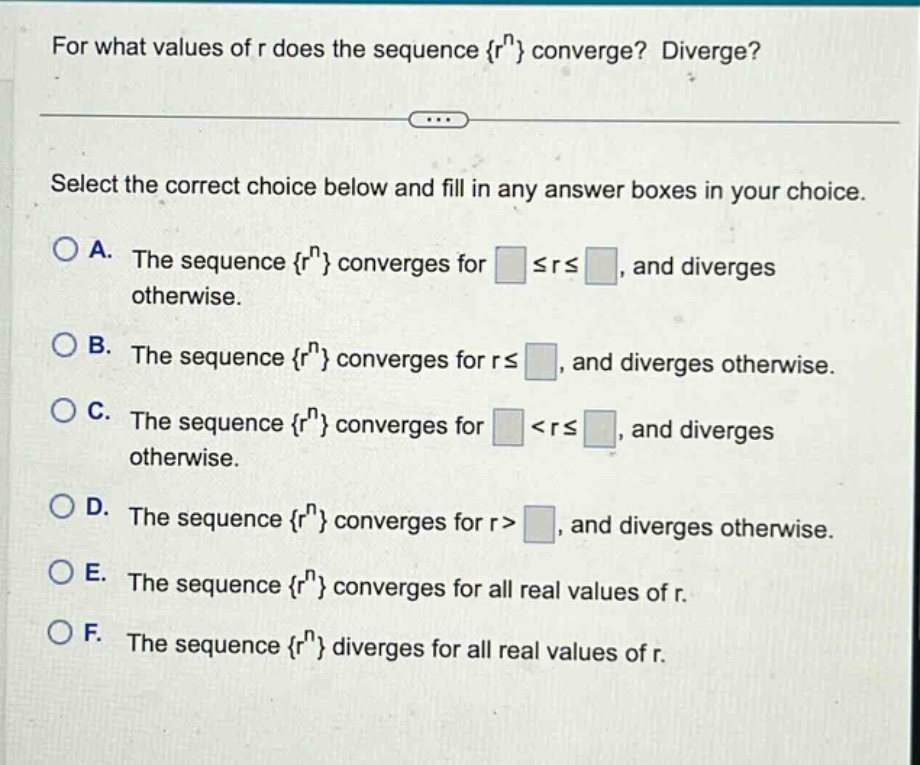
for what values of r does the sequence {r^n} converge? diverge? select the correct choice below and fill in any answer boxes in your choice. a. the sequence {r^n} converges for ≤r≤, and diverges otherwise. b. the sequence {r^n} converges for r≤, and diverges otherwise. c. the sequence {r^n} converges for <r≤, and diverges otherwise. d. the sequence {r^n} converges for r>, and diverges otherwise. e. the sequence {r^n} converges for all real values of r. f. the sequence {r^n} diverges for all real values of r.
Answer
Explanation:
Step1: Analyze cases for (|r|> 1)
If (|r|>1), as (n\to\infty), (r^{n}\to\pm\infty) depending on the sign of (r). For example, if (r = 2), then the sequence is (2,4,8,\cdots) and if (r=-2), the sequence is (- 2,4,-8,\cdots). So the sequence ({r^{n}}) diverges when (|r|>1).
Step2: Analyze case for (r = 1)
When (r = 1), the sequence ({r^{n}}) is (1,1,1,\cdots). So (\lim_{n\rightarrow\infty}r^{n}=1), and the sequence converges.
Step3: Analyze case for (r=-1)
When (r=-1), the sequence ({r^{n}}) is (-1,1,-1,1,\cdots). The limit does not exist as (n\to\infty) since the terms alternate between (- 1) and (1), so the sequence diverges.
Step4: Analyze cases for (|r|<1)
If (|r|<1), then (\lim_{n\rightarrow\infty}r^{n}=0). For example, if (r=\frac{1}{2}), the sequence is (\frac{1}{2},\frac{1}{4},\frac{1}{8},\cdots). So the sequence ({r^{n}}) converges when (|r|<1).
Answer:
A. The sequence ({r^{n}}) converges for (- 1<r\leq1), and diverges otherwise.