what are all values of k for which the series ∑((k³ + 2)e⁻ᵏ)ⁿ converges?\na k = -1.314, k = -1.193, and k =…
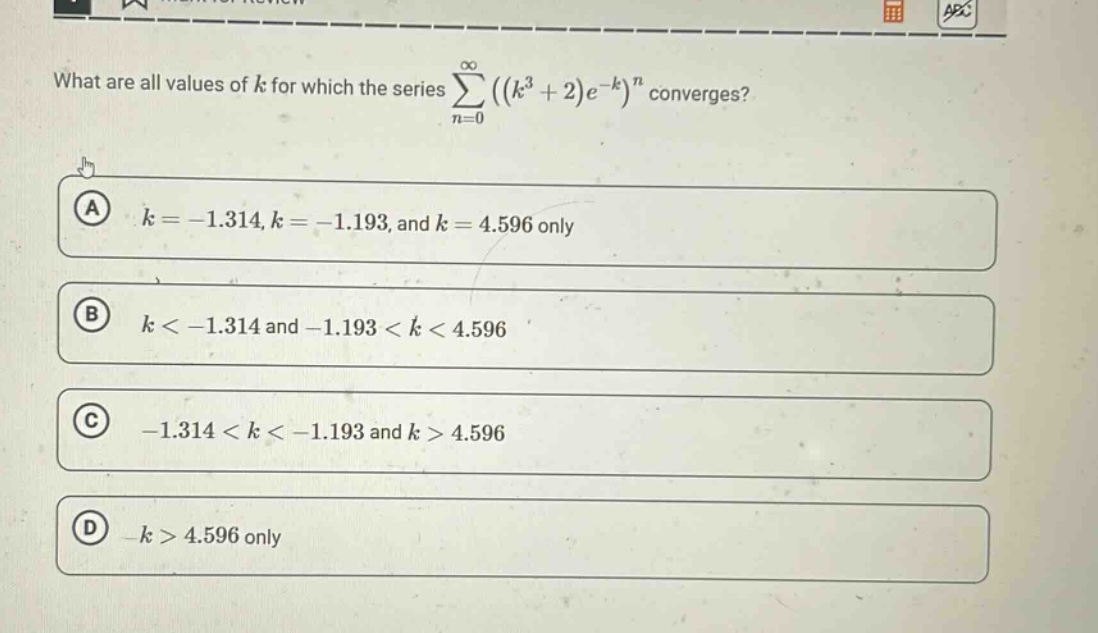
what are all values of k for which the series ∑((k³ + 2)e⁻ᵏ)ⁿ converges?\na k = -1.314, k = -1.193, and k = 4.596 only\nb k < -1.314 and -1.193 < k < 4.596\nc -1.314 < k < -1.193 and k > 4.596\nd k > 4.596 only
Answer
Explanation:
Step1: Identify the series type
The series $\sum_{n = 0}^{\infty}((k^{3}+2)e^{-k})^{n}$ is a geometric series with common - ratio $r=(k^{3}+2)e^{-k}$.
Step2: Apply the geometric - series convergence condition
A geometric series $\sum_{n = 0}^{\infty}r^{n}$ converges if and only if $|r|\lt1$. So we need to solve the inequality $|(k^{3}+2)e^{-k}|\lt1$, or equivalently, $|k^{3}+2|\lt e^{k}$. Let $f(k)=e^{k}-|k^{3}+2|$. Case 1: When $k^{3}+2\geq0$ (i.e., $k\geq-\sqrt[3]{2}\approx - 1.26$), we solve $e^{k}-(k^{3}+2)\lt0$. Case 2: When $k^{3}+2\lt0$ (i.e., $k\lt-\sqrt[3]{2}$), we solve $e^{k}+(k^{3}+2)\lt0$. We can use a graphing utility or analyze the function's behavior. The function $y = e^{k}$ and $y=|k^{3}+2|$ are graphed. By analyzing the intersection points of $y = e^{k}$ and $y = |k^{3}+2|$, we find that $e^{k}\gt|k^{3}+2|$ when $-1.314\lt k\lt - 1.193$ or $k\gt4.596$.
Answer:
C. $-1.314\lt k\lt - 1.193$ and $k\gt4.596$