the values in the table represent the graph of a continuous function. which interval must contain an x…
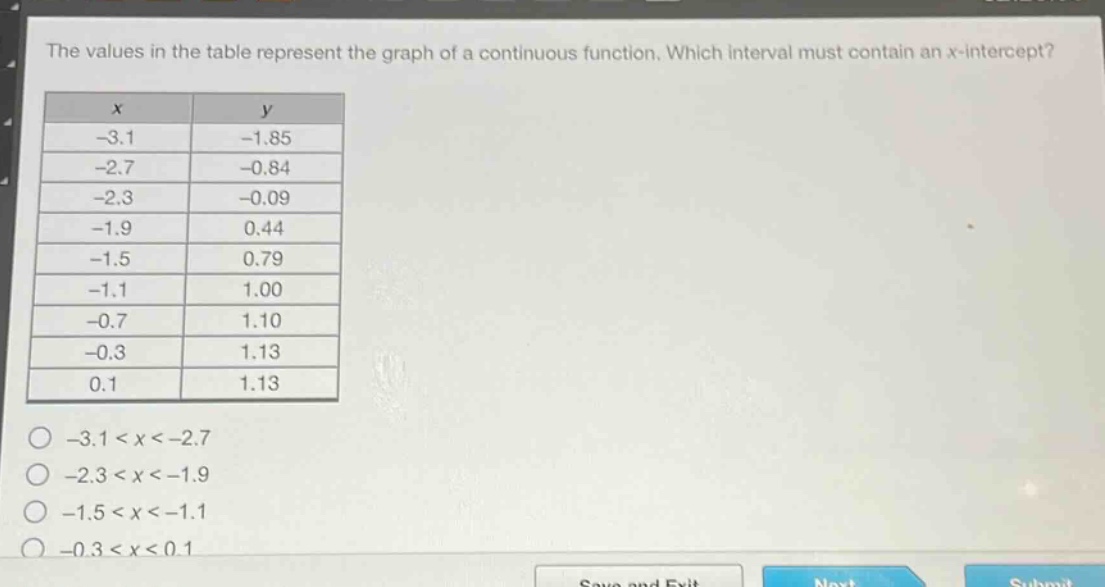
the values in the table represent the graph of a continuous function. which interval must contain an x - intercept?\n| x | y |\n| -3.1 | -1.85 |\n| -2.7 | -0.84 |\n| -2.3 | -0.09 |\n| -1.9 | 0.44 |\n| -1.5 | 0.79 |\n| -1.1 | 1.00 |\n| -0.7 | 1.10 |\n| -0.3 | 1.13 |\n| 0.1 | 1.13 |\n-3.1 < x < -2.7\n-2.3 < x < -1.9\n-1.5 < x < -1.1\n-0.3 < x < 0.1
Answer
Explanation:
Step1: Recall Intermediate - Value Theorem
The Intermediate - Value Theorem states that if a function (y = f(x)) is continuous on a closed interval ([a,b]), and (k) is a number between (f(a)) and (f(b)), then there exists at least one number (c) in the interval ((a,b)) such that (f(c)=k). For an (x) - intercept, (k = 0). We need to find an interval where (y) changes sign.
Step2: Check sign changes of (y) - values
For (x=-2.3), (y=-0.09) (negative). For (x = - 1.9), (y = 0.44) (positive). Since the function is continuous and (y) changes sign from negative to positive between (x=-2.3) and (x=-1.9), by the Intermediate - Value Theorem, there must be an (x) - intercept in the interval (-2.3<x<-1.9).
Answer:
(-2.3 < x < -1.9)