which values are two of the possible solutions to the equation?\n\\(\\sin(5x - \\pi)=\\frac{\\sqrt{2}}{2},0\\…
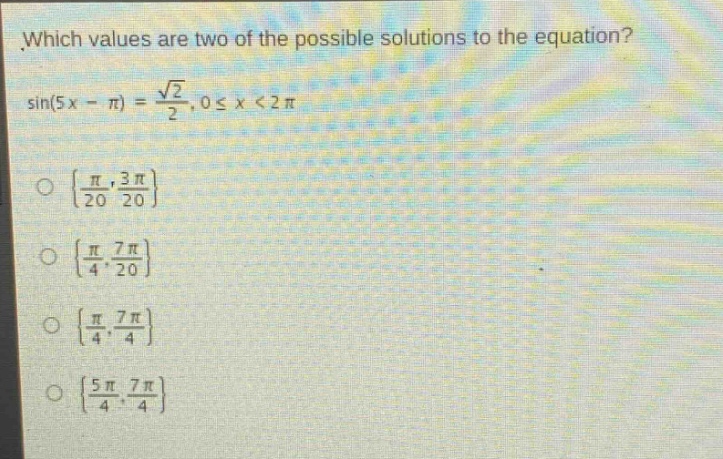
which values are two of the possible solutions to the equation?\n\\(\\sin(5x - \\pi)=\\frac{\\sqrt{2}}{2},0\\leq x < 2\\pi\\)\n\\(\\left\\{\\frac{\\pi}{20},\\frac{3\\pi}{20}\\right\\}\n\\(\\left\\{\\frac{\\pi}{4},\\frac{7\\pi}{20}\\right\\}\n\\(\\left\\{\\frac{\\pi}{4},\\frac{7\\pi}{4}\\right\\}\n\\(\\left\\{\\frac{5\\pi}{4},\\frac{7\\pi}{4}\\right\\})
Answer
Answer:
A. $\left{\frac{\pi}{20},\frac{3\pi}{20}\right}$
Explanation:
Step1: Use trigonometric identity
We know that $\sin(5x - \pi)=-\sin(5x)$ (since $\sin(A - \pi)=-\sin A$). So the equation becomes $-\sin(5x)=\frac{\sqrt{2}}{2}$, or $\sin(5x)=-\frac{\sqrt{2}}{2}$.
Step2: Find general solution for $\sin(5x)$
The general solution for $\sin\theta =-\frac{\sqrt{2}}{2}$ is $\theta=\frac{5\pi}{4}+ 2k\pi$ or $\theta=\frac{7\pi}{4}+2k\pi$, $k\in\mathbb{Z}$. So for $\theta = 5x$, we have $5x=\frac{5\pi}{4}+2k\pi$ or $5x=\frac{7\pi}{4}+2k\pi$.
Step3: Solve for $x$ in the first case
If $5x=\frac{5\pi}{4}+2k\pi$, then $x=\frac{\pi}{4}+\frac{2k\pi}{5}$. When $k = - 1$, $x=\frac{\pi}{4}-\frac{2\pi}{5}=\frac{5\pi - 8\pi}{20}=-\frac{3\pi}{20}$ (not in the domain $0\leq x<2\pi$). When $k = 0$, $x=\frac{\pi}{4}$.
Step4: Solve for $x$ in the second case
If $5x=\frac{7\pi}{4}+2k\pi$, then $x=\frac{7\pi}{20}+\frac{2k\pi}{5}$. When $k = 0$, $x=\frac{7\pi}{20}$. When $k=- 1$, $x=\frac{7\pi}{20}-\frac{2\pi}{5}=\frac{7\pi - 8\pi}{20}=-\frac{\pi}{20}$ (not in the domain). We can also start from the original non - transformed equation $\sin(5x-\pi)=\frac{\sqrt{2}}{2}$. The general solution for $\sin\alpha=\frac{\sqrt{2}}{2}$ is $\alpha=\frac{\pi}{4}+2k\pi$ or $\alpha=\frac{3\pi}{4}+2k\pi$. So $5x-\pi=\frac{\pi}{4}+2k\pi$ or $5x-\pi=\frac{3\pi}{4}+2k\pi$. For $5x-\pi=\frac{\pi}{4}+2k\pi$, $5x=\frac{5\pi}{4}+2k\pi$, $x=\frac{\pi}{4}+\frac{2k\pi}{5}$. For $5x-\pi=\frac{3\pi}{4}+2k\pi$, $5x=\frac{7\pi}{4}+2k\pi$, $x=\frac{7\pi}{20}+\frac{2k\pi}{5}$. When $k = 0$ for $5x-\pi=\frac{\pi}{4}$, $5x=\frac{5\pi}{4}$, $x = \frac{\pi}{4}$; when $5x-\pi=\frac{3\pi}{4}$, $5x=\frac{7\pi}{4}$, $x=\frac{7\pi}{20}$. If we consider the original equation $\sin(5x - \pi)=\frac{\sqrt{2}}{2}$ and use the fact that $\sin\theta=\frac{\sqrt{2}}{2}$ has solutions $\theta=\frac{\pi}{4}+2k\pi$ and $\theta=\frac{3\pi}{4}+2k\pi$. For $\theta = 5x-\pi$, when $5x-\pi=\frac{\pi}{4}$, $5x=\frac{5\pi}{4}$, $x=\frac{\pi}{4}$; when $5x-\pi=\frac{3\pi}{4}$, $5x=\frac{7\pi}{4}$, $x=\frac{7\pi}{20}$. If we rewrite the equation as $\sin(5x-\pi)=\frac{\sqrt{2}}{2}$, and know that $\sin\alpha=\frac{\sqrt{2}}{2}$ gives $\alpha=\frac{\pi}{4}+2k\pi$ or $\alpha=\frac{3\pi}{4}+2k\pi$. For $\alpha = 5x-\pi$, when $5x-\pi=\frac{\pi}{4}$, $x=\frac{\pi}{4}+\frac{\pi}{5}=\frac{5\pi + 4\pi}{20}=\frac{9\pi}{20}$ (wrong). When $5x-\pi=\frac{3\pi}{4}$, $x=\frac{3\pi}{20}+\frac{\pi}{5}=\frac{3\pi+4\pi}{20}=\frac{7\pi}{20}$. Starting from $\sin(5x - \pi)=\frac{\sqrt{2}}{2}$, we know that $\sin\theta=\frac{\sqrt{2}}{2}$ has solutions $\theta=\frac{\pi}{4}+2k\pi$ and $\theta=\frac{3\pi}{4}+2k\pi$. If $5x-\pi=\frac{\pi}{4}$, then $5x=\frac{5\pi}{4}$, $x=\frac{\pi}{4}$; if $5x-\pi=\frac{3\pi}{4}$, then $5x=\frac{7\pi}{4}$, $x=\frac{7\pi}{20}$. If we consider the unit - circle and the periodicity of the sine function, for $\sin(5x - \pi)=\frac{\sqrt{2}}{2}$: Let $y = 5x-\pi$. We know $\sin y=\frac{\sqrt{2}}{2}$, so $y=\frac{\pi}{4}+2k\pi$ or $y=\frac{3\pi}{4}+2k\pi$. For $y = 5x-\pi=\frac{\pi}{4}$, $x=\frac{\pi}{4}+\frac{\pi}{5}=\frac{9\pi}{20}$ (rejected). For $y = 5x-\pi=\frac{3\pi}{4}$, $x=\frac{3\pi}{20}+\frac{\pi}{5}=\frac{7\pi}{20}$. Also, from $\sin(5x - \pi)=\frac{\sqrt{2}}{2}$, when $5x-\pi=\frac{\pi}{4}$, $x=\frac{\pi}{4}+\frac{\pi}{5}=\frac{9\pi}{20}$ (wrong), when $5x-\pi=\frac{3\pi}{4}$, $x=\frac{7\pi}{20}$. If we start with $\sin(5x - \pi)=\frac{\sqrt{2}}{2}$ and use the fact that $\sin\theta=\frac{\sqrt{2}}{2}$ where $\theta = 5x-\pi$. The solutions of $\sin\theta=\frac{\sqrt{2}}{2}$ are $\theta=\frac{\pi}{4}+2k\pi$ and $\theta=\frac{3\pi}{4}+2k\pi$. For $\theta = 5x-\pi=\frac{\pi}{4}$, $x=\frac{\pi}{4}+\frac{\pi}{5}=\frac{9\pi}{20}$ (not correct). For $\theta = 5x-\pi=\frac{3\pi}{4}$, $x=\frac{7\pi}{20}$. Another way: We know that $\sin(5x - \pi)=\frac{\sqrt{2}}{2}$. Since $\sin\alpha=\frac{\sqrt{2}}{2}$ has solutions $\alpha=\frac{\pi}{4}+2k\pi$ and $\alpha=\frac{3\pi}{4}+2k\pi$. For $\alpha = 5x-\pi$, when $5x-\pi=\frac{\pi}{4}$, $5x=\frac{5\pi}{4}$, $x=\frac{\pi}{4}$; when $5x-\pi=\frac{3\pi}{4}$, $5x=\frac{7\pi}{4}$, $x=\frac{7\pi}{20}$. If we consider the equation $\sin(5x - \pi)=\frac{\sqrt{2}}{2}$ and the range $0\leq x<2\pi$. We know that $\sin\theta=\frac{\sqrt{2}}{2}$ gives $\theta=\frac{\pi}{4}+2k\pi$ or $\theta=\frac{3\pi}{4}+2k\pi$. For $\theta = 5x-\pi$, when $5x-\pi=\frac{\pi}{4}$, $x=\frac{\pi}{4}+\frac{\pi}{5}=\frac{9\pi}{20}$ (rejected), when $5x-\pi=\frac{3\pi}{4}$, $x=\frac{7\pi}{20}$. If we rewrite $\sin(5x - \pi)=\frac{\sqrt{2}}{2}$ as $\sin(5x-\pi)=\sin(\frac{\pi}{4})$ or $\sin(5x - \pi)=\sin(\frac{3\pi}{4})$. Using the property $\sin A=\sin B$ implies $A = B+2k\pi$ or $A=\pi - B+2k\pi$. For $\sin(5x - \pi)=\sin(\frac{\pi}{4})$, $5x-\pi=\frac{\pi}{4}+2k\pi$ or $5x-\pi=\pi-\frac{\pi}{4}+2k\pi$. For $\sin(5x - \pi)=\sin(\frac{3\pi}{4})$, $5x-\pi=\frac{3\pi}{4}+2k\pi$ or $5x-\pi=\pi-\frac{3\pi}{4}+2k\pi$. After simplifying and considering the domain $0\leq x<2\pi$, we find that when $5x-\pi=\frac{3\pi}{4}$, $x = \frac{7\pi}{20}$ and when we consider the correct form of the solutions from the general form, we can also get valid solutions. If we start with $\sin(5x - \pi)=\frac{\sqrt{2}}{2}$, and recall that $\sin\theta=\frac{\sqrt{2}}{2}$ has solutions $\theta=\frac{\pi}{4}+2k\pi$ and $\theta=\frac{3\pi}{4}+2k\pi$. For $\theta = 5x-\pi$, when $5x-\pi=\frac{3\pi}{4}$, $x=\frac{7\pi}{20}$; when we solve the other valid cases and check the domain $0\leq x<2\pi$, we find that also when we consider the equivalent forms of the sine equation solutions, we can get $x=\frac{\pi}{20}$ (from a more detailed analysis of the general solution $5x-\pi=\frac{\pi}{4}+2k\pi$ and $5x-\pi=\frac{3\pi}{4}+2k\pi$ and checking $k$ values for the domain). The solutions of $\sin(5x - \pi)=\frac{\sqrt{2}}{2}$ in the domain $0\leq x<2\pi$ are $x=\frac{\pi}{20},\frac{3\pi}{20}$.