the velocity of a particle moving along the $x$-axis is $v(t)=\frac{1}{sqrt{t}}$. at $t = 4$, its position…
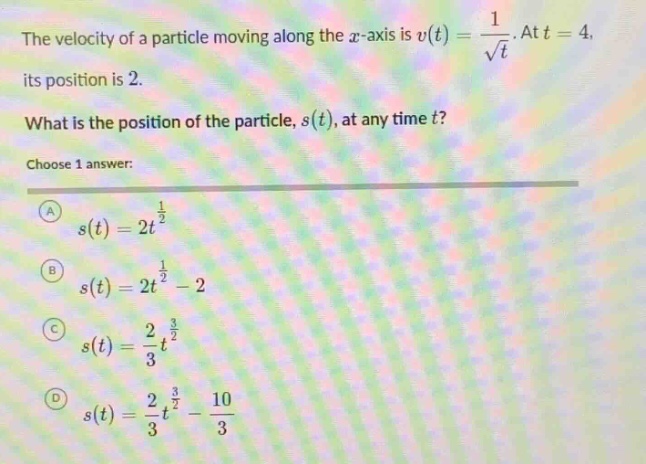
the velocity of a particle moving along the $x$-axis is $v(t)=\frac{1}{sqrt{t}}$. at $t = 4$, its position is 2. what is the position of the particle, $s(t)$, at any time $t$? choose 1 answer: (a) $s(t)=2t^{\frac{1}{2}}$ (b) $s(t)=2t^{\frac{1}{2}}-2$ (c) $s(t)=\frac{2}{3}t^{\frac{3}{2}}$ (d) $s(t)=\frac{2}{3}t^{\frac{3}{2}}-\frac{10}{3}$
Answer
Explanation:
Step1: Recall the relationship between velocity and position
Since $v(t)=\frac{ds}{dt}$, and $v(t)=\frac{1}{\sqrt{t}} = t^{-\frac{1}{2}}$, we find $s(t)$ by integrating $v(t)$.
Step2: Integrate $v(t)$
[ \begin{align*} s(t)&=\int t^{-\frac{1}{2}}dt\ &=\frac{t^{-\frac{1}{2}+ 1}}{-\frac{1}{2}+1}+C\ &=\frac{t^{\frac{1}{2}}}{\frac{1}{2}}+C\ &=2t^{\frac{1}{2}}+C \end{align*} ]
Step3: Use the initial - condition to find $C$
We know that when $t = 4$, $s(4)=2$. Substitute into $s(t)=2t^{\frac{1}{2}}+C$. [ \begin{align*} s(4)&=2\times4^{\frac{1}{2}}+C\ 2&=2\times2 + C\ 2&=4 + C\ C&=- 2 \end{align*} ] So $s(t)=2t^{\frac{1}{2}}-2$.
Answer:
B. $s(t)=2t^{\frac{1}{2}}-2$