what are the vertical and horizontal asymptotes for the function $f(x)=\frac{x^{2}+x - 6}{x^{3}-1}$?\no…
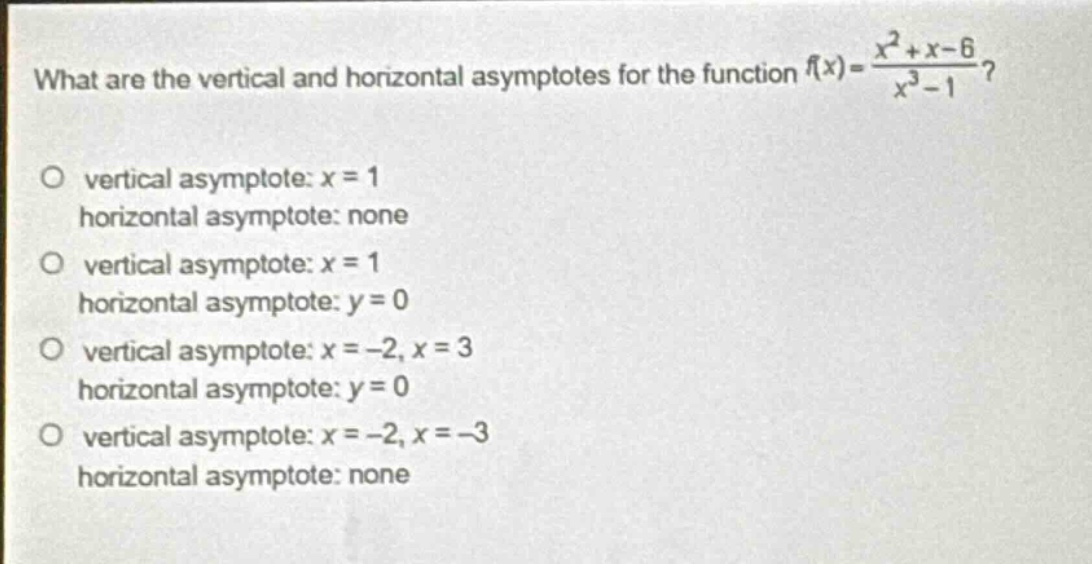
what are the vertical and horizontal asymptotes for the function $f(x)=\frac{x^{2}+x - 6}{x^{3}-1}$?\no vertical asymptote: $x = 1$\n horizontal asymptote: none\no vertical asymptote: $x = 1$\n horizontal asymptote: $y = 0$\no vertical asymptote: $x=-2,x = 3$\n horizontal asymptote: $y = 0$\no vertical asymptote: $x=-2,x=-3$\n horizontal asymptote: none
Answer
Explanation:
Step1: Find vertical asymptotes
Set the denominator equal to zero: $x^{3}-1 = 0$. Using the formula $a^{3}-b^{3}=(a - b)(a^{2}+ab + b^{2})$, where $a=x$ and $b = 1$, we have $(x - 1)(x^{2}+x + 1)=0$. The real - root of $x^{3}-1=0$ is $x = 1$ (since the discriminant of $x^{2}+x + 1$ is $\Delta=1^{2}-4\times1\times1=- 3<0$, so it has no real roots). So the vertical asymptote is $x = 1$.
Step2: Find horizontal asymptotes
Compare the degrees of the numerator and denominator. The degree of the numerator $n = 2$ (for $x^{2}+x - 6$) and the degree of the denominator $m=3$ (for $x^{3}-1$). When $n<m$, the horizontal asymptote is $y = 0$.
Answer:
vertical asymptote: $x = 1$ horizontal asymptote: $y = 0$