for the vertical motion model h(t)= - 16t² + 43t + 5, identify the maximum height reached by an object and…
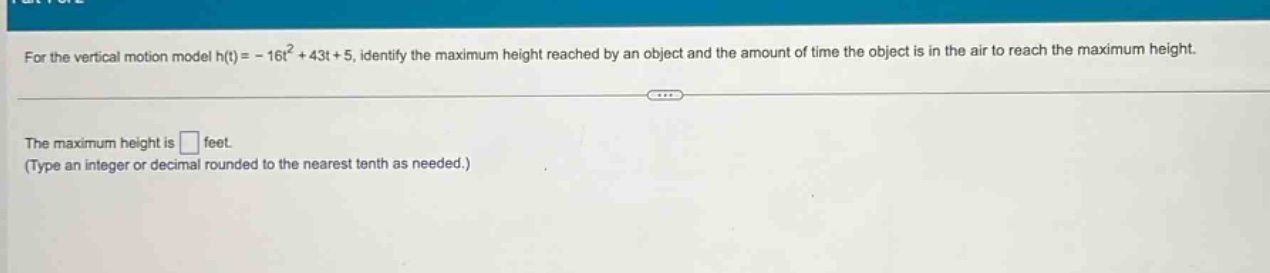
for the vertical motion model h(t)= - 16t² + 43t + 5, identify the maximum height reached by an object and the amount of time the object is in the air to reach the maximum height. the maximum height is □ feet. (type an integer or decimal rounded to the nearest tenth as needed.)
Answer
Explanation:
Step1: Identify coefficients
The height - time function is $h(t)=-16t^{2}+43t + 5$, where $a=-16$, $b = 43$, $c = 5$.
Step2: Find time to reach maximum height
The time $t$ to reach the maximum of a quadratic function $y = ax^{2}+bx + c$ is given by $t=-\frac{b}{2a}$. Substitute $a=-16$ and $b = 43$ into the formula: $t=-\frac{43}{2\times(-16)}=\frac{43}{32}=1.34375$ seconds.
Step3: Find maximum height
Substitute $t = \frac{43}{32}$ into the height - time function $h(t)=-16t^{2}+43t + 5$. [ \begin{align*} h(\frac{43}{32})&=-16\times(\frac{43}{32})^{2}+43\times\frac{43}{32}+5\ &=-16\times\frac{1849}{1024}+\frac{1849}{32}+5\ &=-\frac{1849}{64}+\frac{1849}{32}+5\ &=\frac{-1849 + 3698}{64}+5\ &=\frac{1849}{64}+5\ &=\frac{1849+320}{64}\ &=\frac{2169}{64}\ &=33.9 \end{align*} ]
Answer:
33.9