for each vertical motion model, identify the maximum height (in feet) a. h(t)= - 16t² + 200t + 25 b. h(t)=…
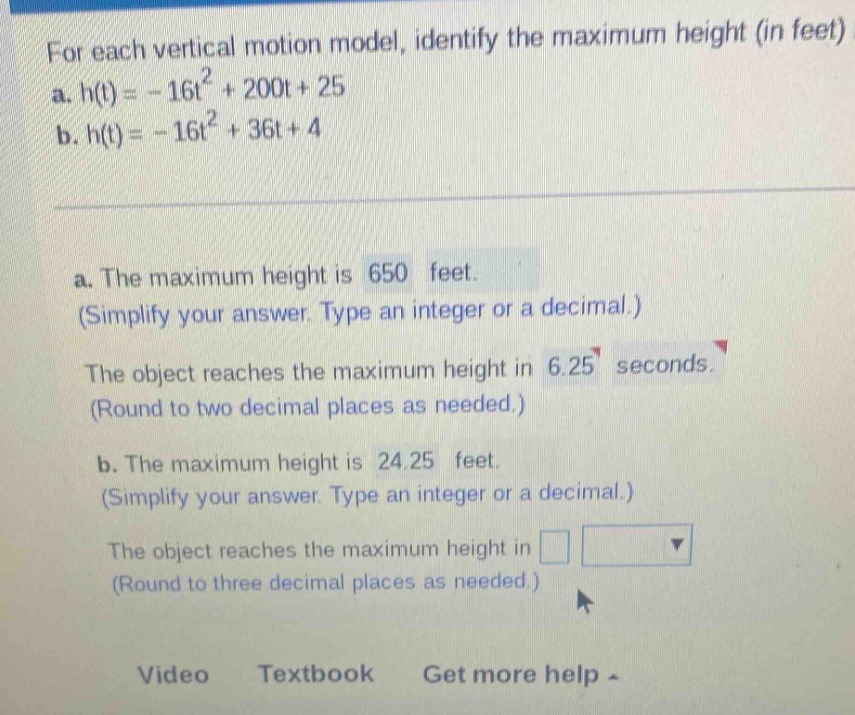
for each vertical motion model, identify the maximum height (in feet) a. h(t)= - 16t² + 200t + 25 b. h(t)= - 16t² + 36t + 4 a. the maximum height is 650 feet. (simplify your answer. type an integer or a decimal.) the object reaches the maximum height in 6.25 seconds. (round to two decimal places as needed.) b. the maximum height is 24.25 feet. (simplify your answer. type an integer or a decimal.) the object reaches the maximum height in (round to three decimal places as needed.) video textbook get more help -
Answer
Explanation:
Step1: Recall the formula for the time - vertex of a quadratic function
For a quadratic function $h(t)=at^{2}+bt + c$, the time $t$ at which the vertex (maximum for $a<0$) occurs is given by $t =-\frac{b}{2a}$.
Step2: Identify the coefficients for part b
For $h(t)=- 16t^{2}+36t + 4$, we have $a=-16$ and $b = 36$.
Step3: Calculate the time of maximum height
Using the formula $t=-\frac{b}{2a}$, we substitute $a=-16$ and $b = 36$: $t=-\frac{36}{2\times(-16)}=\frac{36}{32}=\frac{9}{8}=1.125$
Answer:
1.125