video example find the maclaurin series of the function f(x) = e^2x and its radius of convergence. solution…
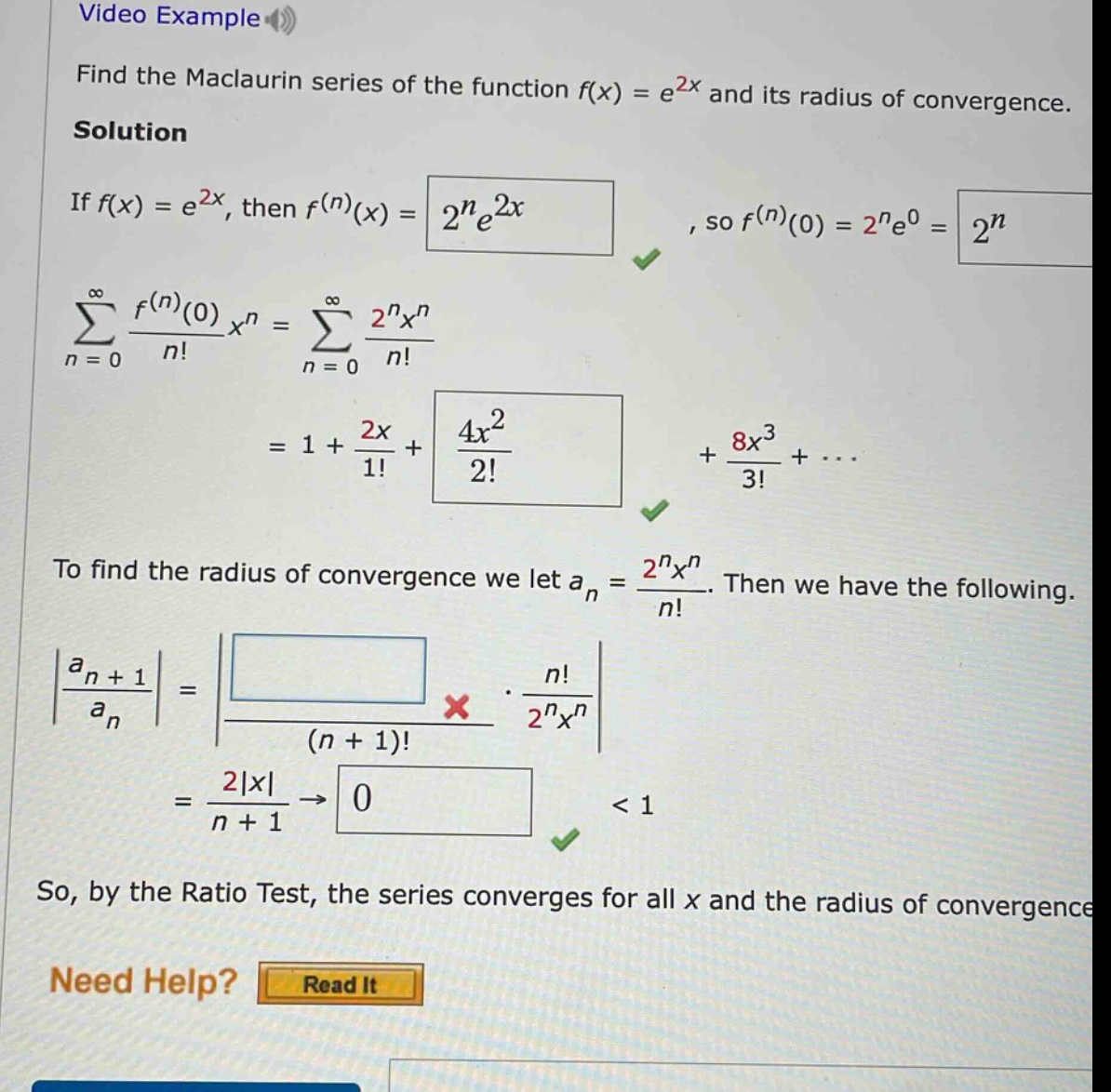
video example find the maclaurin series of the function f(x) = e^2x and its radius of convergence. solution if f(x) = e^2x, then f^(n)(x) = 2^n e^2x, so f^(n)(0) = 2^n e^0 = 2^n. ∑(n = 0 to ∞) f^(n)(0)/n! x^n = ∑(n = 0 to ∞) 2^n x^n/n! = 1 + 2x/1! + 4x^2/2! + 8x^3/3! + ... to find the radius of convergence we let a_n = 2^n x^n/n!. then we have the following. |a_n + 1/a_n| = |(n!)/(n + 1)! * 2^n x^n| = 2|x|/(n + 1) → 0 < 1 so, by the ratio test, the series converges for all x and the radius of convergence need help? read it
Answer
Explanation:
Step1: Find n - th derivative of $f(x)$
If $f(x)=e^{2x}$, by the chain - rule, $f^{(n)}(x)=2^{n}e^{2x}$. Evaluating at $x = 0$, we get $f^{(n)}(0)=2^{n}e^{0}=2^{n}$.
Step2: Write the Maclaurin series
The Maclaurin series of a function $f(x)$ is given by $\sum_{n = 0}^{\infty}\frac{f^{(n)}(0)}{n!}x^{n}$. Substituting $f^{(n)}(0)=2^{n}$, we have $\sum_{n = 0}^{\infty}\frac{2^{n}x^{n}}{n!}=1+\frac{2x}{1!}+\frac{4x^{2}}{2!}+\frac{8x^{3}}{3!}+\cdots$.
Step3: Find the radius of convergence using the Ratio Test
Let $a_{n}=\frac{2^{n}x^{n}}{n!}$. Then $a_{n + 1}=\frac{2^{n+1}x^{n + 1}}{(n + 1)!}$. Calculate $\left|\frac{a_{n+1}}{a_{n}}\right|=\left|\frac{\frac{2^{n + 1}x^{n+1}}{(n + 1)!}}{\frac{2^{n}x^{n}}{n!}}\right|=\left|\frac{2^{n+1}x^{n+1}n!}{2^{n}x^{n}(n + 1)!}\right|=\frac{2|x|}{n + 1}$. As $n\to\infty$, $\lim_{n\rightarrow\infty}\frac{2|x|}{n + 1}=0$. Since $0<1$ for all $x\in R$, the series converges for all $x$.
Answer:
The Maclaurin series of $f(x)=e^{2x}$ is $\sum_{n = 0}^{\infty}\frac{2^{n}x^{n}}{n!}=1 + 2x+\frac{4x^{2}}{2!}+\frac{8x^{3}}{3!}+\cdots$, and the radius of convergence $R=\infty$.