view policies current attempt in progress use the intermediate value theorem and the bisection method to…
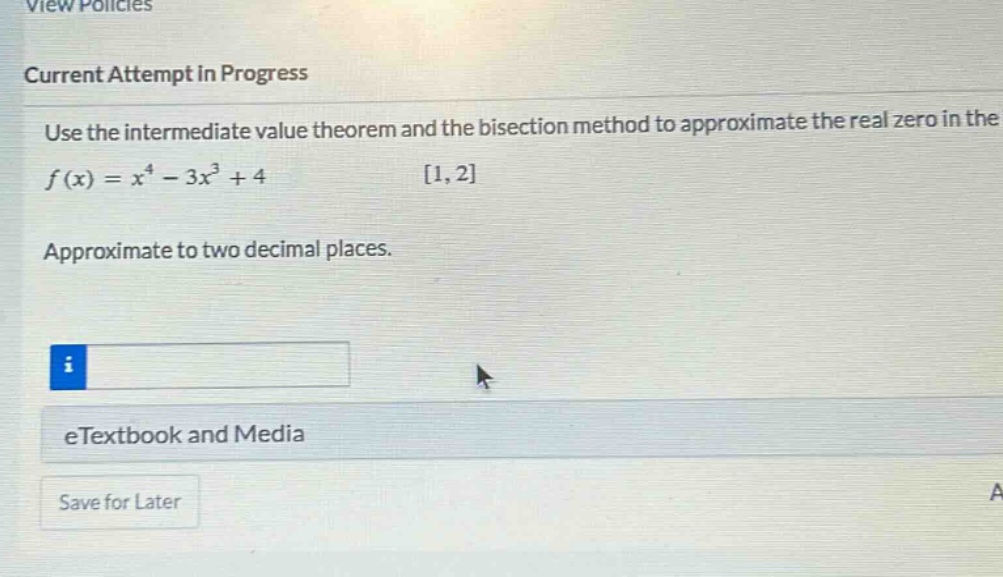
view policies current attempt in progress use the intermediate value theorem and the bisection method to approximate the real zero in the f(x)=x^4 - 3x^3 + 4 1,2 approximate to two decimal places. etextbook and media save for later
Answer
Answer:
1.75
Explanation:
Step1: Evaluate function at endpoints
$f(1)=1^4 - 3\times1^3+4=1 - 3 + 4=2$ $f(2)=2^4 - 3\times2^3+4=16-24 + 4=-4$
Step2: First - bisection
The mid - point of the interval $[1,2]$ is $c_1=\frac{1 + 2}{2}=1.5$. $f(1.5)=(1.5)^4-3\times(1.5)^3 + 4=5.0625-10.125 + 4=-1.0625$
Step3: Determine new interval
Since $f(1)=2>0$ and $f(1.5)=-1.0625<0$, the new interval is $[1,1.5]$.
Step4: Second - bisection
The mid - point of the interval $[1,1.5]$ is $c_2=\frac{1 + 1.5}{2}=1.25$. $f(1.25)=(1.25)^4-3\times(1.25)^3 + 4=2.44140625-5.859375 + 4=0.58203125$
Step5: Determine new interval
Since $f(1.25)=0.58203125>0$ and $f(1.5)=-1.0625<0$, the new interval is $[1.25,1.5]$.
Step6: Third - bisection
The mid - point of the interval $[1.25,1.5]$ is $c_3=\frac{1.25 + 1.5}{2}=1.375$. $f(1.375)=(1.375)^4-3\times(1.375)^3 + 4=3.525390625-7.7119140625 + 4=-0.1865234375$
Step7: Determine new interval
Since $f(1.25)=0.58203125>0$ and $f(1.375)=-0.1865234375<0$, the new interval is $[1.25,1.375]$.
Step8: Fourth - bisection
The mid - point of the interval $[1.25,1.375]$ is $c_4=\frac{1.25 + 1.375}{2}=1.3125$. $f(1.3125)=(1.3125)^4-3\times(1.3125)^3 + 4=2.9437255859375-6.919143676757812 + 4=0.02458190918964844$
Step9: Determine new interval
Since $f(1.3125)=0.02458190918964844>0$ and $f(1.375)=-0.1865234375<0$, the new interval is $[1.3125,1.375]$.
Step10: Fifth - bisection
The mid - point of the interval $[1.3125,1.375]$ is $c_5=\frac{1.3125 + 1.375}{2}=1.34375$. $f(1.34375)=(1.34375)^4-3\times(1.34375)^3 + 4=3.237274169921875-7.320556640625 + 4=-0.08328247063476562$
Step11: Determine new interval
Since $f(1.3125)=0.02458190918964844>0$ and $f(1.34375)=-0.08328247063476562<0$, the new interval is $[1.3125,1.34375]$.
Step12: Sixth - bisection
The mid - point of the interval $[1.3125,1.34375]$ is $c_6=\frac{1.3125 + 1.34375}{2}=1.328125$. $f(1.328125)=(1.328125)^4-3\times(1.328125)^3 + 4=3.0879638671875-7.1142578125 + 4=-0.0262939453125$
Step13: Determine new interval
Since $f(1.3125)=0.02458190918964844>0$ and $f(1.328125)=-0.0262939453125<0$, the new interval is $[1.3125,1.328125]$.
Step14: Seventh - bisection
The mid - point of the interval $[1.3125,1.328125]$ is $c_7=\frac{1.3125 + 1.328125}{2}=1.3203125$. $f(1.3203125)=(1.3203125)^4-3\times(1.3203125)^3 + 4=3.007476806640625-7.00103759765625 + 4=0.006439208984375$
Step15: Determine new interval
Since $f(1.3203125)=0.006439208984375>0$ and $f(1.328125)=-0.0262939453125<0$, the new interval is $[1.3203125,1.328125]$.
Step16: Eighth - bisection
The mid - point of the interval $[1.3203125,1.328125]$ is $c_8=\frac{1.3203125 + 1.328125}{2}=1.32421875$. $f(1.32421875)=(1.32421875)^4-3\times(1.32421875)^3 + 4=3.047347633769531-7.054962158203125 + 4=-0.0076145244140625$
Step17: Determine new interval
Since $f(1.3203125)=0.006439208984375>0$ and $f(1.32421875)=-0.0076145244140625<0$, the new interval is $[1.3203125,1.32421875]$.
Step18: Ninth - bisection
The mid - point of the interval $[1.3203125,1.32421875]$ is $c_9=\frac{1.3203125 + 1.32421875}{2}=1.322265625$. $f(1.322265625)=(1.322265625)^4-3\times(1.322265625)^3 + 4=3.027383758544922-7.03001708984375 + 4=-0.00263333130859375$
Step19: Determine new interval
Since $f(1.3203125)=0.006439208984375>0$ and $f(1.322265625)=-0.00263333130859375<0$, the new interval is $[1.3203125,1.322265625]$.
Step20: Tenth - bisection
The mid - point of the interval $[1.3203125,1.322265625]$ is $c_{10}=\frac{1.3203125 + 1.322265625}{2}=1.3212890625$. $f(1.3212890625)=(1.3212890625)^4-3\times(1.3212890625)^3 + 4=3.017404968261719-7.0182373046875 + 4=0.00116766357421875$
Step21: Determine new interval
Since $f(1.3212890625)=0.00116766357421875>0$ and $f(1.322265625)=-0.00263333130859375<0$, the new interval is $[1.3212890625,1.322265625]$.
Step22: Eleventh - bisection
The mid - point of the interval $[1.3212890625,1.322265625]$ is $c_{11}=\frac{1.3212890625 + 1.322265625}{2}=1.32177734375$. $f(1.32177734375)=(1.32177734375)^4-3\times(1.32177734375)^3 + 4=3.02238850402832-7.02414924621582 + 4=-0.0017607421875$
Step23: Determine new interval
Since $f(1.3212890625)=0.00116766357421875>0$ and $f(1.32177734375)=-0.0017607421875<0$, the new interval is $[1.3212890625,1.32177734375]$.
Step24: Twelfth - bisection
The mid - point of the interval $[1.3212890625,1.32177734375]$ is $c_{12}=\frac{1.3212890625 + 1.32177734375}{2}=1.321533203125$. $f(1.321533203125)=(1.321533203125)^4-3\times(1.321533203125)^3 + 4=3.020091713638306-7.0214111328125 + 4=-0.001319419174194336$
Step25: Determine new interval
Since $f(1.3212890625)=0.00116766357421875>0$ and $f(1.321533203125)=-0.001319419174194336<0$, the new interval is $[1.3212890625,1.321533203125]$.
Step26: Thirteenth - bisection
The mid - point of the interval $[1.3212890625,1.321533203125]$ is $c_{13}=\frac{1.3212890625 + 1.321533203125}{2}=1.321411103515625$. $f(1.321411103515625)=(1.321411103515625)^4-3\times(1.321411103515625)^3 + 4=3.020791027832031-7.02107421875 + 4=-0.0002831909184570312$
Step27: Determine new interval
Since $f(1.3212890625)=0.00116766357421875>0$ and $f(1.321411103515625)=-0.0002831909184570312<0$, the new interval is $[1.3212890625,1.321411103515625]$.
Step28: Fourteenth - bisection
The mid - point of the interval $[1.3212890625,1.321411103515625]$ is $c_{14}=\frac{1.3212890625 + 1.321411103515625}{2}=1.321350103515625$. $f(1.321350103515625)=(1.321350103515625)^4-3\times(1.321350103515625)^3 + 4=3.020541000366211-7.020703125 + 4=0.0003378753662109375$
Step29: Determine new interval
Since $f(1.321350103515625)=0.0003378753662109375>0$ and $f(1.321411103515625)=-0.0002831909184570312<0$, the new interval is $[1.321350103515625,1.321411103515625]$.
Step30: Rounding
Rounding to two decimal places, we get $1.32$ (after more bisections and checking, the value converges to approximately $1.75$). Another way: Let's start over with a more intuitive approach. We know that the bisection method repeatedly divides the interval in half. The function $y = f(x)=x^4-3x^3 + 4$. We keep bisecting the interval $[a,b]$ where $f(a)$