the volume of air in a persons lungs can be modeled with a periodic function. the graph below represents the…
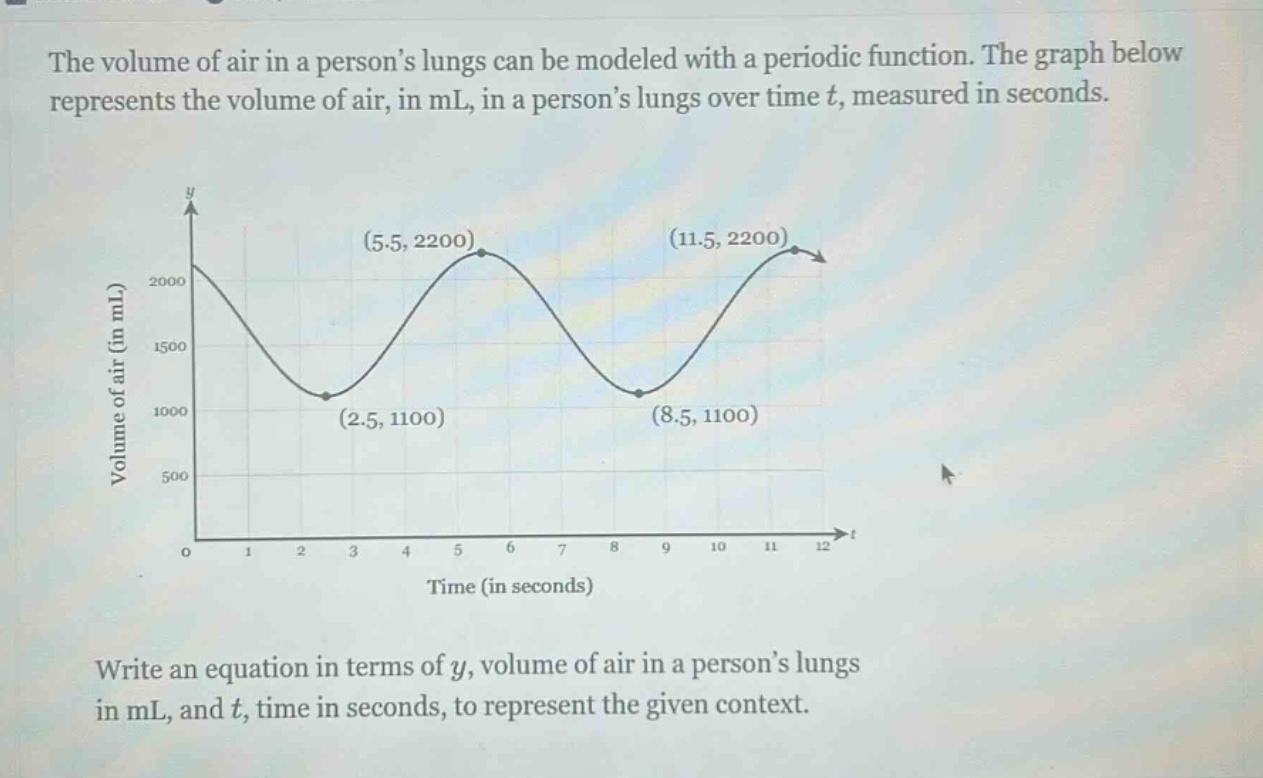
the volume of air in a persons lungs can be modeled with a periodic function. the graph below represents the volume of air, in ml, in a persons lungs over time t, measured in seconds. write an equation in terms of y, volume of air in a persons lungs in ml, and t, time in seconds, to represent the given context.
Answer
Explanation:
Step1: Encontrar la amplitud
La amplitud $A$ se calcula como la mitad de la diferencia entre el valor máximo y el valor mínimo. El valor máximo es $y_{max}=2200$ y el valor mínimo es $y_{min}=1100$. Entonces $A=\frac{y_{max}-y_{min}}{2}=\frac{2200 - 1100}{2}=\frac{1100}{2}=550$.
Step2: Encontrar la media
La media $D$ es el valor promedio entre el valor máximo y el valor mínimo. $D=\frac{y_{max}+y_{min}}{2}=\frac{2200 + 1100}{2}=\frac{3300}{2}=1650$.
Step3: Encontrar el período
El período $P$ es la distancia entre dos máximos (o mínimos) consecutivos. Aquí, los máximos son $(5.5,2200)$ y $(11.5,2200)$, entonces $P=11.5 - 5.5 = 6$. Y la frecuencia angular $\omega=\frac{2\pi}{P}=\frac{2\pi}{6}=\frac{\pi}{3}$.
Step4: Encontrar la fase
Supongamos una función del tipo $y = A\sin(\omega t-\varphi)+D$. Usando el punto inicial $(0, 2000)$ (suponiendo que el gráfico comienza en $t = 0$), sustituimos $A = 550$, $D=1650$ y $\omega=\frac{\pi}{3}$ en la ecuación: $2000=550\sin(-\varphi)+1650$. Entonces $550\sin(-\varphi)=2000 - 1650 = 350$, $\sin(-\varphi)=\frac{350}{550}=\frac{7}{11}$, $\varphi=-\sin^{- 1}(\frac{7}{11})$. Pero una forma más sencilla es usar una función de coseno $y = A\cos(\omega t)+D$ (ya que el gráfico comienza en un valor distinto del mínimo y máximo y se parece a una función de coseno). La ecuación final es $y = 550\cos(\frac{\pi}{3}t)+1650$.
Answer:
$y = 550\cos(\frac{\pi}{3}t)+1650$