the volume of air in a persons lungs can be modeled with a periodic function. the graph below represents the…
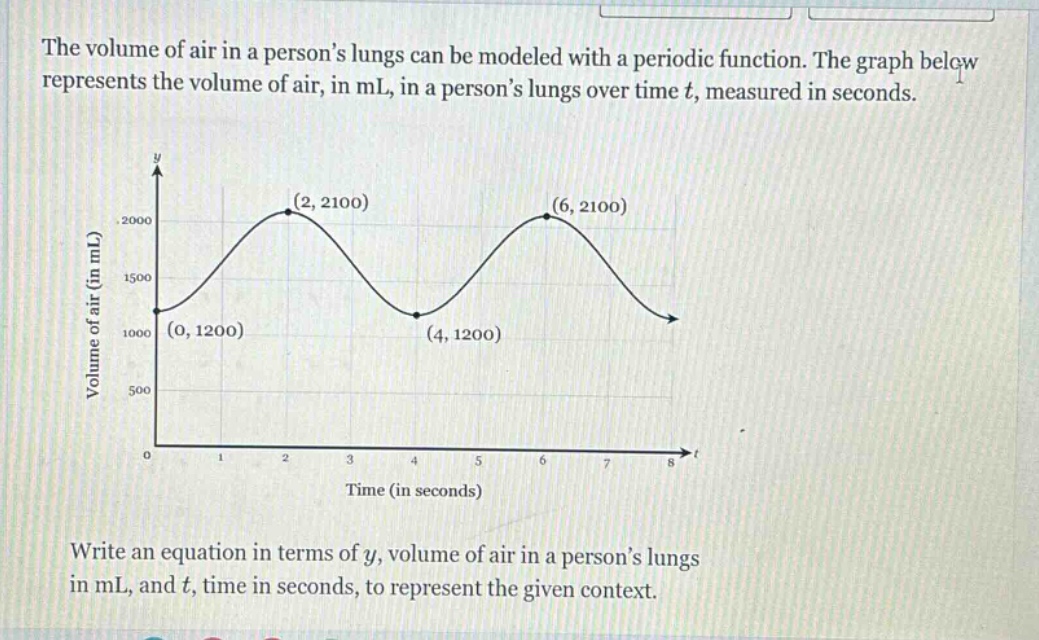
the volume of air in a persons lungs can be modeled with a periodic function. the graph below represents the volume of air, in ml, in a persons lungs over time t, measured in seconds.\nwrite an equation in terms of y, volume of air in a persons lungs in ml, and t, time in seconds, to represent the given context.
Answer
Explanation:
Step1: Determine the amplitude
The amplitude $A$ is half of the vertical distance between the maximum and minimum values. The maximum value is $y = 2100$ and the minimum value is $y=1200$. So, $A=\frac{2100 - 1200}{2}=\frac{900}{2}=450$.
Step2: Determine the vertical shift
The vertical - shift $D$ is the average of the maximum and minimum values. So, $D=\frac{2100 + 1200}{2}=\frac{3300}{2}=1650$.
Step3: Determine the period
The period $T$ is the time it takes for one complete cycle. From the graph, the period $T = 4$ seconds. The formula for the angular frequency $\omega=\frac{2\pi}{T}$. Since $T = 4$, then $\omega=\frac{2\pi}{4}=\frac{\pi}{2}$.
Step4: Determine the phase shift
The graph passes through the point $(0,1200)$. For a cosine function of the form $y = A\cos(\omega t-\varphi)+D$, when $t = 0$, $y=1200$. Substituting the known values of $A = 450$, $D = 1650$ and $\omega=\frac{\pi}{2}$ into $y = A\cos(\omega t-\varphi)+D$, we get $1200=450\cos(-\varphi)+1650$. Then $450\cos(-\varphi)=1200 - 1650=-450$, so $\cos(-\varphi)=-1$. Since $\cos(-\varphi)=\cos(\varphi)$, then $\varphi=\pi$. The equation of the cosine function is $y = 450\cos(\frac{\pi}{2}t-\pi)+1650$. Using the identity $\cos(A - \pi)=-\cos(A)$, we can rewrite the equation as $y=-450\cos(\frac{\pi}{2}t)+1650$.
Answer:
$y=-450\cos(\frac{\pi}{2}t)+1650$