we can re - write 1/6(x/6)^n as (x^n / 6^(n + 1)). therefore, f(x)=1/6 sum(n = 0 to infinity) (-1)^n(x/6)^n…
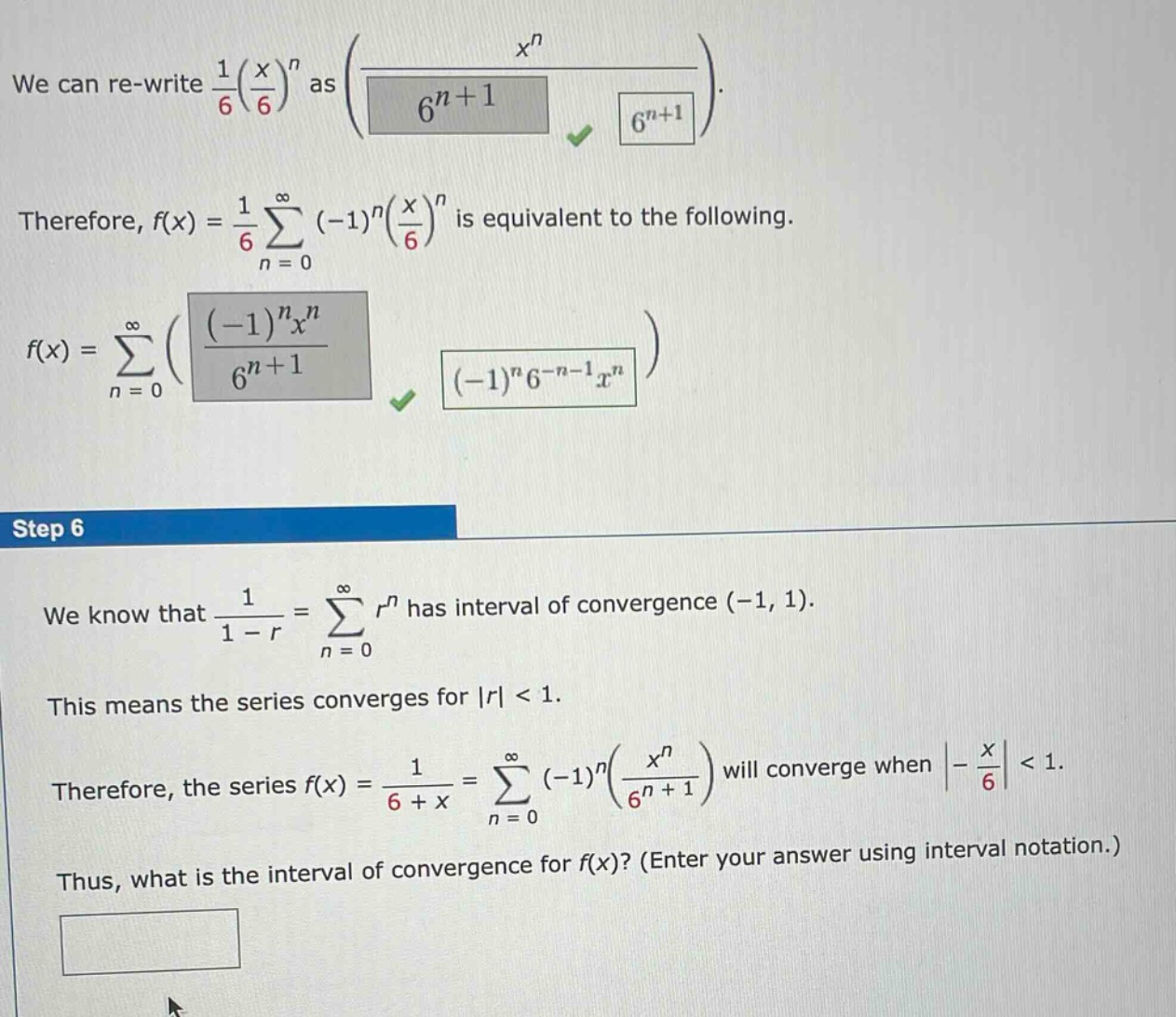
we can re - write 1/6(x/6)^n as (x^n / 6^(n + 1)). therefore, f(x)=1/6 sum(n = 0 to infinity) (-1)^n(x/6)^n is equivalent to the following. f(x)=sum(n = 0 to infinity) ((-1)^n x^n / 6^(n + 1)). step 6 we know that 1/(1 - r)=sum(n = 0 to infinity) r^n has interval of convergence (-1, 1). this means the series converges for |r| < 1. therefore, the series f(x)=1/(6 + x)=sum(n = 0 to infinity) (-1)^n(x^n / 6^(n + 1)) will converge when |-x/6| < 1. thus, what is the interval of convergence for f(x)? (enter your answer using interval notation.)
Answer
Explanation:
Step1: Analyze convergence - condition
We know the series $\sum_{n = 0}^{\infty}r^{n}$ converges for $|r|<1$. Here $r =-\frac{x}{6}$.
Step2: Solve the inequality
We have $\left|-\frac{x}{6}\right|<1$, which simplifies to $\left|\frac{x}{6}\right|<1$.
Step3: Find the interval
Multiply both sides of the inequality $\left|\frac{x}{6}\right|<1$ by 6. We get $|x|<6$, which means $- 6<x<6$.
Answer:
$(-6,6)$