a weight is attached to a spring, which moves up and down as a function of time. p(t) gives the position of…
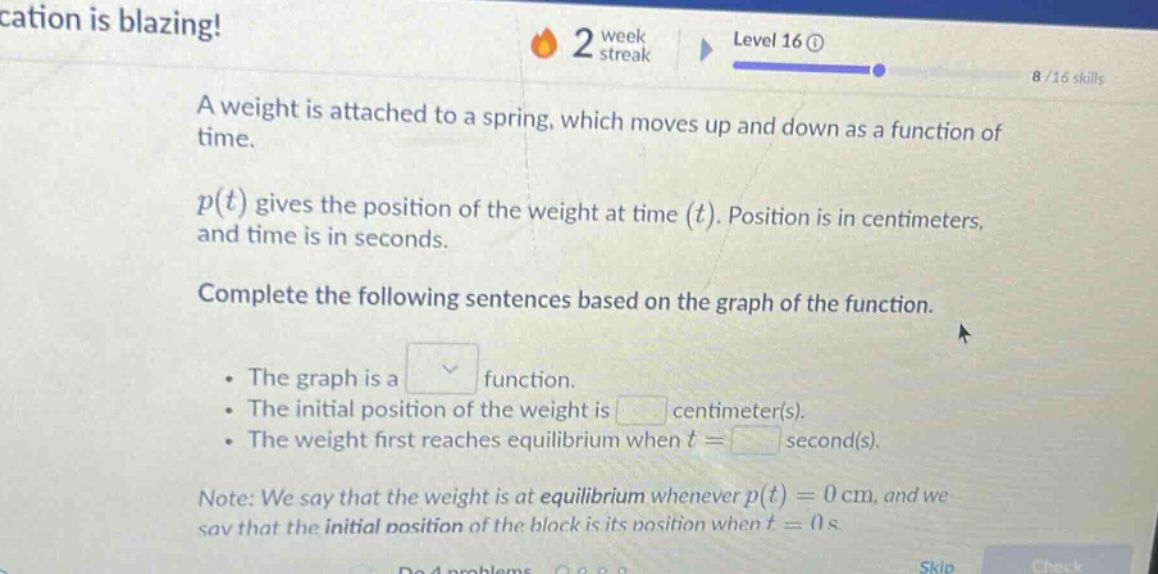
a weight is attached to a spring, which moves up and down as a function of time. p(t) gives the position of the weight at time (t). position is in centimeters, and time is in seconds. complete the following sentences based on the graph of the function. the graph is a function. the initial position of the weight is centimeter(s). the weight first reaches equilibrium when t = second(s). note: we say that the weight is at equilibrium whenever p(t)=0 cm, and we say that the initial position of the block is its position when t = 0 s.
Answer
Explanation:
Step1: Identify function type
The motion of a weight - attached spring is a periodic motion, so the graph of $p(t)$ is a periodic function.
Step2: Find initial position
The initial position is when $t = 0$. We look at the value of $p(t)$ at $t=0$ on the graph.
Step3: Find first - equilibrium time
The weight is at equilibrium when $p(t)=0$. We find the first positive $t$ value for which $p(t) = 0$ on the graph.
Answer:
- The graph is a periodic function.
- The initial position of the weight is [value from graph at t = 0] centimeter(s).
- The weight first reaches equilibrium when $t=$ [first positive t - value where p(t)=0] second(s).