a window - washer drops a bucket from 650 meters above a sidewalk. the buckets height h(t), in meters, above…
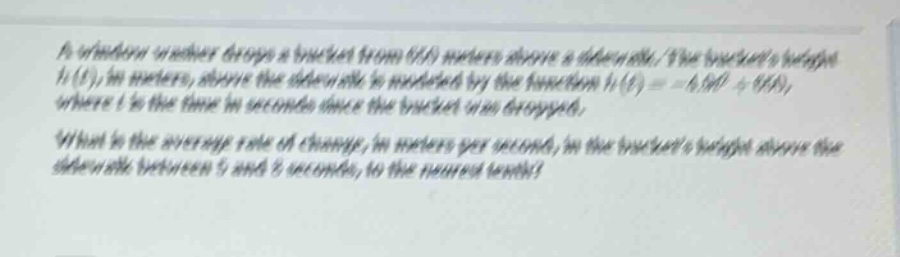
a window - washer drops a bucket from 650 meters above a sidewalk. the buckets height h(t), in meters, above the sidewalk is modeled by the function h(t)= - 4.9t²+650, where t is the time in seconds since the bucket was dropped. what is the average rate of change, in meters per second, in the buckets height above the sidewalk between 5 and 8 seconds, to the nearest tenth?
Answer
Explanation:
Step1: Recall average rate - of - change formula
The average rate of change of a function $y = h(t)$ over the interval $[a,b]$ is given by $\frac{h(b)-h(a)}{b - a}$. Here, $a = 5$, $b = 8$, and $h(t)=-4.9t^{2}+650$.
Step2: Calculate $h(5)$
Substitute $t = 5$ into $h(t)$: $h(5)=-4.9\times5^{2}+650=-4.9\times25 + 650=-122.5+650 = 527.5$.
Step3: Calculate $h(8)$
Substitute $t = 8$ into $h(t)$: $h(8)=-4.9\times8^{2}+650=-4.9\times64+650=-313.6 + 650=336.4$.
Step4: Calculate the average rate of change
Using the formula $\frac{h(8)-h(5)}{8 - 5}$, we have $\frac{336.4 - 527.5}{3}=\frac{-191.1}{3}=-63.7$.
Answer:
$-63.7$