workbook question 5\nthe height of a baseball, in feet, is modeled by the function & given by the equation…
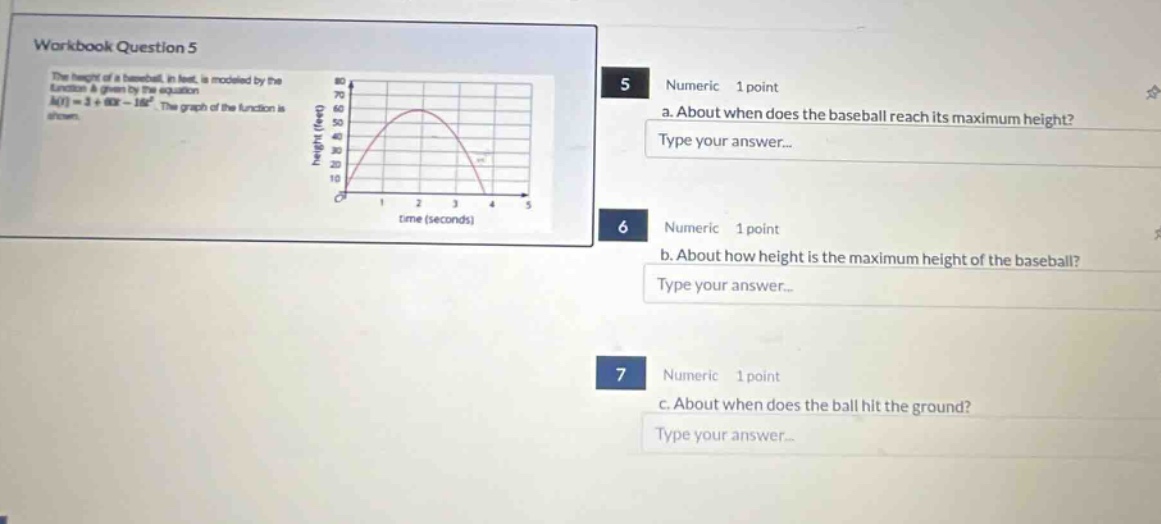
workbook question 5\nthe height of a baseball, in feet, is modeled by the function & given by the equation h(t)=2 + 60t - 16t². the graph of the function is shown.\n5 numeric 1 point\na. about when does the baseball reach its maximum height?\ntype your answer...\n6 numeric 1 point\nb. about how height is the maximum height of the baseball?\ntype your answer...\n7 numeric 1 point\nc. about when does the ball hit the ground?\ntype your answer...
Answer
Explanation:
Step1: Identify the function
The height - time function is $h(t)=2 + 60t-16t^{2}$, which is a quadratic function in the form $y = ax^{2}+bx + c$ where $a=-16$, $b = 60$ and $c = 2$.
Step2: Find the time of maximum height
For a quadratic function $y = ax^{2}+bx + c$, the $x$ - coordinate (in our case $t$ - coordinate) of the vertex is given by $t=-\frac{b}{2a}$. Substituting $a=-16$ and $b = 60$ into the formula, we have $t=-\frac{60}{2\times(-16)}=\frac{60}{32}=\frac{15}{8}=1.875$ seconds.
Step3: Find the maximum height
Substitute $t = 1.875$ into the function $h(t)=2 + 60t-16t^{2}$. $h(1.875)=2+60\times1.875-16\times(1.875)^{2}$ $=2 + 112.5-16\times3.515625$ $=2+112.5 - 56.25$ $=58.25$ feet.
Step4: Find the time when the ball hits the ground
Set $h(t)=0$, so $2 + 60t-16t^{2}=0$. Using the quadratic formula $t=\frac{-b\pm\sqrt{b^{2}-4ac}}{2a}$ for the quadratic equation $-16t^{2}+60t + 2=0$ (where $a=-16$, $b = 60$ and $c = 2$). First, calculate the discriminant $\Delta=b^{2}-4ac=(60)^{2}-4\times(-16)\times2=3600 + 128 = 3728$. Then $t=\frac{-60\pm\sqrt{3728}}{-32}=\frac{-60\pm61.06}{-32}$. We get two solutions for $t$: $t_1=\frac{-60 + 61.06}{-32}\approx - 0.033$ (rejected since time cannot be negative) and $t_2=\frac{-60-61.06}{-32}=\frac{-121.06}{-32}\approx3.78$ seconds.
Answer:
a. 1.875 seconds b. 58.25 feet c. 3.78 seconds