write the composite function in the form f(g(x)). y = e^7√x. u = g(x) = blank y = f(u) = blank then find the…
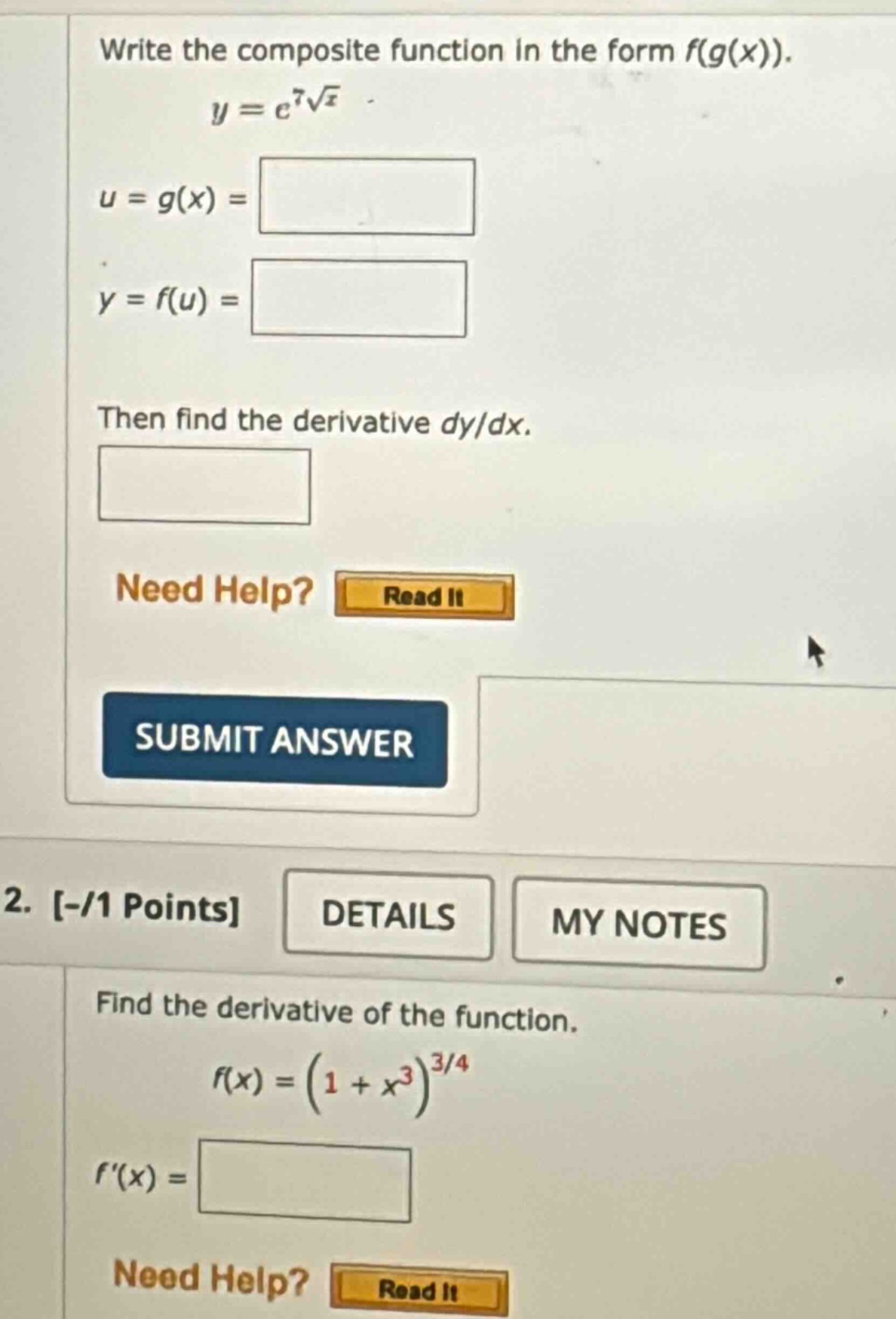
write the composite function in the form f(g(x)). y = e^7√x. u = g(x) = blank y = f(u) = blank then find the derivative dy/dx. blank need help? read it submit answer 2. -/1 points details my notes find the derivative of the function. f(x) = (1 + x^3)^3/4 f(x) = blank need help? read it
Answer
Explanation:
Step1: Identify inner - outer functions for $y = e^{7\sqrt{x}}$
Let $u = g(x)=7\sqrt{x}=7x^{\frac{1}{2}}$, and $y = f(u)=e^{u}$.
Step2: Find derivatives of $g(x)$ and $f(u)$
The derivative of $g(x)$ using the power rule $\frac{d}{dx}(ax^{n})=nax^{n - 1}$ is $g'(x)=\frac{7}{2}x^{-\frac{1}{2}}$. The derivative of $f(u)$ is $f'(u)=e^{u}$.
Step3: Apply chain - rule $\frac{dy}{dx}=f'(g(x))\cdot g'(x)$
Substitute $u = g(x)$ into $f'(u)$ and multiply by $g'(x)$. We get $\frac{dy}{dx}=e^{7\sqrt{x}}\cdot\frac{7}{2\sqrt{x}}$.
Step4: For $f(x)=(1 + x^{3})^{\frac{3}{4}}$
Let $u = g(x)=1 + x^{3}$, and $y = f(u)=u^{\frac{3}{4}}$.
Step5: Find derivatives of $g(x)$ and $f(u)$
$g'(x)=3x^{2}$, and $f'(u)=\frac{3}{4}u^{-\frac{1}{4}}$ using the power rule $\frac{d}{dx}(x^{n})=nx^{n - 1}$.
Step6: Apply chain - rule $\frac{dy}{dx}=f'(g(x))\cdot g'(x)$
Substitute $u = g(x)$ into $f'(u)$ and multiply by $g'(x)$. We have $f'(x)=\frac{3}{4}(1 + x^{3})^{-\frac{1}{4}}\cdot3x^{2}=\frac{9x^{2}}{4(1 + x^{3})^{\frac{1}{4}}}$.
Answer:
For $y = e^{7\sqrt{x}}$, $u = g(x)=7\sqrt{x}$, $y = f(u)=e^{u}$, $\frac{dy}{dx}=\frac{7e^{7\sqrt{x}}}{2\sqrt{x}}$ For $f(x)=(1 + x^{3})^{\frac{3}{4}}$, $f'(x)=\frac{9x^{2}}{4(1 + x^{3})^{\frac{1}{4}}}$