write the domain and range of the function using interval notation. then analyze the intercepts and…
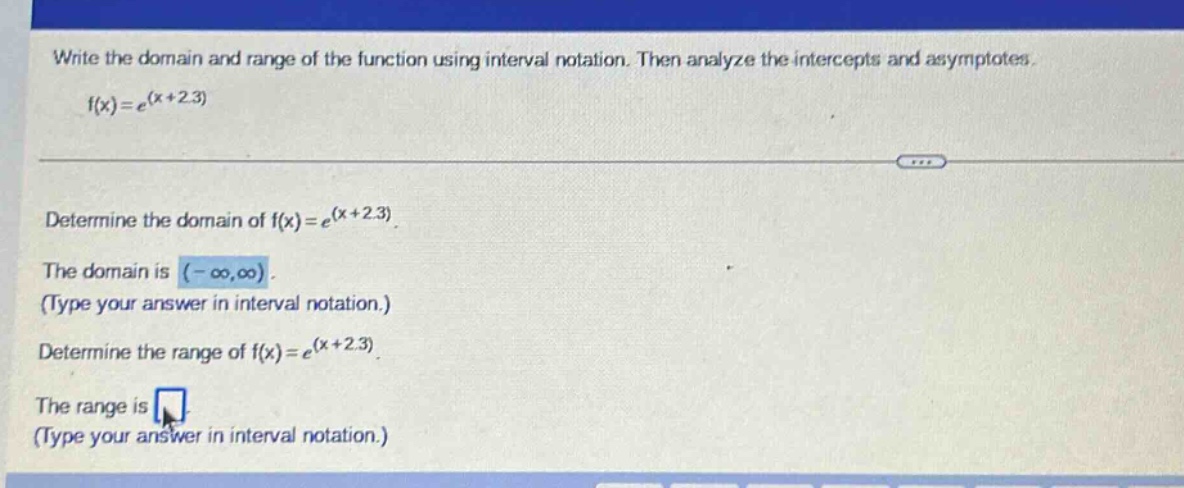
write the domain and range of the function using interval notation. then analyze the intercepts and asymptotes. f(x)=e^(x + 2.3) determine the domain of f(x)=e^(x + 2.3). the domain is (-∞,∞). (type your answer in interval notation.) determine the range of f(x)=e^(x + 2.3). the range is (type your answer in interval notation.)
Answer
Explanation:
Step1: Recall the property of exponential function
The exponential function $y = e^u$ where $u=x + 2.3$ has the property that $e^u>0$ for all real - valued $u$. Since $u=x + 2.3$ can take any real value (because $x\in(-\infty,\infty)$), the range of $y = e^{x + 2.3}$ is all positive real numbers.
Step2: Write the range in interval notation
The set of all positive real numbers in interval notation is $(0,\infty)$.
Answer:
$(0,\infty)$