write the domain and range of the function using interval notation. then analyze the - intercepts and…
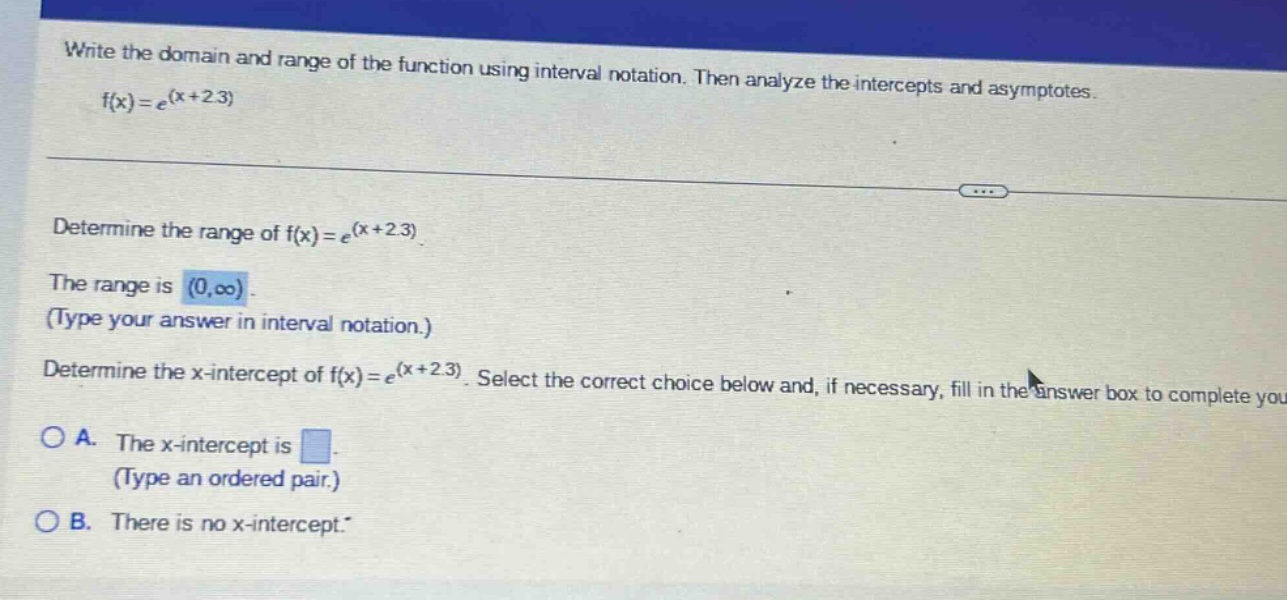
write the domain and range of the function using interval notation. then analyze the - intercepts and asymptotes. f(x)=e^(x + 2.3) determine the range of f(x)=e^(x + 2.3). the range is (0,oo). (type your answer in interval notation.) determine the x - intercept of f(x)=e^(x + 2.3). select the correct choice below and, if necessary, fill in the answer box to complete you a. the x - intercept is. (type an ordered pair.) b. there is no x - intercept.
Answer
Explanation:
Step1: Recall the property of exponential - functions
The exponential function (y = e^{u}), where (u=x + 2.3), has a domain of all real numbers for (x) since we can substitute any real - number value for (x) into the function (f(x)=e^{x + 2.3}). So, the domain of (f(x)) is ((-\infty,\infty)).
Step2: Analyze the range of the exponential function
The exponential function (y = e^{u}) always has positive output values. That is, (e^{u}>0) for all real values of (u). Since (u=x + 2.3) and (x\in(-\infty,\infty)), the range of (y = e^{x + 2.3}) is ((0,\infty)).
Step3: Find the x - intercept
The x - intercept is found by setting (y = f(x)=0). So, we set (e^{x + 2.3}=0). But the exponential function (y = e^{u}) is never equal to zero for any real value of (u) (because the graph of (y = e^{u}) is always above the x - axis). So, there is no x - intercept.
Answer:
Domain: ((-\infty,\infty)) Range: ((0,\infty)) x - intercept: B. There is no x - intercept.