write the domain and range of the function using interval notation. then analyze the inte f(x)=e^x - 8 - 1…
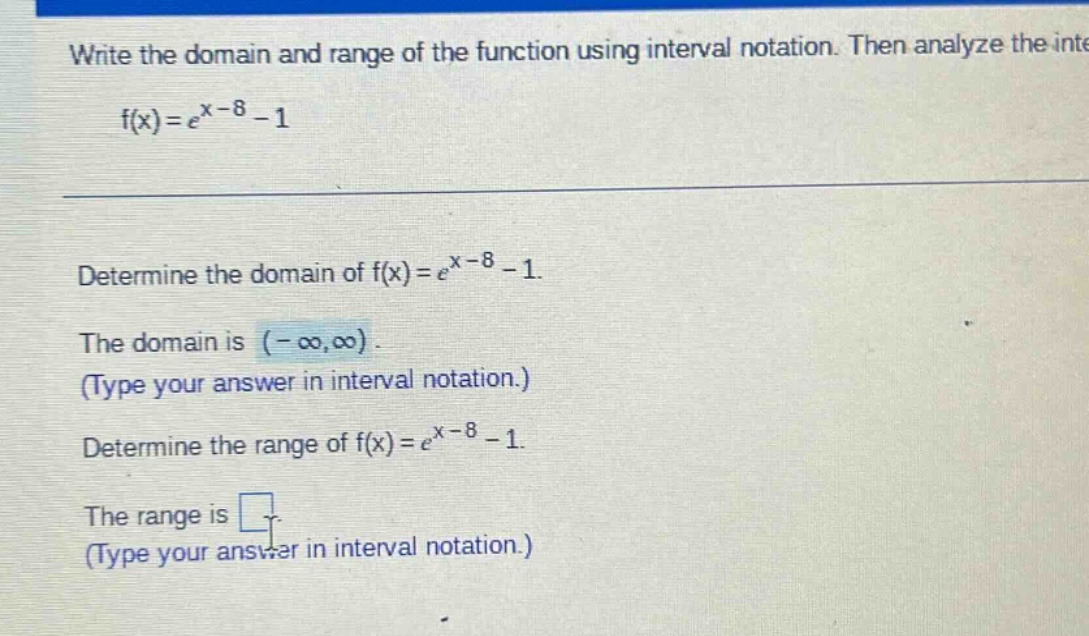
write the domain and range of the function using interval notation. then analyze the inte f(x)=e^x - 8 - 1 determine the domain of f(x)=e^x - 8 - 1. the domain is (-∞,∞). (type your answer in interval notation.) determine the range of f(x)=e^x - 8 - 1. the range is . (type your answer in interval notation.)
Answer
Explanation:
Step1: Recall property of exponential function
The exponential function $y = e^{u}$ has a range of $(0,+\infty)$ for any real - valued $u$. In the function $f(x)=e^{x - 8}-1$, let $u=x - 8$. Since $x\in(-\infty,\infty)$, then $u=x - 8\in(-\infty,\infty)$.
Step2: Find the range of $e^{x - 8}$
The function $y = e^{x - 8}$ has a range of $(0,+\infty)$ because the exponential function $y = e^{u}$ with $u=x - 8$ and $u\in(-\infty,\infty)$ always gives positive values.
Step3: Find the range of $e^{x - 8}-1$
If $y = e^{x - 8}$ has a range of $(0,+\infty)$, then for $f(x)=e^{x - 8}-1$, we subtract 1 from each value in the range of $e^{x - 8}$. Let $z = e^{x - 8}-1$. When $z$ is obtained by subtracting 1 from values in $(0,+\infty)$, we get $z\in(-1,+\infty)$.
Answer:
$(-1,+\infty)$