write an equation of the form ( y = a sin bx ) or ( y = a cos bx ) to describe the graph below.
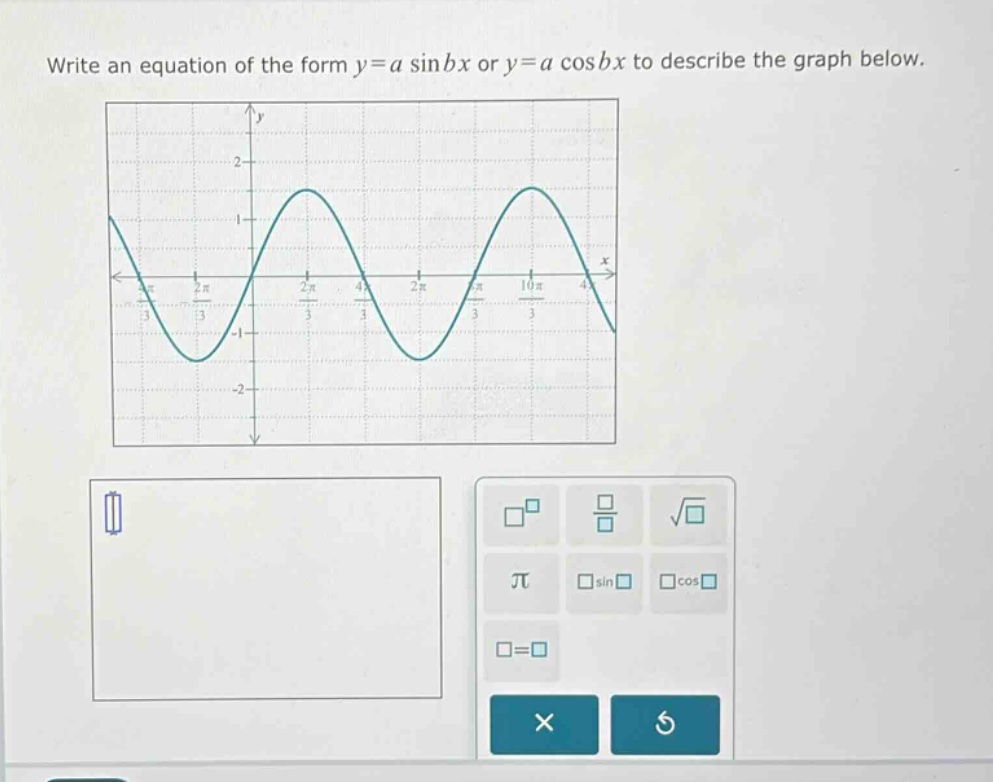
write an equation of the form ( y = a sin bx ) or ( y = a cos bx ) to describe the graph below.
Answer
Explanation:
Step1: Determine the amplitude (a)
The amplitude (a) is the maximum value of the function. From the graph, the maximum value is (1.5) and the minimum is (-1.5). So, (a = 1.5=\frac{3}{2})
Step2: Determine the period (T) and (b)
The period (T) of a sine or cosine function (y = a\sin(bx)) or (y=a\cos(bx)) is given by (T=\frac{2\pi}{b}). From the graph, the period (T = 4\pi). Using the formula (T=\frac{2\pi}{b}), we substitute (T = 4\pi) [4\pi=\frac{2\pi}{b}] Solve for (b): Multiply both sides by (b): (4\pi b=2\pi) Divide both sides by (4\pi): (b=\frac{2\pi}{4\pi}=\frac{1}{2})
Step3: Determine the function type
Since the graph passes through the origin ((0,0)), we use the sine - function (because (y = a\cos(bx)) has a (y) - intercept of (a) when (x = 0), and (y=a\sin(bx)) has a (y) - intercept of (0) when (x = 0))
Answer:
(y=\frac{3}{2}\sin\left(\frac{1}{2}x\right))