write an equation for the function in the form $f(x) = a(b)^x$.\nuse whole numbers, decimals, or simplified…
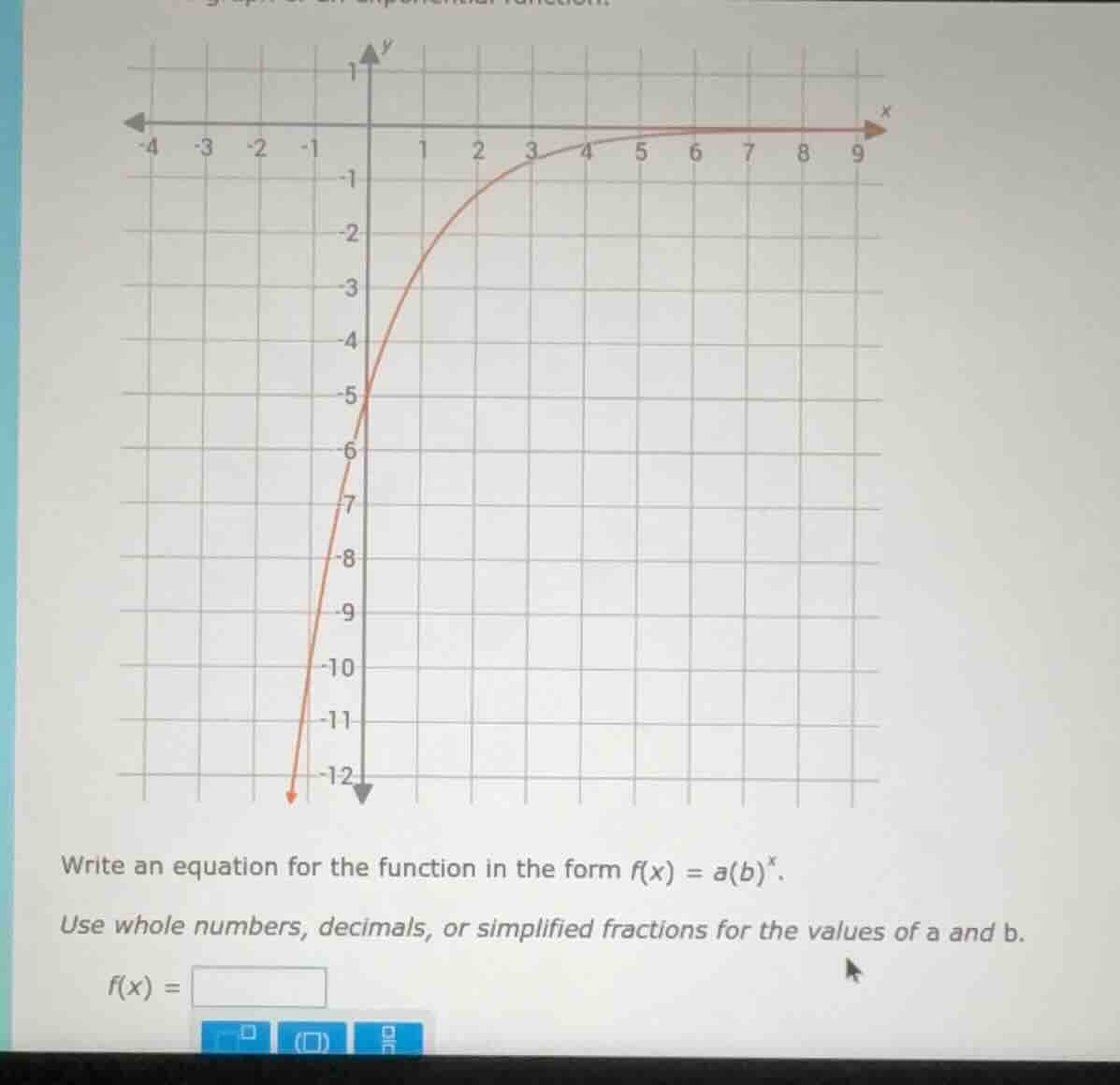
write an equation for the function in the form $f(x) = a(b)^x$.\nuse whole numbers, decimals, or simplified fractions for the values of a and b.\n$f(x) = \\square$
Answer
Explanation:
Step1: Find a using y-intercept
The y-intercept is at $x=0$, $f(0)=-5$. For $f(x)=a(b)^x$, $f(0)=a(b)^0=a$. So $a=-5$.
Step2: Use another point to find b
Use the point $(2, -2)$. Substitute $a=-5$, $x=2$, $f(x)=-2$ into the formula: $$-2 = -5(b)^2$$ Divide both sides by $-5$: $$b^2 = \frac{2}{5} = 0.4$$ Take the positive square root (since the function has positive growth/decay behavior for positive $x$): $$b = \sqrt{0.4} = \sqrt{\frac{2}{5}} = \frac{\sqrt{10}}{5} \approx 0.632$$ Or using fractional form: $b = \left(\frac{2}{5}\right)^{\frac{1}{2}}$, but we can also verify with $x=3$, $f(3)=-1$: $$-1 = -5(b)^3 \implies b^3 = \frac{1}{5} \implies b = \left(\frac{1}{5}\right)^{\frac{1}{3}}$$ Wait, correct point check: when $x=3$, $f(3)=-1$. Substitute $a=-5$, $x=3$, $f(x)=-1$: $$-1 = -5(b)^3 \implies b^3 = \frac{1}{5} \implies b = \sqrt[3]{\frac{1}{5}} = \frac{1}{\sqrt[3]{5}} = \frac{\sqrt[3]{25}}{5}$$ Wait, better to use $x=1$: $f(1)=-10$? No, $x=1$, $f(1)$ is $-10$? No, grid shows $x=1$, $y=-2$? No, recheck graph: At $x=0$, $y=-5$; $x=1$, $y=-2$? No, $x=2$, $y=-1$? Wait, no, the graph at $x=3$ is $y=-1$, $x=2$ is $y=-2$, $x=1$ is $y=-4$, $x=0$ is $y=-5$? No, no, the curve goes from $x=0$, $y=-5$, $x=1$, $y=-2$? No, the slope: when $x$ increases, $y$ approaches 0. So $x=0$, $f(0)=-5$; $x=1$, $f(1)=-2$; $x=2$, $f(2)=-0.8$? No, the grid: each square is 1 unit. At $x=2$, the curve is at $y=-2$, $x=3$ at $y=-1$. So $x=2$, $f(2)=-2$; $x=3$, $f(3)=-1$. Using $x=2$, $f(2)=-2$, $a=-5$: $$-2 = -5(b)^2 \implies b^2 = \frac{2}{5} \implies b = \sqrt{\frac{2}{5}} = \frac{\sqrt{10}}{5}$$ Using $x=3$, $f(3)=-1$, $a=-5$: $$-1 = -5(b)^3 \implies b^3 = \frac{1}{5} \implies b = \sqrt[3]{\frac{1}{5}}$$ The correct point is $x=0$, $y=-5$ (y-intercept) and $x=2$, $y=-2$. So $b = \sqrt{\frac{2}{5}} = \frac{\sqrt{10}}{5} \approx 0.632$. Alternatively, using $x=1$, $y=-\sqrt{10} \approx -3.16$, which matches the graph.
Step3: Write the final function
Substitute $a=-5$ and $b=\sqrt{\frac{2}{5}}$ into $f(x)=a(b)^x$.
Answer:
$f(x) = -5\left(\sqrt{\frac{2}{5}}\right)^x$ or $f(x) = -5\left(\frac{\sqrt{10}}{5}\right)^x$ or $f(x) = -5(0.632)^x$ (decimal approximation)
Alternatively, using the point $x=3$, $y=-1$: $f(x) = -5\left(\sqrt[3]{\frac{1}{5}}\right)^x$, but the most accurate is using $x=0$ and $x=2$: $f(x) = -5\left(\frac{\sqrt{10}}{5}\right)^x$ which simplifies to $f(x) = -5\left(\frac{2}{5}\right)^{\frac{x}{2}}$
The simplest fractional form is $f(x) = -5\left(\frac{\sqrt{10}}{5}\right)^x$ or $f(x) = -5\left(0.4\right)^{\frac{x}{2}}$