a. write the equation of the line that represents the linear approximation to the following function at the…
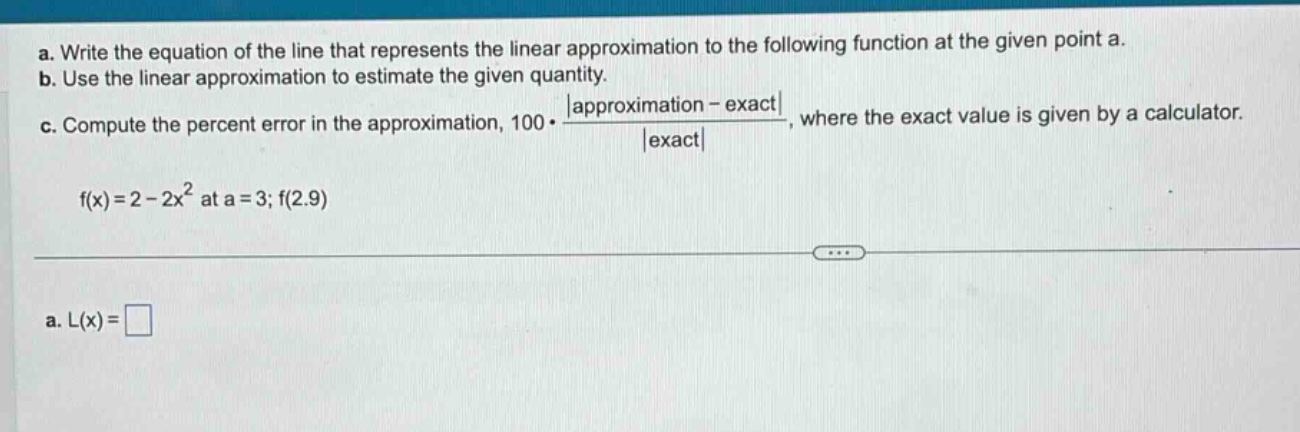
a. write the equation of the line that represents the linear approximation to the following function at the given point a. b. use the linear approximation to estimate the given quantity. c. compute the percent error in the approximation, 100·|approximation - exact|/|exact|, where the exact value is given by a calculator. f(x)=2 - 2x² at a = 3; f(2.9) a. l(x)=
Answer
Explanation:
Step1: Find the derivative of the function
The function is $f(x)=2 - 2x^{2}$. Using the power - rule $(x^n)'=nx^{n - 1}$, we have $f'(x)=-4x$.
Step2: Evaluate $f(a)$ and $f'(a)$
Given $a = 3$, then $f(3)=2-2\times3^{2}=2 - 18=-16$ and $f'(3)=-4\times3=-12$.
Step3: Write the linear approximation formula
The linear approximation formula is $L(x)=f(a)+f'(a)(x - a)$. Substituting $a = 3$, $f(3)=-16$ and $f'(3)=-12$ into the formula, we get $L(x)=-16-12(x - 3)$.
Step4: Simplify the linear - approximation formula
$L(x)=-16-12x + 36=-12x+20$.
Answer:
$L(x)=-12x + 20$