write the equation of the trigonometric function shown in the graph. try fractional values or $pi$ for the…
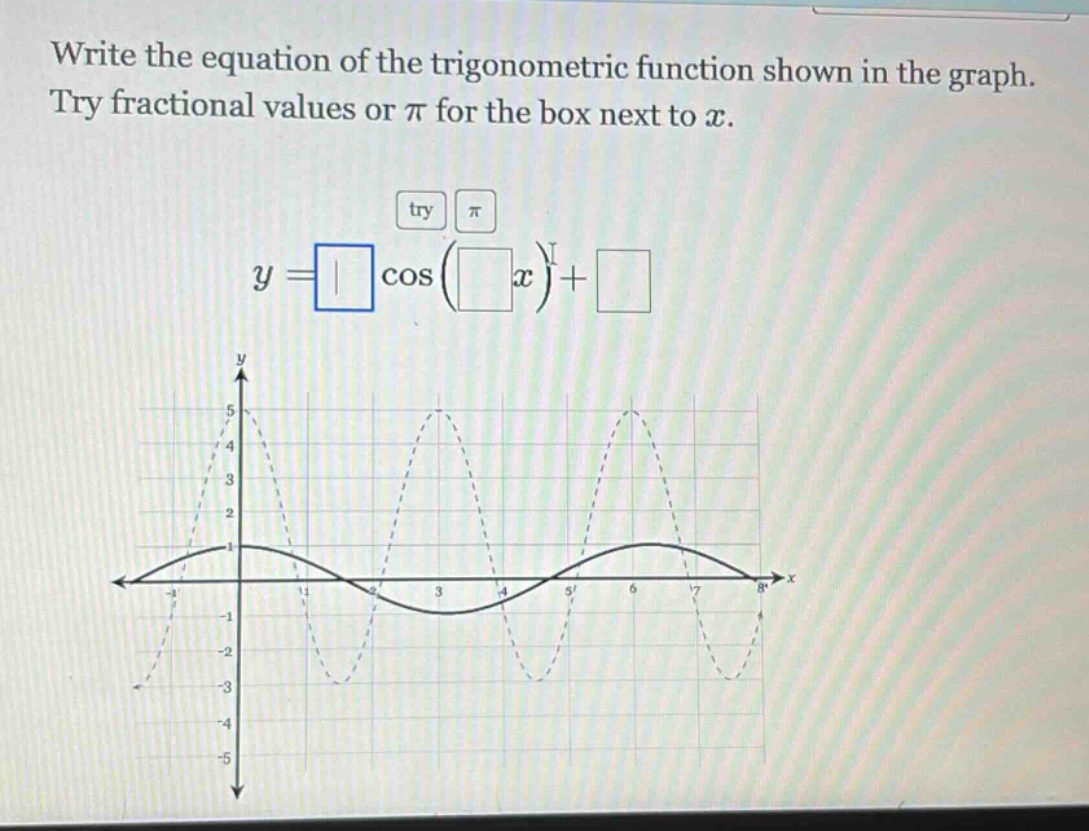
write the equation of the trigonometric function shown in the graph. try fractional values or $pi$ for the box next to $x$.\n$y=squarecos(square x)+square$
Answer
Explanation:
Step1: Determine the amplitude
The amplitude $A$ of a cosine - function $y = A\cos(Bx)+C$ is half the distance between the maximum and minimum values of the function. The maximum value of the function is $y = 5$ and the minimum value is $y=- 3$. So, $A=\frac{5 - (-3)}{2}=\frac{8}{2}=4$.
Step2: Determine the vertical shift
The vertical shift $C$ is the mid - value between the maximum and minimum values. $C=\frac{5+( - 3)}{2}=\frac{2}{2}=1$.
Step3: Determine the period
The period $T$ of a cosine function $y = A\cos(Bx)+C$ is the distance between two consecutive maxima or minima. From the graph, the period $T = 4$. The formula for the period of a cosine function is $T=\frac{2\pi}{B}$. Since $T = 4$, we have $4=\frac{2\pi}{B}$, then $B=\frac{\pi}{2}$.
Answer:
$y = 4\cos\left(\frac{\pi}{2}x\right)+1$