write the equation of the trigonometric function shown in the graph. try whole numbers or unit fractions for…
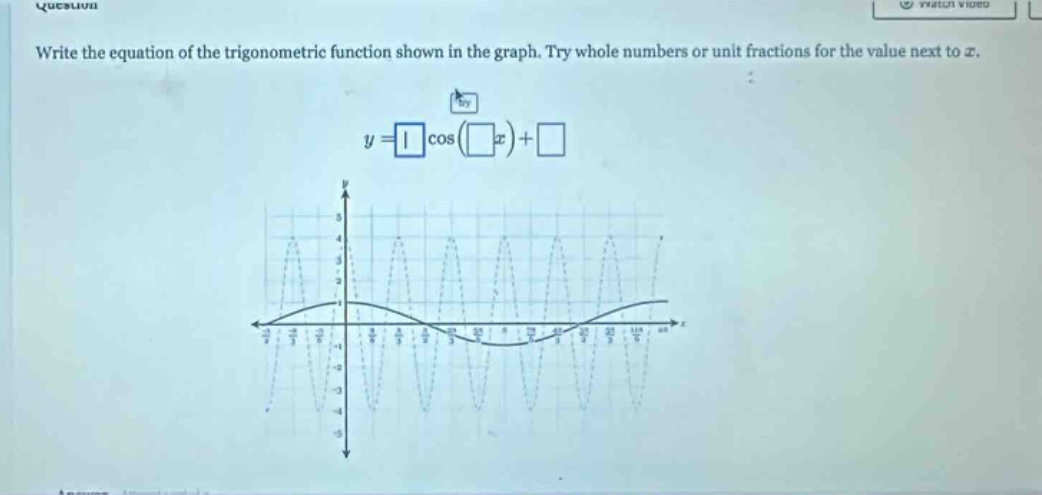
write the equation of the trigonometric function shown in the graph. try whole numbers or unit fractions for the value next to x.\n$y=squarecos(square x)+square$
Answer
Explanation:
Step1: Determine the amplitude
The amplitude $A$ of a cosine - function $y = A\cos(Bx)+C$ is half the distance between the maximum and minimum values of the function. The maximum value of the given function is $4$ and the minimum is $0$. So, $A=\frac{4 - 0}{2}=2$.
Step2: Determine the period
The period $T$ of a cosine - function $y = A\cos(Bx)+C$ is given by $T=\frac{2\pi}{B}$. From the graph, the period $T = 1$. So, $1=\frac{2\pi}{B}$, and solving for $B$ gives $B = 2\pi$.
Step3: Determine the vertical shift
The vertical shift $C$ of a cosine - function $y = A\cos(Bx)+C$ is the mid - value between the maximum and minimum values. The mid - value between $4$ and $0$ is $\frac{4 + 0}{2}=2$.
Answer:
$y = 2\cos(2\pi x)+2$