write the equation of the trigonometric graph. use a positive coefficient on cosine for this activity. y = □…
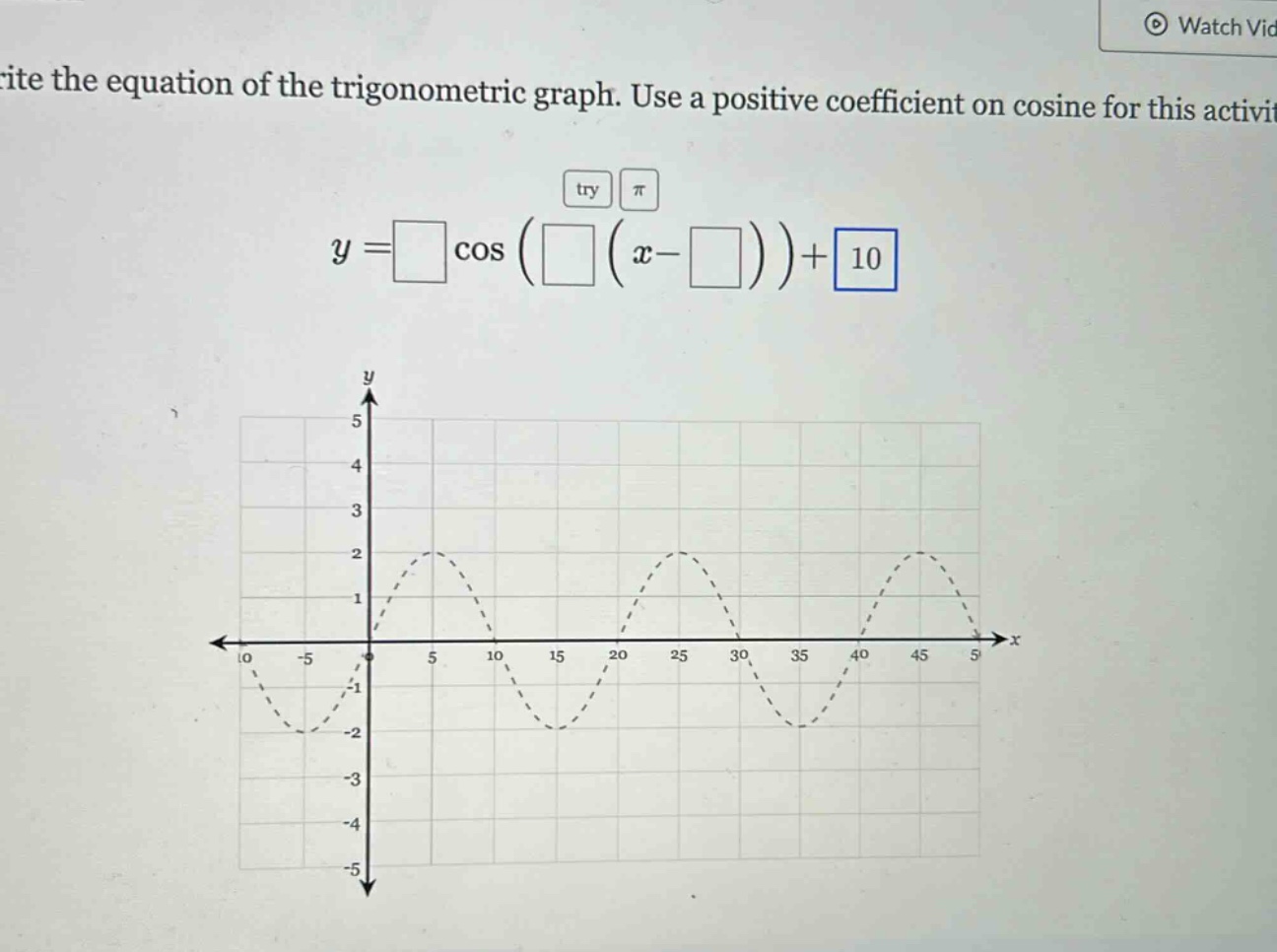
write the equation of the trigonometric graph. use a positive coefficient on cosine for this activity. y = □ cos ( □ ( x - □ ) ) + 10
Answer
Explanation:
Step1: Determine the amplitude
The amplitude $A$ is half the vertical distance between the maximum and minimum values. The maximum value is $y = 2$ and the minimum is $y=- 2$. So, $A=\frac{2 - (-2)}{2}=2$.
Step2: Determine the period
The period $T$ is the horizontal distance between two consecutive maxima or minima. From the graph, $T = 20$. The formula for the period of $y = A\cos(B(x - C))+D$ is $T=\frac{2\pi}{B}$. Solving for $B$: $B=\frac{2\pi}{T}=\frac{2\pi}{20}=\frac{\pi}{10}$.
Step3: Determine the phase - shift
The graph of $y = \cos x$ has a maximum at $x = 0$. The given cosine - type graph has a maximum at $x = 5$. So the phase - shift $C = 5$.
Step4: Determine the vertical shift
The mid - line of the graph is $y = 0$. In the general form $y=A\cos(B(x - C))+D$, the vertical shift $D$ is the $y$ - value of the mid - line. Here, the equation is given with $D = 10$.
Answer:
$y = 2\cos\left(\frac{\pi}{10}(x - 5)\right)+10$