write the 4 equivalent trigonometric functions using the 4 starting points. (-2,2) (0.5,3) (3.5,3) (2,-2) a…
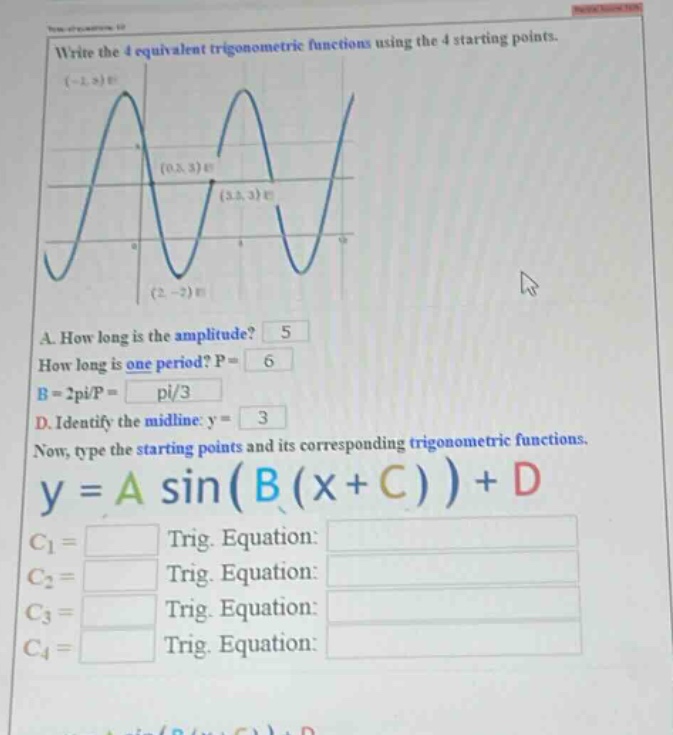
write the 4 equivalent trigonometric functions using the 4 starting points. (-2,2) (0.5,3) (3.5,3) (2,-2) a. how long is the amplitude? 5 how long is one period? p = 6 b = 2pi/p = pi/3 d. identify the midline: y = 3 now, type the starting points and its corresponding trigonometric functions. y = a sin(b(x + c))+d c1 = trig. equation: c2 = trig. equation: c3 = trig. equation: c4 = trig. equation:
Answer
Explanation:
Step1: Recall the general sine - function formula
The general form of a sine - function is $y = A\sin(B(x + C))+D$, where $A$ is the amplitude, $B=\frac{2\pi}{P}$ ($P$ is the period), $C$ is the phase - shift, and $D$ is the mid - line. We are given that $A = 5$, $B=\frac{\pi}{3}$, and $D = 3$.
Step2: For the point $(-2,8)$
Substitute $x=-2$ and $y = 8$ into $y = A\sin(B(x + C))+D$. $8=5\sin(\frac{\pi}{3}(-2 + C))+3$. First, subtract 3 from both sides: $5 = 5\sin(\frac{\pi}{3}(-2 + C))$. Then $\sin(\frac{\pi}{3}(-2 + C)) = 1$. We know that $\sin\theta=1$ when $\theta=\frac{\pi}{2}+2k\pi,k\in\mathbb{Z}$. So $\frac{\pi}{3}(-2 + C)=\frac{\pi}{2}+2k\pi$. Multiply both sides by $\frac{3}{\pi}$: $-2 + C=\frac{3}{2}+6k$. Let $k = 0$, then $C=\frac{3}{2}+2=\frac{7}{2}$. The trigonometric equation for the starting - point $(-2,8)$ is $y = 5\sin(\frac{\pi}{3}(x+\frac{7}{2}))+3$.
Step3: For the point $(0.5,3)$
Substitute $x = 0.5$ and $y = 3$ into $y = A\sin(B(x + C))+D$. $3=5\sin(\frac{\pi}{3}(0.5 + C))+3$. Subtract 3 from both sides: $0 = 5\sin(\frac{\pi}{3}(0.5 + C))$. Then $\sin(\frac{\pi}{3}(0.5 + C)) = 0$. We know that $\sin\theta=0$ when $\theta = k\pi,k\in\mathbb{Z}$. So $\frac{\pi}{3}(0.5 + C)=k\pi$. Let $k = 0$, then $0.5 + C = 0$, and $C=-0.5$. The trigonometric equation for the starting - point $(0.5,3)$ is $y = 5\sin(\frac{\pi}{3}(x - 0.5))+3$.
Step4: For the point $(3.5,3)$
Substitute $x = 3.5$ and $y = 3$ into $y = A\sin(B(x + C))+D$. $3=5\sin(\frac{\pi}{3}(3.5 + C))+3$. Subtract 3 from both sides: $0 = 5\sin(\frac{\pi}{3}(3.5 + C))$. Then $\sin(\frac{\pi}{3}(3.5 + C)) = 0$. We know that $\sin\theta=0$ when $\theta = k\pi,k\in\mathbb{Z}$. So $\frac{\pi}{3}(3.5 + C)=k\pi$. Let $k = 1$, then $3.5 + C = 3$, and $C=-0.5$. The trigonometric equation for the starting - point $(3.5,3)$ is $y = 5\sin(\frac{\pi}{3}(x - 0.5))+3$.
Step5: For the point $(2,-2)$
Substitute $x = 2$ and $y=-2$ into $y = A\sin(B(x + C))+D$. $-2=5\sin(\frac{\pi}{3}(2 + C))+3$. Subtract 3 from both sides: $-5 = 5\sin(\frac{\pi}{3}(2 + C))$. Then $\sin(\frac{\pi}{3}(2 + C))=-1$. We know that $\sin\theta=-1$ when $\theta=\frac{3\pi}{2}+2k\pi,k\in\mathbb{Z}$. So $\frac{\pi}{3}(2 + C)=\frac{3\pi}{2}+2k\pi$. Multiply both sides by $\frac{3}{\pi}$: $2 + C=\frac{9}{2}+6k$. Let $k = 0$, then $C=\frac{9}{2}-2=\frac{5}{2}$. The trigonometric equation for the starting - point $(2,-2)$ is $y = 5\sin(\frac{\pi}{3}(x+\frac{5}{2}))+3$.
Answer:
$C_1=\frac{7}{2}$, Trig. Equation: $y = 5\sin(\frac{\pi}{3}(x+\frac{7}{2}))+3$ $C_2=-0.5$, Trig. Equation: $y = 5\sin(\frac{\pi}{3}(x - 0.5))+3$ $C_3=-0.5$, Trig. Equation: $y = 5\sin(\frac{\pi}{3}(x - 0.5))+3$ $C_4=\frac{5}{2}$, Trig. Equation: $y = 5\sin(\frac{\pi}{3}(x+\frac{5}{2}))+3$