write out the first few terms of the series ∑(n = 0 to ∞) ((-1)^n / 12^n). what is the series sum? the first…
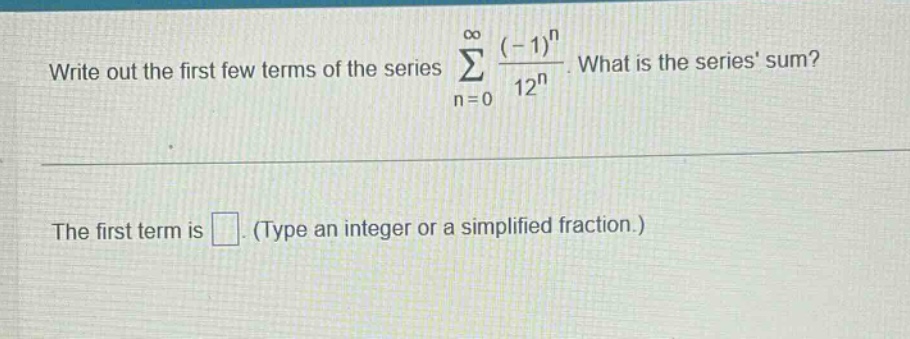
write out the first few terms of the series ∑(n = 0 to ∞) ((-1)^n / 12^n). what is the series sum? the first term is. (type an integer or a simplified fraction.)
Answer
Explanation:
Step1: Find the first - term
When (n = 0), substitute (n) into the series (\sum_{n = 0}^{\infty}\frac{(-1)^{n}}{12^{n}}). Using the formula (a_{n}=\frac{(-1)^{n}}{12^{n}}), when (n = 0), we have (a_{0}=\frac{(-1)^{0}}{12^{0}}). Since any non - zero number to the power of (0) is (1) ((a^{0}=1,a\neq0)), then ((-1)^{0}=1) and (12^{0}=1), so (a_{0}=\frac{1}{1}=1).
Step2: Identify the series type
The series (\sum_{n = 0}^{\infty}\frac{(-1)^{n}}{12^{n}}=\sum_{n = 0}^{\infty}(-\frac{1}{12})^{n}) is a geometric series with the general form (\sum_{n = 0}^{\infty}ar^{n}), where (a = 1) (the first - term) and (r=-\frac{1}{12}).
Step3: Use the sum formula for a geometric series
The sum formula for an infinite geometric series is (S=\frac{a}{1 - r}) when (|r|\lt1). Here, (a = 1) and (r=-\frac{1}{12}), and (|r|=\left|-\frac{1}{12}\right|=\frac{1}{12}\lt1). Substitute (a = 1) and (r =-\frac{1}{12}) into the formula: (S=\frac{1}{1-(-\frac{1}{12})}=\frac{1}{1 + \frac{1}{12}}=\frac{1}{\frac{12 + 1}{12}}=\frac{12}{13}).
Answer:
The first term is (1). The sum of the series is (\frac{12}{13}).