write an integral that represents the area of the shaded region of the figure. do not evaluate the…
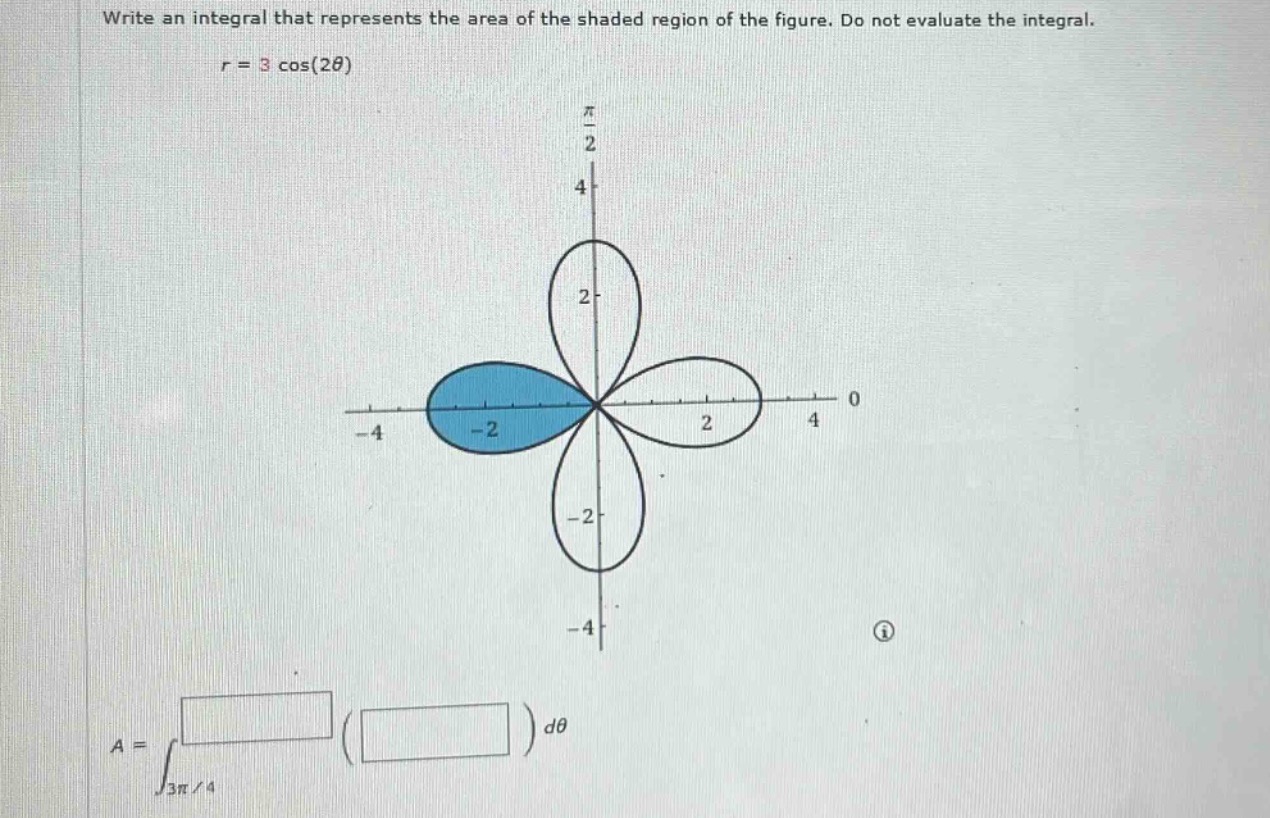
write an integral that represents the area of the shaded region of the figure. do not evaluate the integral.\n$r = 3\\cos(2\\theta)$\n$a=int_{3pi/4}( )d\\theta$
Answer
Explanation:
Step1: Recall area formula in polar coordinates
The area $A$ of a polar - curve $r = f(\theta)$ is given by $A=\frac{1}{2}\int_{\alpha}^{\beta}r^{2}d\theta$.
Step2: Determine the limits of integration
For the polar curve $r = 3\cos(2\theta)$, we want to find the limits of integration for the shaded region. The curve $r = 3\cos(2\theta)$ is a four - leaf rose. To find the limits for the left - hand leaf (the shaded region), we set $r = 0$. So, $3\cos(2\theta)=0$, which gives $2\theta=\pm\frac{\pi}{2}+2k\pi$, or $\theta=\pm\frac{\pi}{4}+k\pi$. For the left - hand leaf, the lower limit $\alpha=\frac{3\pi}{4}$ and the upper limit $\beta=\frac{5\pi}{4}$.
Step3: Substitute $r$ into the area formula
Since $r = 3\cos(2\theta)$, then $r^{2}=9\cos^{2}(2\theta)$. The area integral is $A=\frac{1}{2}\int_{\frac{3\pi}{4}}^{\frac{5\pi}{4}}(9\cos^{2}(2\theta))d\theta$.
Answer:
$\frac{1}{2}\int_{\frac{3\pi}{4}}^{\frac{5\pi}{4}}(9\cos^{2}(2\theta))d\theta$