xample 2. choosing a different center find the taylor series for f(x) = 1 / (1 - x) centered at 5, and then…
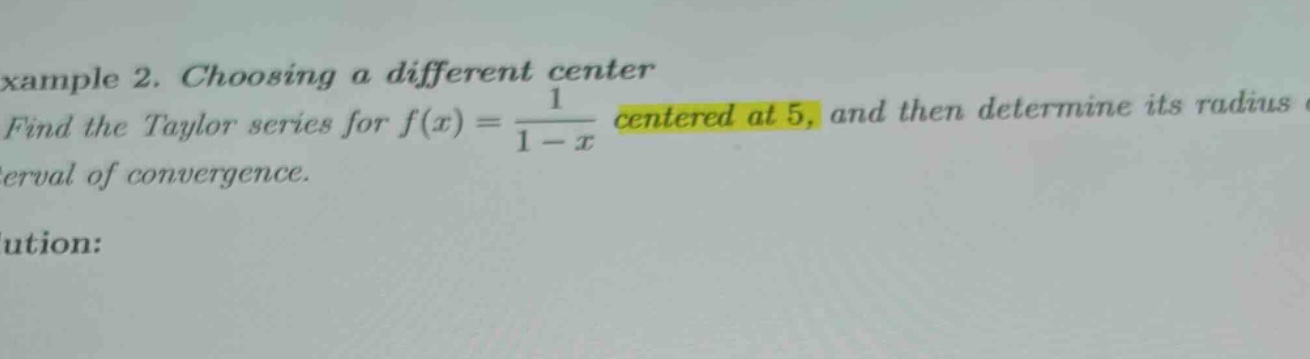
xample 2. choosing a different center find the taylor series for f(x) = 1 / (1 - x) centered at 5, and then determine its radius of convergence.
Answer
Explanation:
Step1: Recall Taylor - series formula
The Taylor series of a function $f(x)$ centered at $a$ is given by $f(x)=\sum_{n = 0}^{\infty}\frac{f^{(n)}(a)}{n!}(x - a)^n$. First, rewrite $f(x)=\frac{1}{1 - x}$ as $f(x)=\frac{1}{-4-(x - 5)}=-\frac{1}{4}\frac{1}{1+\frac{x - 5}{4}}$.
Step2: Use geometric - series formula
The geometric series formula is $\frac{1}{1 + t}=\sum_{n=0}^{\infty}(-t)^n$, for $|t|\lt1$. Let $t=\frac{x - 5}{4}$, then $f(x)=-\frac{1}{4}\sum_{n = 0}^{\infty}(-1)^n(\frac{x - 5}{4})^n=\sum_{n=0}^{\infty}\frac{(-1)^{n + 1}}{4^{n+1}}(x - 5)^n$.
Step3: Find radius of convergence
For the geometric series $\sum_{n=0}^{\infty}(-1)^n(\frac{x - 5}{4})^n$, we use the ratio - test. Let $a_n=\frac{(-1)^{n + 1}}{4^{n+1}}(x - 5)^n$. Then $\lim_{n\rightarrow\infty}\left|\frac{a_{n + 1}}{a_n}\right|=\lim_{n\rightarrow\infty}\left|\frac{\frac{(-1)^{n+2}}{4^{n + 2}}(x - 5)^{n+1}}{\frac{(-1)^{n + 1}}{4^{n+1}}(x - 5)^n}\right|=\lim_{n\rightarrow\infty}\left|\frac{x - 5}{4}\right|$. For convergence, $\lim_{n\rightarrow\infty}\left|\frac{x - 5}{4}\right|\lt1$, so $|x - 5|\lt4$.
Answer:
The Taylor series is $\sum_{n=0}^{\infty}\frac{(-1)^{n + 1}}{4^{n+1}}(x - 5)^n$ and the radius of convergence $R = 4$.