if f(x) = { e² + eˣ for 0 < x < 2; x²eˣ - xeˣ for 2 ≤ x < 8, then lim(x→2) f(x) is (a) 0 (b) e² (c) 2e² (d)…
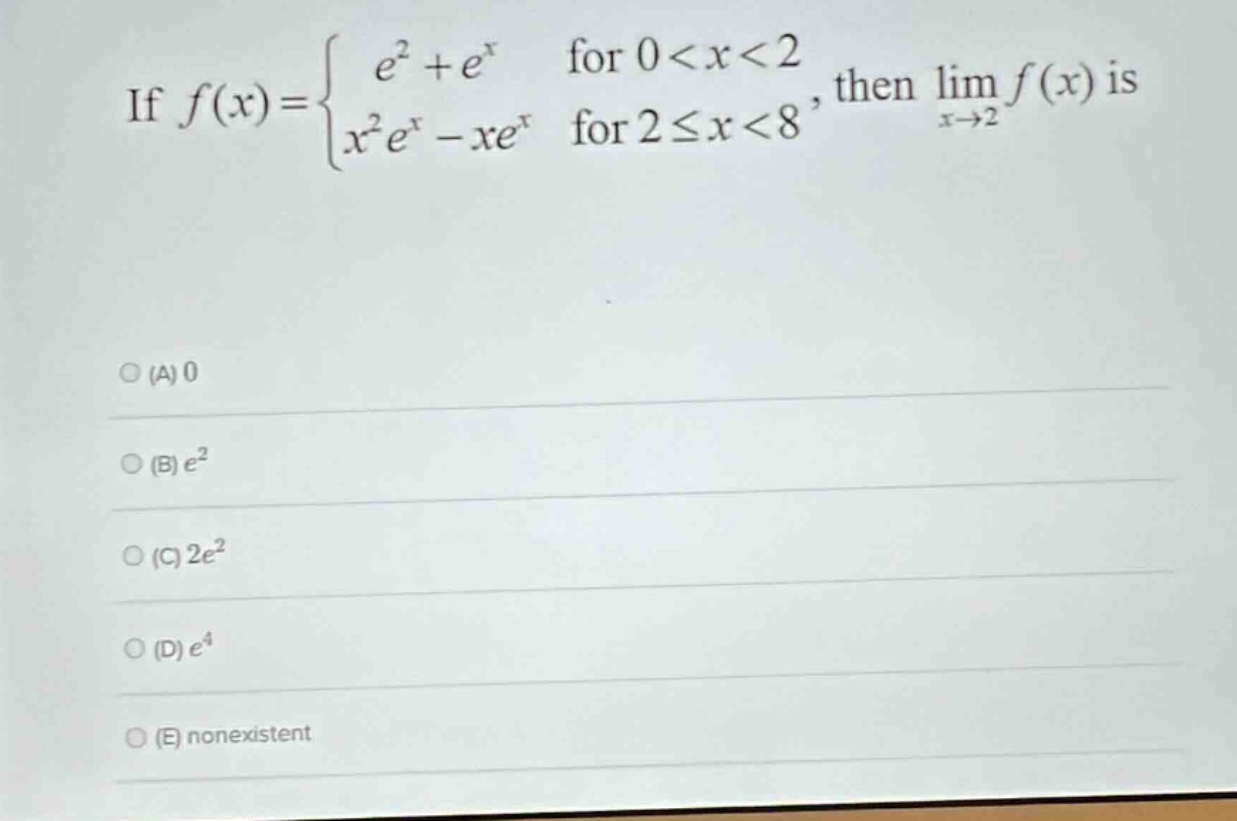
if f(x) = { e² + eˣ for 0 < x < 2; x²eˣ - xeˣ for 2 ≤ x < 8, then lim(x→2) f(x) is (a) 0 (b) e² (c) 2e² (d) e⁴ (e) nonexistent
Answer
Explanation:
Step1: Find left - hand limit
For (0 < x<2), (f(x)=e^{2}+e^{x}). Calculate (\lim_{x\rightarrow2^{-}}f(x)): (\lim_{x\rightarrow2^{-}}(e^{2}+e^{x})=e^{2}+e^{2}=2e^{2})
Step2: Find right - hand limit
For (2\leq x < 8), (f(x)=x^{2}e^{x}-xe^{x}). Calculate (\lim_{x\rightarrow2^{+}}f(x)): First, factor (f(x)=xe^{x}(x - 1)). Then (\lim_{x\rightarrow2^{+}}xe^{x}(x - 1)=2e^{2}(2 - 1)=2e^{2})
Step3: Determine the limit
Since (\lim_{x\rightarrow2^{-}}f(x)=\lim_{x\rightarrow2^{+}}f(x)=2e^{2}), (\lim_{x\rightarrow2}f(x)=2e^{2})
Answer:
C. (2e^{2})