2. in the xy - plane, the graph of which of the following functions has a vertical asymptote at x = π/2? a…
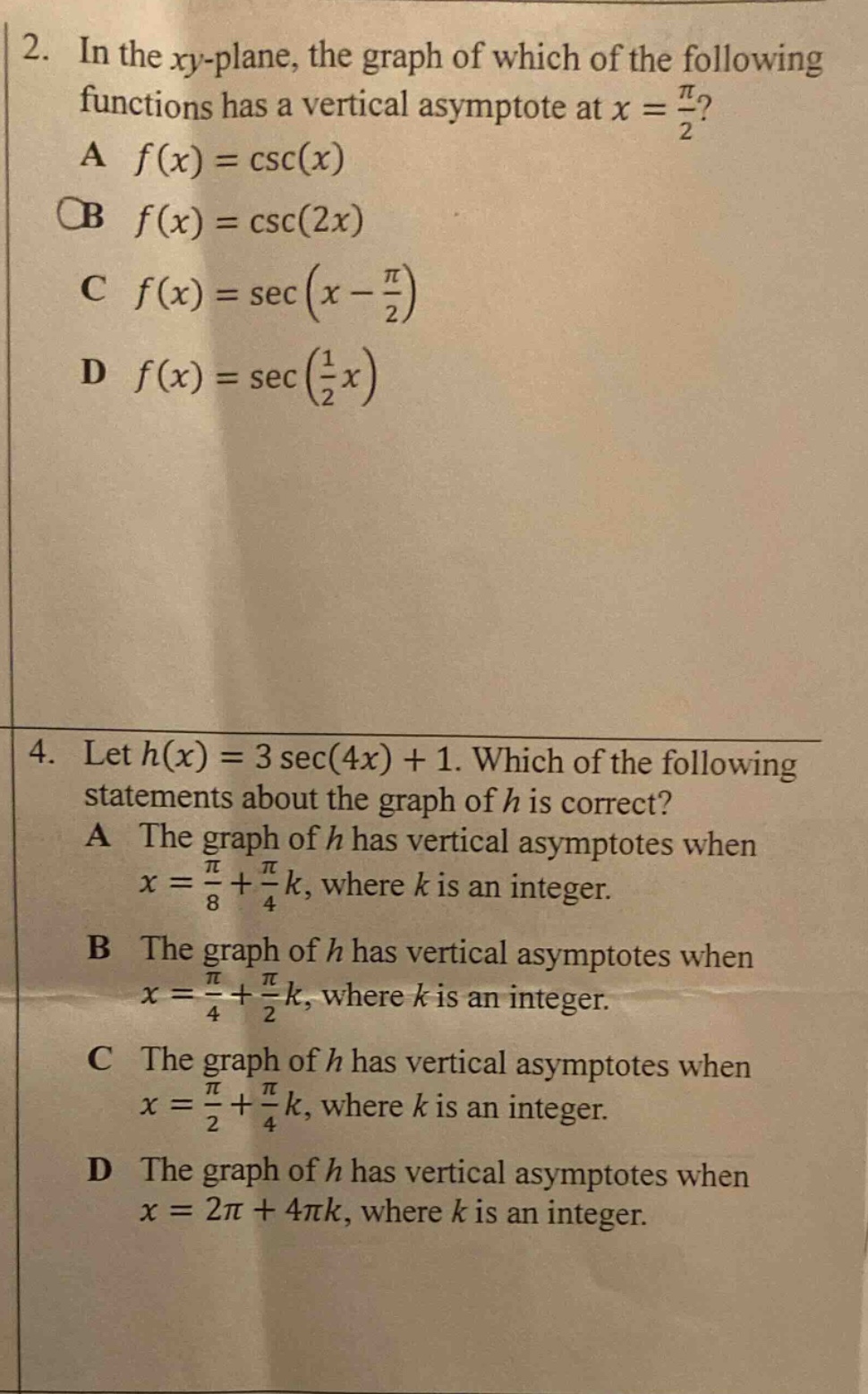
2. in the xy - plane, the graph of which of the following functions has a vertical asymptote at x = π/2? a f(x)=csc(x) b f(x)=csc(2x) c f(x)=sec(x - π/2) d f(x)=sec(1/2x) 4. let h(x)=3sec(4x)+1. which of the following statements about the graph of h is correct? a the graph of h has vertical asymptotes when x = π/8+π/4k, where k is an integer. b the graph of h has vertical asymptotes when x = π/4+π/2k, where k is an integer. c the graph of h has vertical asymptotes when x = π/2+π/4k, where k is an integer. d the graph of h has vertical asymptotes when x = 2π+4πk, where k is an integer.
Answer
Explanation:
Step1: Recall the definition of vertical - asymptote for trigonometric functions
Vertical asymptotes of (y = \csc(x)=\frac{1}{\sin(x)}) occur when (\sin(x)=0), and vertical asymptotes of (y=\sec(x)=\frac{1}{\cos(x)}) occur when (\cos(x) = 0).
Step2: Analyze option A for (y = \csc(x))
For (y=\csc(x)=\frac{1}{\sin(x)}), (\sin(x)=0) when (x = k\pi,k\in\mathbb{Z}). When (x=\frac{\pi}{2}), (\sin(\frac{\pi}{2}) = 1), so there is no vertical - asymptote at (x=\frac{\pi}{2}).
Step3: Analyze option B for (y=\csc(2x))
For (y = \csc(2x)=\frac{1}{\sin(2x)}), (\sin(2x)=0) when (2x=k\pi), or (x=\frac{k\pi}{2},k\in\mathbb{Z}). When (x = \frac{\pi}{2}), (\sin(2\times\frac{\pi}{2})=\sin(\pi)=0), but we want to check if it's the only relevant one.
Step4: Analyze option C for (y=\sec(x - \frac{\pi}{2}))
For (y=\sec(x-\frac{\pi}{2})=\frac{1}{\cos(x - \frac{\pi}{2})}), and we know that (\cos(x-\frac{\pi}{2})=\sin(x)). When (x=\frac{\pi}{2}), (\cos(\frac{\pi}{2}-\frac{\pi}{2})=\cos(0)=1), so there is no vertical - asymptote at (x=\frac{\pi}{2}).
Step5: Analyze option D for (y=\sec(\frac{1}{2}x))
For (y=\sec(\frac{1}{2}x)=\frac{1}{\cos(\frac{1}{2}x)}), (\cos(\frac{1}{2}x)=0) when (\frac{1}{2}x=(2k + 1)\frac{\pi}{2}), or (x=(2k + 1)\pi,k\in\mathbb{Z}). When (x=\frac{\pi}{2}), (\cos(\frac{1}{2}\times\frac{\pi}{2})=\cos(\frac{\pi}{4})=\frac{\sqrt{2}}{2}\neq0), so there is no vertical - asymptote at (x=\frac{\pi}{2}).
For the second question:
Step1: Recall the vertical - asymptote formula for (y = \sec(u))
The function (y=\sec(u)=\frac{1}{\cos(u)}) has vertical asymptotes when (\cos(u)=0). For (u = 4x), (\cos(4x)=0) when (4x=(2k + 1)\frac{\pi}{2},k\in\mathbb{Z}).
Step2: Solve for (x)
Solve the equation (4x=(2k + 1)\frac{\pi}{2}) for (x). Divide both sides by 4: (x=\frac{(2k + 1)\pi}{8}=\frac{\pi}{8}+\frac{\pi}{4}k,k\in\mathbb{Z}).
Answer:
- B
- A