o yes, it does not matter if f is continuous or differentiable; every function satisfies the mean value…
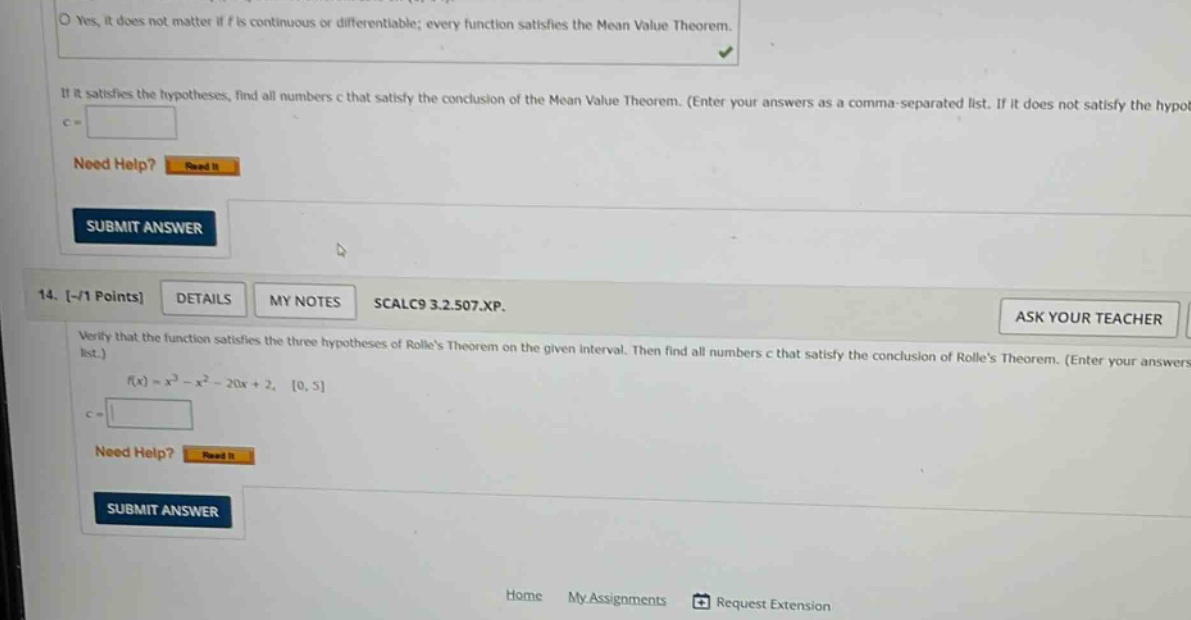
o yes, it does not matter if f is continuous or differentiable; every function satisfies the mean value theorem. if it satisfies the hypotheses, find all numbers c that satisfy the conclusion of the mean value theorem. (enter your answers as a comma - separated list. if it does not satisfy the hypo c = need help? read it submit answer 14. -/1 points details my notes scalc9 3.2.507.xp. ask your teacher verify that the function satisfies the three hypotheses of rolles theorem on the given interval. then find all numbers c that satisfy the conclusion of rolles theorem. (enter your answers list.) f(x)=x³ - x² - 20x + 2, 0, 5 c = need help? read it submit answer home my assignments request extension
Answer
Explanation:
Step1: Check Rolle's Theorem hypotheses
- Continuity: The function (f(x)=x^{3}-x^{2}-20x + 2) is a polynomial. Polynomials are continuous everywhere, so (f(x)) is continuous on the closed - interval ([0,5]).
- Differentiability: The derivative of (f(x)) is (f^\prime(x)=3x^{2}-2x - 20). Since (f^\prime(x)) exists for all real (x), (f(x)) is differentiable on the open - interval ((0,5)).
- (f(0)=f(5)):
- Calculate (f(0)): (f(0)=0^{3}-0^{2}-20\times0 + 2=2).
- Calculate (f(5)): (f(5)=5^{3}-5^{2}-20\times5 + 2=125 - 25-100 + 2=2). So (f(0)=f(5)).
Step2: Find (c) using (f^\prime(c)=0)
Set (f^\prime(c)=3c^{2}-2c - 20 = 0). Using the quadratic formula (c=\frac{-b\pm\sqrt{b^{2}-4ac}}{2a}) for the quadratic equation (ax^{2}+bx + c = 0) (here (a = 3), (b=-2), (c=-20)). [ \begin{align*} c&=\frac{2\pm\sqrt{(-2)^{2}-4\times3\times(-20)}}{2\times3}\ &=\frac{2\pm\sqrt{4 + 240}}{6}\ &=\frac{2\pm\sqrt{244}}{6}\ &=\frac{2\pm2\sqrt{61}}{6}\ &=\frac{1\pm\sqrt{61}}{3} \end{align*} ] We keep the value of (c) that lies in the interval ((0,5)). (c=\frac{1+\sqrt{61}}{3}\approx\frac{1 + 7.81}{3}=\frac{8.81}{3}\approx2.94\in(0,5)) and (c=\frac{1-\sqrt{61}}{3}\approx\frac{1 - 7.81}{3}\approx - 2.27\notin(0,5))
Answer:
(\frac{1 + \sqrt{61}}{3})