how do you compare the approximate rate of change of the function over the interval 250 < p < 500 with that…
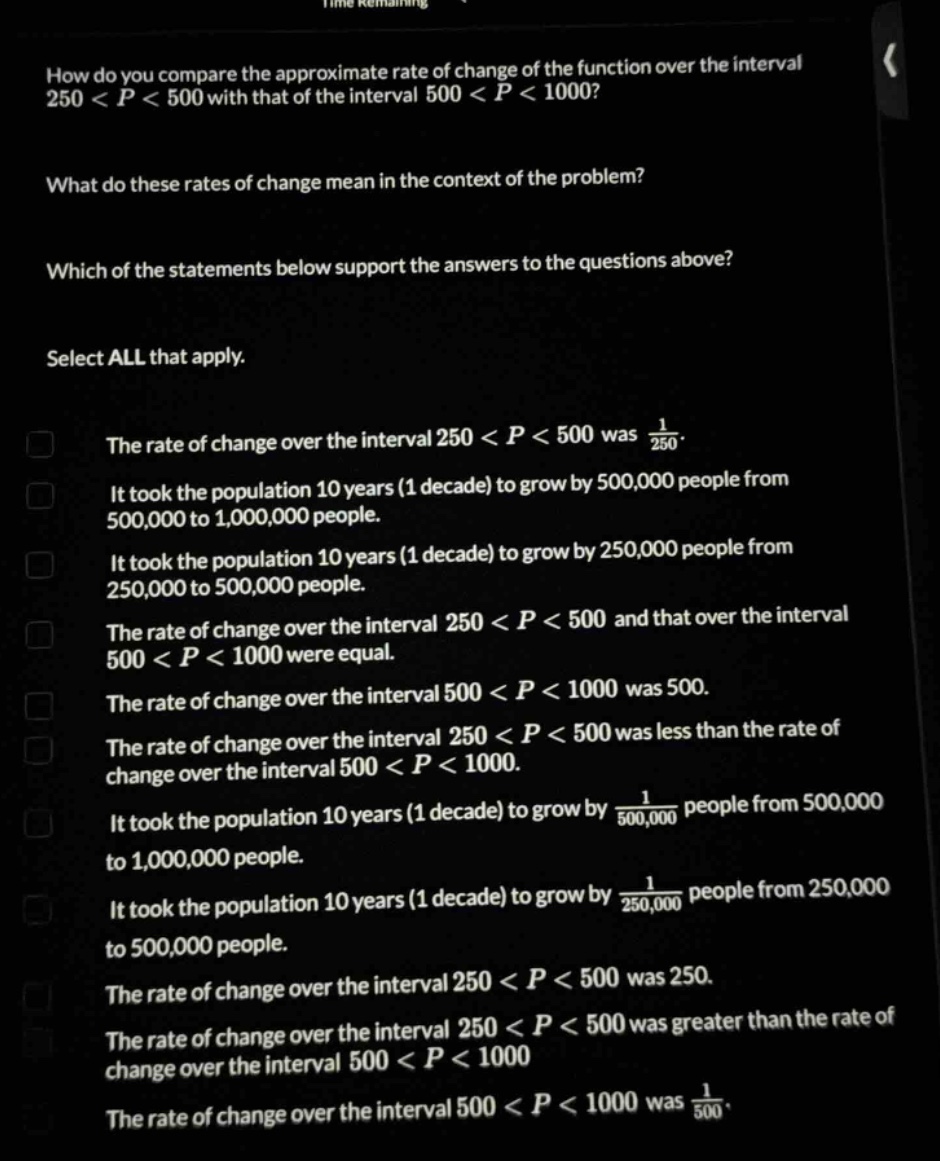
how do you compare the approximate rate of change of the function over the interval 250 < p < 500 with that of the interval 500 < p < 1000? what do these rates of change mean in the context of the problem? which of the statements below support the answers to the questions above? select all that apply. the rate of change over the interval 250 < p < 500 was 1/250. it took the population 10 years (1 decade) to grow by 500,000 people from 500,000 to 1,000,000 people. it took the population 10 years (1 decade) to grow by 250,000 people from 250,000 to 500,000 people. the rate of change over the interval 250 < p < 500 and that over the interval 500 < p < 1000 were equal. the rate of change over the interval 500 < p < 1000 was 500. the rate of change over the interval 250 < p < 500 was less than the rate of change over the interval 500 < p < 1000. it took the population 10 years (1 decade) to grow by 1/500,000 people from 500,000 to 1,000,000 people. it took the population 10 years (1 decade) to grow by 1/250,000 people from 250,000 to 500,000 people. the rate of change over the interval 250 < p < 500 was 250. the rate of change over the interval 250 < p < 500 was greater than the rate of change over the interval 500 < p < 1000. the rate of change over the interval 500 < p < 1000 was 1/500.
Answer
Answer:
- It took the population 10 years (1 decade) to grow by 250,000 people from 250,000 to 500,000 people.
- The rate of change over the interval (250 < P < 500) was greater than the rate of change over the interval (500 < P < 1000).
- The rate of change over the interval (500 < P < 1000) was (\frac{1}{500}).
Explanation:
Step1: Recall rate - of - change formula
The average rate of change of a function (y = f(x)) over the interval ([a,b]) is (\frac{f(b)-f(a)}{b - a}). Here, assume the function is related to population growth over time.
Step2: Analyze the first interval (250 < P < 500)
If we assume a linear - like growth (since we are talking about average rate of change), if the population (P) goes from 250000 to 500000 in 10 years, the change in population (\Delta P=500000 - 250000 = 250000). The rate of change (r_1=\frac{500000 - 250000}{10}=25000) people per year. In a more general sense, if we consider the ratio of change with respect to the population values, we can think of it in terms of the inverse of the population change per unit time.
Step3: Analyze the second interval (500 < P < 1000)
If the population goes from 500000 to 1000000 in 10 years, the change in population (\Delta P = 1000000-500000=500000). The rate of change (r_2=\frac{1000000 - 500000}{10}=50000) people per year. But if we consider the ratio with respect to the population values, the rate of change in terms of the inverse of population - change per unit time is (\frac{1}{500}) (assuming some non - standard but relevant way of expressing rate with respect to population values). And clearly, since the population growth from 250000 to 500000 is 250000 in 10 years and from 500000 to 1000000 is 500000 in 10 years, the rate of change over (250 < P < 500) is greater when considering the relative change in population values.