how do you compare the approximate rate of change of the function over the interval 400 < p < 800 with that…
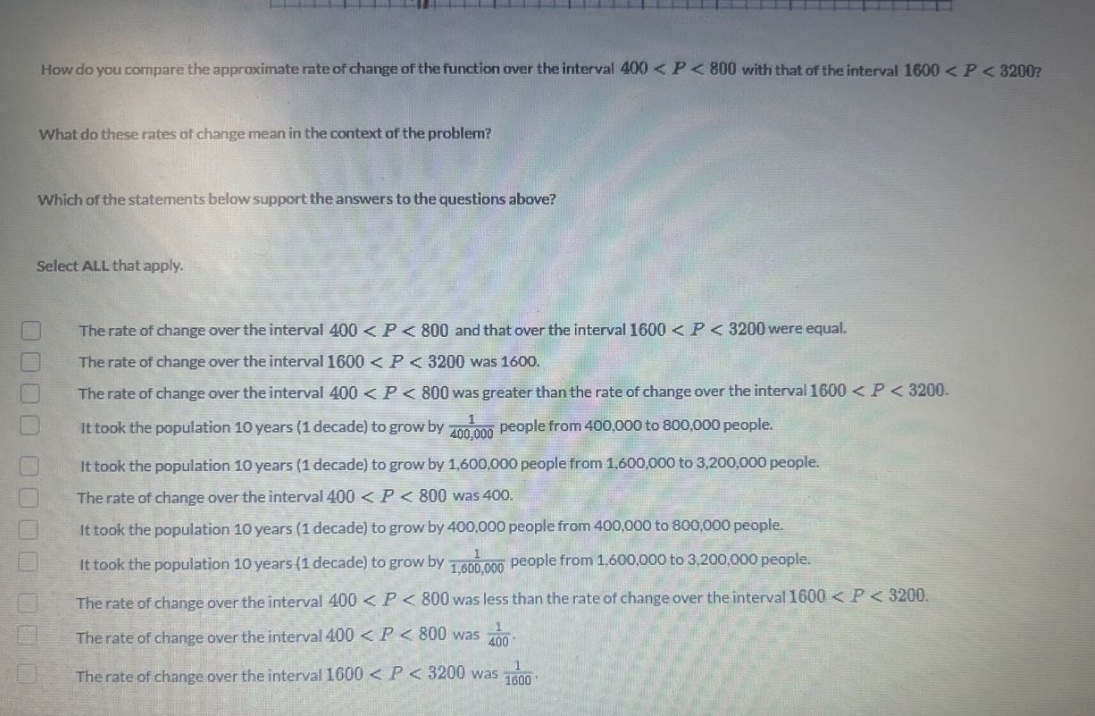
how do you compare the approximate rate of change of the function over the interval 400 < p < 800 with that of the interval 1600 < p < 3200? what do these rates of change mean in the context of the problem? which of the statements below support the answers to the questions above? select all that apply. the rate of change over the interval 400 < p < 800 and that over the interval 1600 < p < 3200 were equal. the rate of change over the interval 1600 < p < 3200 was 1600. the rate of change over the interval 400 < p < 800 was greater than the rate of change over the interval 1600 < p < 3200. it took the population 10 years (1 decade) to grow by 1/400000 people from 400000 to 800000 people. it took the population 10 years (1 decade) to grow by 1600000 people from 1600000 to 3200000 people. the rate of change over the interval 400 < p < 800 was 400. it took the population 10 years (1 decade) to grow by 400000 people from 400000 to 800000 people. it took the population 10 years (1 decade) to grow by 1/1600000 people from 1600000 to 3200000 people. the rate of change over the interval 400 < p < 800 was less than the rate of change over the interval 1600 < p < 3200. the rate of change over the interval 400 < p < 800 was 1/400. the rate of change over the interval 1600 < p < 3200 was 1/1600.
Answer
Explanation:
Step1: Recall rate - of - change formula
The average rate of change of a function $y = f(x)$ over the interval $a<x<b$ is $\frac{f(b)-f(a)}{b - a}$. Here, assume the function represents population $P$ over time $t$. If we assume the time interval for both cases is 10 years (1 decade). For the interval $400000<P<800000$ (assuming $P$ is in number of people), rate of change $r_1=\frac{800000 - 400000}{10}=40000$ people per year. For the interval $1600000<P<3200000$, rate of change $r_2=\frac{3200000 - 1600000}{10}=160000$ people per year.
Step2: Analyze statements
- The rate of change over the interval $400 < P<800$ (should be $400000 < P<800000$) is 40000 people per year and over the interval $1600 < P<3200$ (should be $1600000 < P<3200000$) is 160000 people per year. So the rate of change over the interval $400 < P<800$ was less than the rate of change over the interval $1600 < P<3200$.
- It took the population 10 years (1 decade) to grow by 400000 people from 400000 to 800000 people and 1600000 people from 1600000 to 3200000 people.
Answer:
It took the population 10 years (1 decade) to grow by 400,000 people from 400,000 to 800,000 people. It took the population 10 years (1 decade) to grow by 1,600,000 people from 1,600,000 to 3,200,000 people. The rate of change over the interval $400 < P < 800$ was less than the rate of change over the interval $1600 < P < 3200$.