how would you describe the relationship between the real zero(s) and x - intercept(s) of the function…
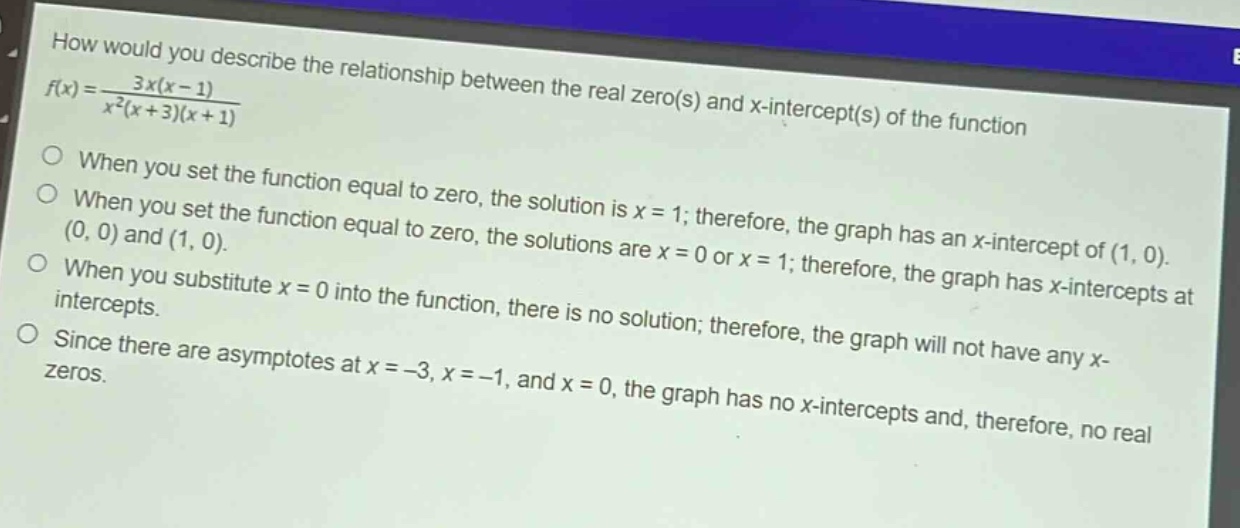
how would you describe the relationship between the real zero(s) and x - intercept(s) of the function $f(x)=\frac{3x(x - 1)}{x^{2}(x + 3)(x + 1)}$\n○ when you set the function equal to zero, the solution is $x = 1$; therefore, the graph has an x - intercept of $(1,0)$.\n○ when you set the function equal to zero, the solutions are $x = 0$ or $x = 1$; therefore, the graph has x - intercepts at $(0,0)$ and $(1,0)$.\n○ when you substitute $x = 0$ into the function, there is no solution; therefore, the graph will not have any x - intercepts.\n○ since there are asymptotes at $x=-3,x = - 1$, and $x = 0$, the graph has no x - intercepts and, therefore, no real zeros.
Answer
Explanation:
Step1: Recall zero - x - intercept relationship
The real zeros of a function (y = f(x)) are the values of (x) for which (f(x)=0). The (x) - intercepts of the graph of the function (y = f(x)) are the points ((x,0)) where the graph crosses or touches the (x) - axis, which also occur when (y = f(x)=0).
Step2: Set the function equal to zero
Set (f(x)=\frac{3x(x - 1)}{x^{2}(x + 3)(x + 1)}=0). A rational function is zero when its numerator is zero and its denominator is non - zero. Set the numerator (3x(x - 1)=0). Using the zero - product property (ab = 0) implies (a = 0) or (b = 0), we have (3x=0) or (x - 1=0), so (x = 0) or (x = 1). But when (x = 0), the denominator (x^{2}(x + 3)(x + 1)=0), so (x = 0) is a removable singularity (a hole in the graph). For (x = 1), the denominator (1^{2}(1 + 3)(1+1)=8\neq0). So the real zero of the function is (x = 1), and the (x) - intercept is ((1,0)).
Answer:
When you set the function equal to zero, the solution is (x = 1); therefore, the graph has an (x) - intercept of ((1,0)).