how would you explain the relationship between the real zero(s) of the function and x - intercept(s) of the…
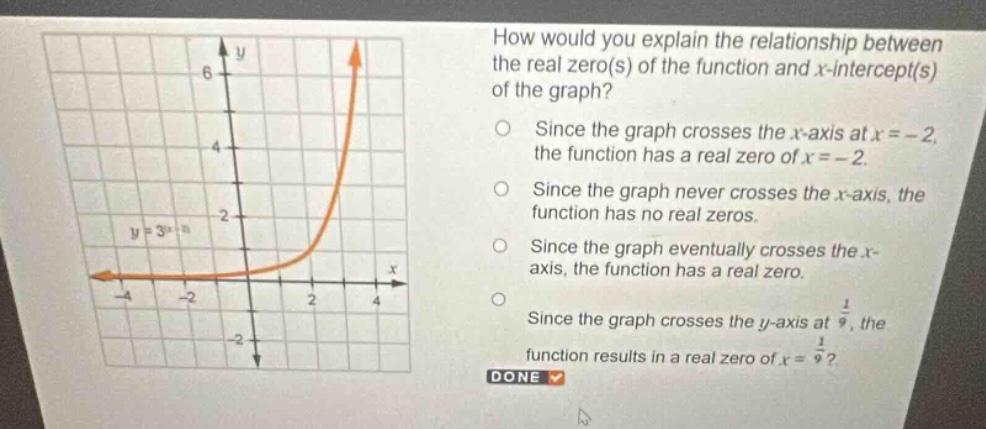
how would you explain the relationship between the real zero(s) of the function and x - intercept(s) of the graph?\nsince the graph crosses the x - axis at x = - 2, the function has a real zero of x = - 2.\nsince the graph never crosses the x - axis, the function has no real zeros.\nsince the graph eventually crosses the x - axis, the function has a real zero.\nsince the graph crosses the y - axis at $\frac{1}{9}$, the function results in a real zero of x = $\frac{1}{9}$?
Answer
Explanation:
Step1: Analyze the concept of real zeros and x - intercepts
A real zero of a function (y = f(x)) is a value of (x) for which (y=f(x)=0). The (x) - intercepts of the graph of (y = f(x)) are the points ((x,0)) on the graph. So, the (x) - values of the (x) - intercepts are the real zeros of the function.
Step2: Analyze each option
- Option 1: For the function (y = 3^{x - 2}), when (y = 0), (3^{x-2}=0). Since (a^{b}>0) for (a>0,a\neq1) and all real (b) (exponential function (y = a^{x}), (a = 3>0)), (3^{x - 2}\neq0) for all real (x). The graph of (y=3^{x - 2}) does not cross the (x) - axis.
- Option 2: Since (y = 3^{x-2}>0) for all real (x) (because the exponential function (y=a^{x}), (a = 3>0) and (y=a^{x}) has a range of ((0,\infty)) for (a>0,a\neq1)), the equation (3^{x - 2}=0) has no solution. And since the (x) - intercepts of (y = f(x)) are the solutions of (f(x)=0), the graph of (y = 3^{x-2}) never crosses the (x) - axis and the function has no real zeros.
- Option 3: The graph of (y = 3^{x-2}) (an exponential function (y=a^{x - h}), (a = 3>1), (h = 2)) approaches (y = 0) as (x\to-\infty) but never actually reaches (y = 0).
- Option 4: The (y) - intercept is found by setting (x = 0). (y=3^{0 - 2}=\frac{1}{9}), but the (y) - intercept ((0,\frac{1}{9})) has nothing to do with the real zeros (which are related to (y = 0)).
Answer:
Since the graph never crosses the (x) - axis, the function has no real zeros.