if you are given the graph of ( h(x)=log _{6} x ), how could you graph ( m(x)=log _{6}(x + 3) )?\ntranslate…
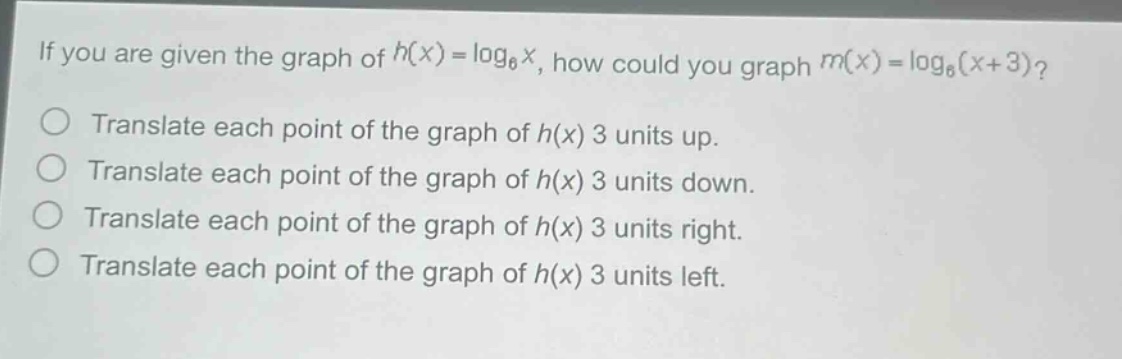
if you are given the graph of ( h(x)=log _{6} x ), how could you graph ( m(x)=log _{6}(x + 3) )?\ntranslate each point of the graph of ( h(x) ) 3 units up.\ntranslate each point of the graph of ( h(x) ) 3 units down.\ntranslate each point of the graph of ( h(x) ) 3 units right.\ntranslate each point of the graph of ( h(x) ) 3 units left.
Answer
Brief Explanations:
For a function (y = f(x)), the transformation (y=f(x + k)) (where (k>0)) is a horizontal translation. When (k = 3) and the function changes from (h(x)=\log_{6}x) to (m(x)=\log_{6}(x + 3)), according to the rule of horizontal translation of functions: if (y = f(x)) and (y=f(x + k)), the graph of (y = f(x)) is translated (k) units to the left.
Answer:
Translate each point of the graph of (h(x)) 3 units left.