what can you say about the series ∑an in each of the following cases? (a) lim┬(n→∞)|(a_(n + 1))/a_n |=9…
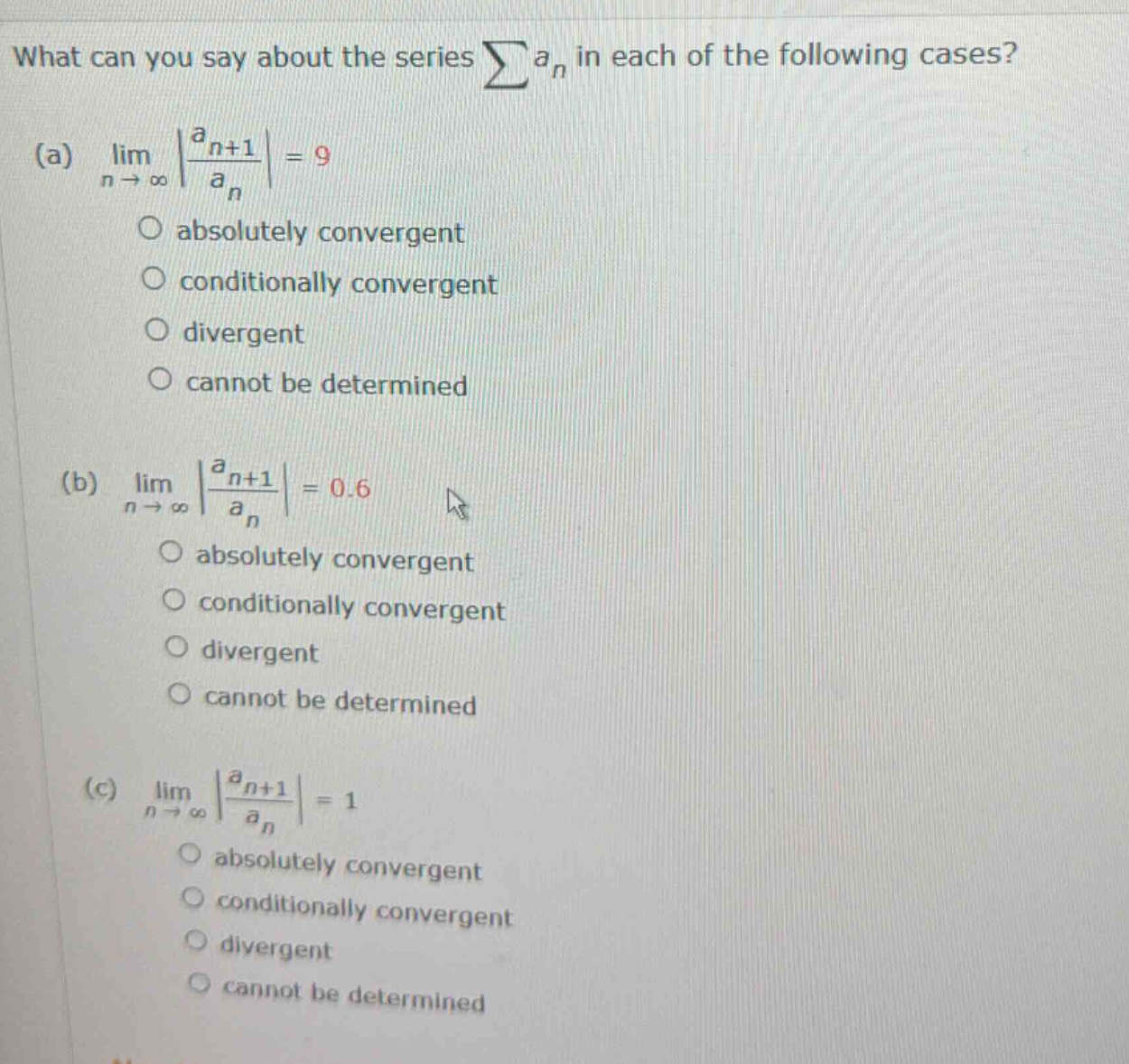
what can you say about the series ∑an in each of the following cases? (a) lim┬(n→∞)|(a_(n + 1))/a_n |=9 absolutely convergent conditionally convergent divergent cannot be determined (b) lim┬(n→∞)|(a_(n + 1))/a_n |=0.6 absolutely convergent conditionally convergent divergent cannot be determined (c) lim┬(n→∞)|(a_(n + 1))/a_n |=1 absolutely convergent conditionally convergent divergent cannot be determined
Answer
Explanation:
Step1: Recall ratio - test rules
The ratio - test states that for a series $\sum a_{n}$, consider $L=\lim_{n\rightarrow\infty}\left|\frac{a_{n + 1}}{a_{n}}\right|$. If $L<1$, the series $\sum a_{n}$ is absolutely convergent. If $L > 1$, the series $\sum a_{n}$ is divergent. If $L = 1$, the ratio - test is inconclusive.
Step2: Analyze part (a)
Given $\lim_{n\rightarrow\infty}\left|\frac{a_{n+1}}{a_{n}}\right|=9$. Since $9>1$, by the ratio - test, the series $\sum a_{n}$ is divergent.
Step3: Analyze part (b)
Given $\lim_{n\rightarrow\infty}\left|\frac{a_{n+1}}{a_{n}}\right| = 0.6$. Since $0.6<1$, by the ratio - test, the series $\sum a_{n}$ is absolutely convergent.
Step4: Analyze part (c)
Given $\lim_{n\rightarrow\infty}\left|\frac{a_{n+1}}{a_{n}}\right|=1$. By the ratio - test, when $L = 1$, we cannot determine whether the series $\sum a_{n}$ is convergent or divergent.
Answer:
(a) divergent (b) absolutely convergent (c) cannot be determined