your turn\n1. consider the function f(x)=1/2 sin(4x).\n a. the graph will have a horizontal…
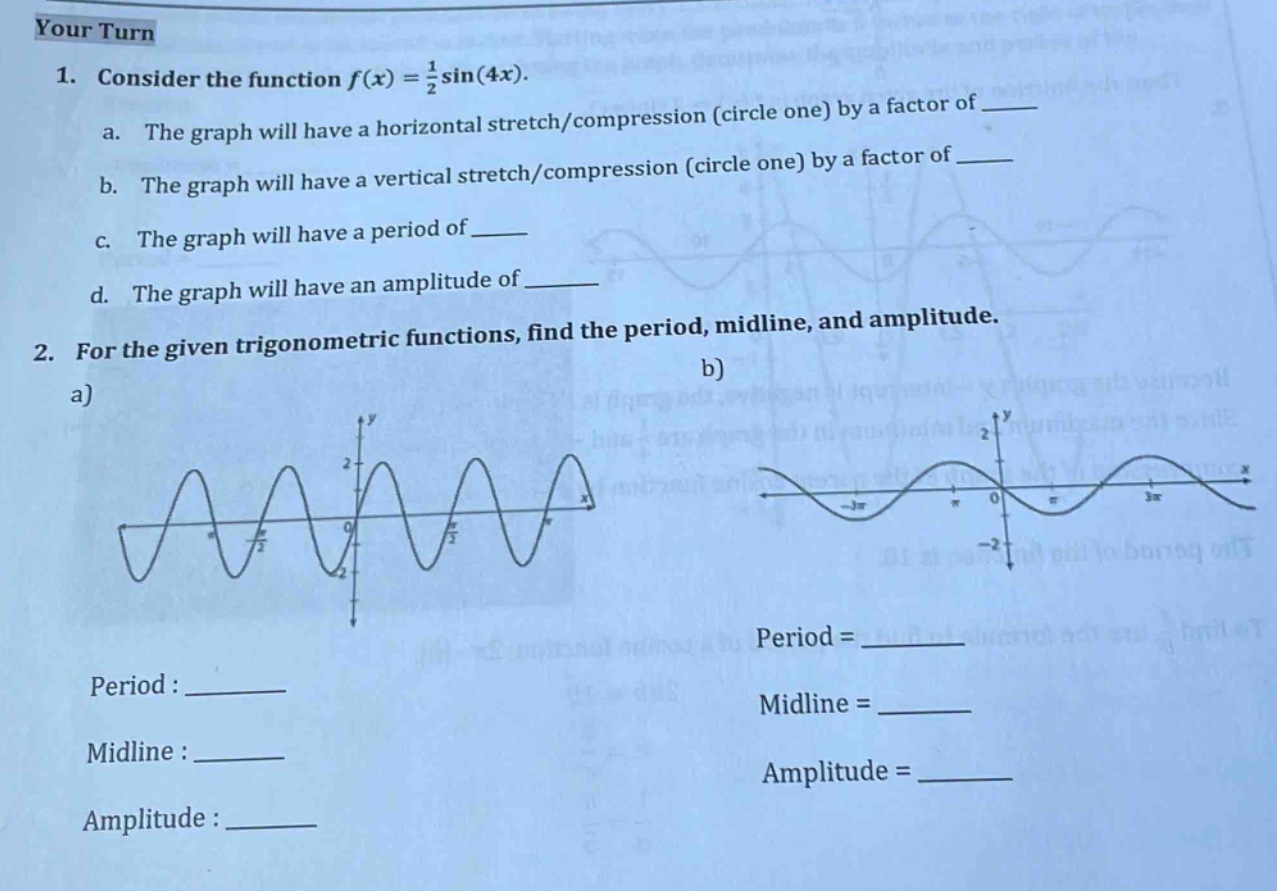
your turn\n1. consider the function f(x)=1/2 sin(4x).\n a. the graph will have a horizontal stretch/compression (circle one) by a factor of \n b. the graph will have a vertical stretch/compression (circle one) by a factor of \n c. the graph will have a period of \n d. the graph will have an amplitude of \n2. for the given trigonometric functions, find the period, mid - line, and amplitude.\n a)\n b)\n period: \n midline: \n amplitude: \n period = \n midline = \n amplitude =
Answer
Explanation:
Step1: Recall horizontal stretch/compression formula
For $y = A\sin(Bx)$, horizontal stretch/compression factor is $\frac{1}{B}$. Given $f(x)=\frac{1}{2}\sin(4x)$, $B = 4$, so factor is $\frac{1}{4}$.
Step2: Recall vertical stretch/compression formula
For $y = A\sin(Bx)$, vertical stretch/compression factor is $A$. Here $A=\frac{1}{2}$.
Step3: Recall period formula
The period of $y = A\sin(Bx)$ is $T=\frac{2\pi}{B}$. With $B = 4$, $T=\frac{2\pi}{4}=\frac{\pi}{2}$.
Step4: Recall amplitude formula
The amplitude of $y = A\sin(Bx)$ is $|A|$. So amplitude is $\left|\frac{1}{2}\right|=\frac{1}{2}$.
Step5: Analyze graph a
From the graph, the period is $\frac{\pi}{2}$, mid - line is $y = 0$, amplitude is $2$.
Step6: Analyze graph b
From the graph, the period is $4\pi$, mid - line is $y = 0$, amplitude is $2$.
Answer:
a. Compression, $\frac{1}{4}$ b. Compression, $\frac{1}{2}$ c. $\frac{\pi}{2}$ d. $\frac{1}{2}$ 2. a. Period: $\frac{\pi}{2}$, Midline: $y = 0$, Amplitude: $2$ b. Period: $4\pi$, Midline: $y = 0$, Amplitude: $2$