4.000 g of compound $x$ with molecular formula $c_{5}h_{10}$ are burned in a constant - pressure calorimeter…
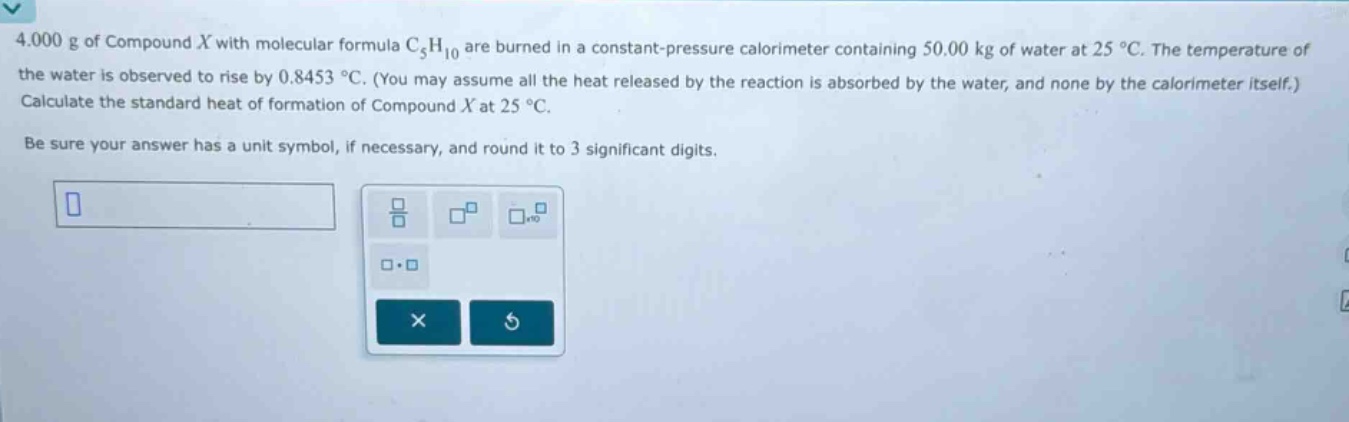
4.000 g of compound $x$ with molecular formula $c_{5}h_{10}$ are burned in a constant - pressure calorimeter containing 50.00 kg of water at 25 $^{circ}$c. the temperature of the water is observed to rise by 0.8453 $^{circ}$c. (you may assume all the heat released by the reaction is absorbed by the water, and none by the calorimeter itself.) calculate the standard heat of formation of compound $x$ at 25 $^{circ}$c. be sure your answer has a unit symbol, if necessary, and round it to 3 significant digits.
Answer
Explanation:
Step1: Calculate heat absorbed by water
The specific - heat capacity of water $c = 4.184\ J/(g\cdot^{\circ}C)$. The mass of water $m = 50.00\ kg=50000\ g$, and the temperature change $\Delta T = 0.8453^{\circ}C$. Using the formula $q = mc\Delta T$, we have $q=(50000\ g)\times(4.184\ J/(g\cdot^{\circ}C))\times(0.8453^{\circ}C)$. $q = 50000\times4.184\times0.8453\ J= 177947.6\ J\approx177.95\ kJ$.
Step2: Calculate moles of compound X
The molar mass of $C_{5}H_{10}$ is $M=(5\times12.01 + 10\times1.01)\ g/mol=(60.05 + 10.1)\ g/mol = 70.15\ g/mol$. The mass of compound $X$ is $m = 4.000\ g$. The number of moles $n=\frac{m}{M}=\frac{4.000\ g}{70.15\ g/mol}\approx0.0570\ mol$.
Step3: Calculate heat of combustion per mole of compound X
The heat of combustion per mole $\Delta H_{comb}$ is $\Delta H_{comb}=-\frac{q}{n}$. Since the heat released by the reaction is absorbed by water, the heat of the reaction for the amount of compound burned is $- 177.95\ kJ$ (negative because it is an exothermic reaction). So $\Delta H_{comb}=-\frac{177.95\ kJ}{0.0570\ mol}\approx - 3122\ kJ/mol$.
Step4: Use Hess's law to find the standard heat of formation
The combustion reaction of $C_{5}H_{10}$ is $C_{5}H_{10}(l)+\frac{15}{2}O_{2}(g)\rightarrow5CO_{2}(g)+5H_{2}O(l)$. The standard heat of formation of $CO_{2}(g)$ is $\Delta H_{f}^{\circ}(CO_{2})=- 393.5\ kJ/mol$, the standard heat of formation of $H_{2}O(l)$ is $\Delta H_{f}^{\circ}(H_{2}O)=-285.8\ kJ/mol$, and the standard heat of formation of $O_{2}(g)$ is $0\ kJ/mol$. By Hess's law, $\Delta H_{comb}=\sum n\Delta H_{f}^{\circ}(products)-\sum m\Delta H_{f}^{\circ}(reactants)$. $\Delta H_{comb}=[5\times\Delta H_{f}^{\circ}(CO_{2}) + 5\times\Delta H_{f}^{\circ}(H_{2}O)]-\Delta H_{f}^{\circ}(C_{5}H_{10})$. $-3122\ kJ/mol=[5\times(-393.5\ kJ/mol)+5\times(-285.8\ kJ/mol)]-\Delta H_{f}^{\circ}(C_{5}H_{10})$. First, calculate the right - hand side of the equation: $5\times(-393.5\ kJ/mol)+5\times(-285.8\ kJ/mol)=5\times(-393.5 - 285.8)\ kJ/mol=5\times(-679.3\ kJ/mol)=-3396.5\ kJ/mol$. Then, solve for $\Delta H_{f}^{\circ}(C_{5}H_{10})$: $\Delta H_{f}^{\circ}(C_{5}H_{10})=-3396.5\ kJ/mol + 3122\ kJ/mol=- 274.5\ kJ/mol\approx - 275\ kJ/mol$.
Answer:
$-275\ kJ/mol$