10. in a chemical reaction, the mass of the products\na. is less than the mass of the reactants.\nb. is…
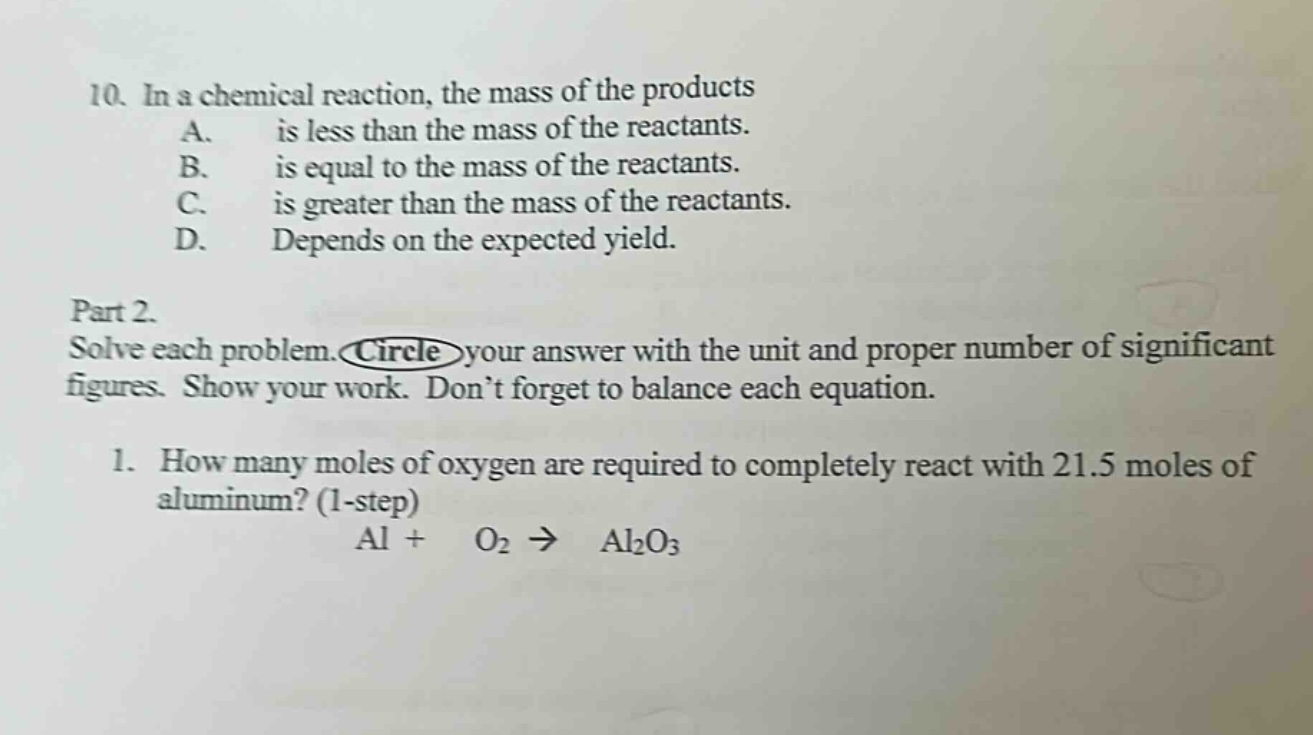
10. in a chemical reaction, the mass of the products\na. is less than the mass of the reactants.\nb. is equal to the mass of the reactants.\nc. is greater than the mass of the reactants.\nd. depends on the expected yield.\npart 2.\nsolve each problem. circle your answer with the unit and proper number of significant figures. show your work. don’t forget to balance each equation.\n1. how many moles of oxygen are required to completely react with 21.5 moles of aluminum? (1 - step)\nal + o₂ → al₂o₃
Answer
10.
Brief Explanations:
According to the law of conservation of mass in chemical reactions, the total mass of the products is equal to the total mass of the reactants.
Answer:
B. is equal to the mass of the reactants.
Part 2 - 1.
Explanation:
Step1: Balance the chemical equation
The balanced equation for the reaction between aluminum ($Al$) and oxygen ($O_2$) to form aluminum - oxide ($Al_2O_3$) is $4Al + 3O_2\rightarrow2Al_2O_3$.
Step2: Determine the mole - ratio
From the balanced equation, the mole - ratio of $Al$ to $O_2$ is $4:3$.
Step3: Calculate the moles of $O_2$
Let $x$ be the moles of $O_2$. We know that $\frac{n_{Al}}{n_{O_2}}=\frac{4}{3}$, where $n_{Al} = 21.5$ moles. So $x=\frac{3\times21.5}{4}$ moles. $x=\frac{64.5}{4}=16.125\approx16.1$ moles (rounded to 3 significant figures)
Answer:
16.1 moles