10. how many moles of iron (fe) is 5.98 x 10^24 atoms of iron?\n11. what mass of molybdenum (mo) is 6.68…
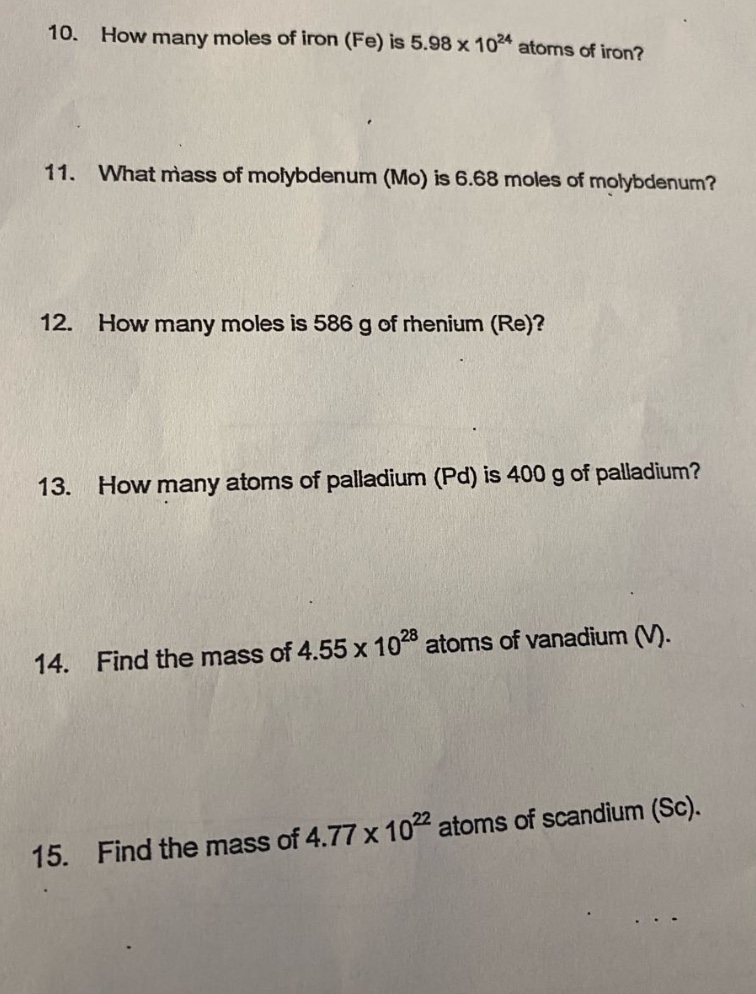
10. how many moles of iron (fe) is 5.98 x 10^24 atoms of iron?\n11. what mass of molybdenum (mo) is 6.68 moles of molybdenum?\n12. how many moles is 586 g of rhenium (re)?\n13. how many atoms of palladium (pd) is 400 g of palladium?\n14. find the mass of 4.55 x 10^28 atoms of vanadium (v).\n15. find the mass of 4.77 x 10^22 atoms of scandium (sc).
Answer
10.
Explanation:
Step1: Record Avogadro's number
Avogadro's number $N_A = 6.022\times10^{23}\text{ atoms/mol}$.
Step2: Calculate moles of iron
Usamos la fórmula $n=\frac{N}{N_A}$, donde $N = 5.98\times 10^{24}$ átomos. Entonces $n=\frac{5.98\times 10^{24}\text{ atoms}}{6.022\times10^{23}\text{ atoms/mol}}\approx9.93$ mol.
Answer:
$9.93$ mol
11.
Explanation:
Step1: Record molar - mass of molybdenum
La masa molar de molibdeno $M_{Mo}=95.96$ g/mol.
Step2: Calculate mass of molybdenum
Usamos la fórmula $m = n\times M$, donde $n = 6.68$ mol. Entonces $m=6.68\text{ mol}\times95.96\text{ g/mol}\approx641$ g.
Answer:
$641$ g
12.
Explanation:
Step1: Record molar - mass of rhenium
La masa molar de renio $M_{Re}=186.21$ g/mol.
Step2: Calculate moles of rhenium
Usamos la fórmula $n=\frac{m}{M}$, donde $m = 586$ g. Entonces $n=\frac{586\text{ g}}{186.21\text{ g/mol}}\approx3.15$ mol.
Answer:
$3.15$ mol
13.
Explanation:
Step1: Record molar - mass of palladium
La masa molar de paladio $M_{Pd}=106.42$ g/mol.
Step2: Calculate moles of palladium
$n=\frac{m}{M}=\frac{400\text{ g}}{106.42\text{ g/mol}}\approx3.76$ mol.
Step3: Calculate number of atoms
Usamos $N=n\times N_A$, donde $N_A = 6.022\times10^{23}\text{ atoms/mol}$. Entonces $N = 3.76\text{ mol}\times6.022\times10^{23}\text{ atoms/mol}\approx2.26\times 10^{24}$ átomos.
Answer:
$2.26\times 10^{24}$ átomos
14.
Explanation:
Step1: Calculate moles of vanadium
Usamos $n=\frac{N}{N_A}$, donde $N = 4.55\times 10^{28}$ átomos y $N_A = 6.022\times10^{23}\text{ atoms/mol}$. Entonces $n=\frac{4.55\times 10^{28}\text{ atoms}}{6.022\times10^{23}\text{ atoms/mol}}\approx7.56\times 10^{4}$ mol.
Step2: Record molar - mass of vanadium
La masa molar de vanadio $M_V = 50.94$ g/mol.
Step3: Calculate mass of vanadium
$m=n\times M=(7.56\times 10^{4}\text{ mol})\times50.94\text{ g/mol}\approx3.85\times 10^{6}$ g.
Answer:
$3.85\times 10^{6}$ g
15.
Explanation:
Step1: Calculate moles of scandium
Usamos $n=\frac{N}{N_A}$, donde $N = 4.77\times 10^{22}$ átomos y $N_A = 6.022\times10^{23}\text{ atoms/mol}$. Entonces $n=\frac{4.77\times 10^{22}\text{ atoms}}{6.022\times10^{23}\text{ atoms/mol}}\approx0.0792$ mol.
Step2: Record molar - mass of scandium
La masa molar de escandio $M_{Sc}=44.96$ g/mol.
Step3: Calculate mass of scandium
$m=n\times M = 0.0792\text{ mol}\times44.96\text{ g/mol}\approx3.57$ g.
Answer:
$3.57$ g