11. which of the following would occur if you used too much titrant (naoh) during the titration?\na) the…
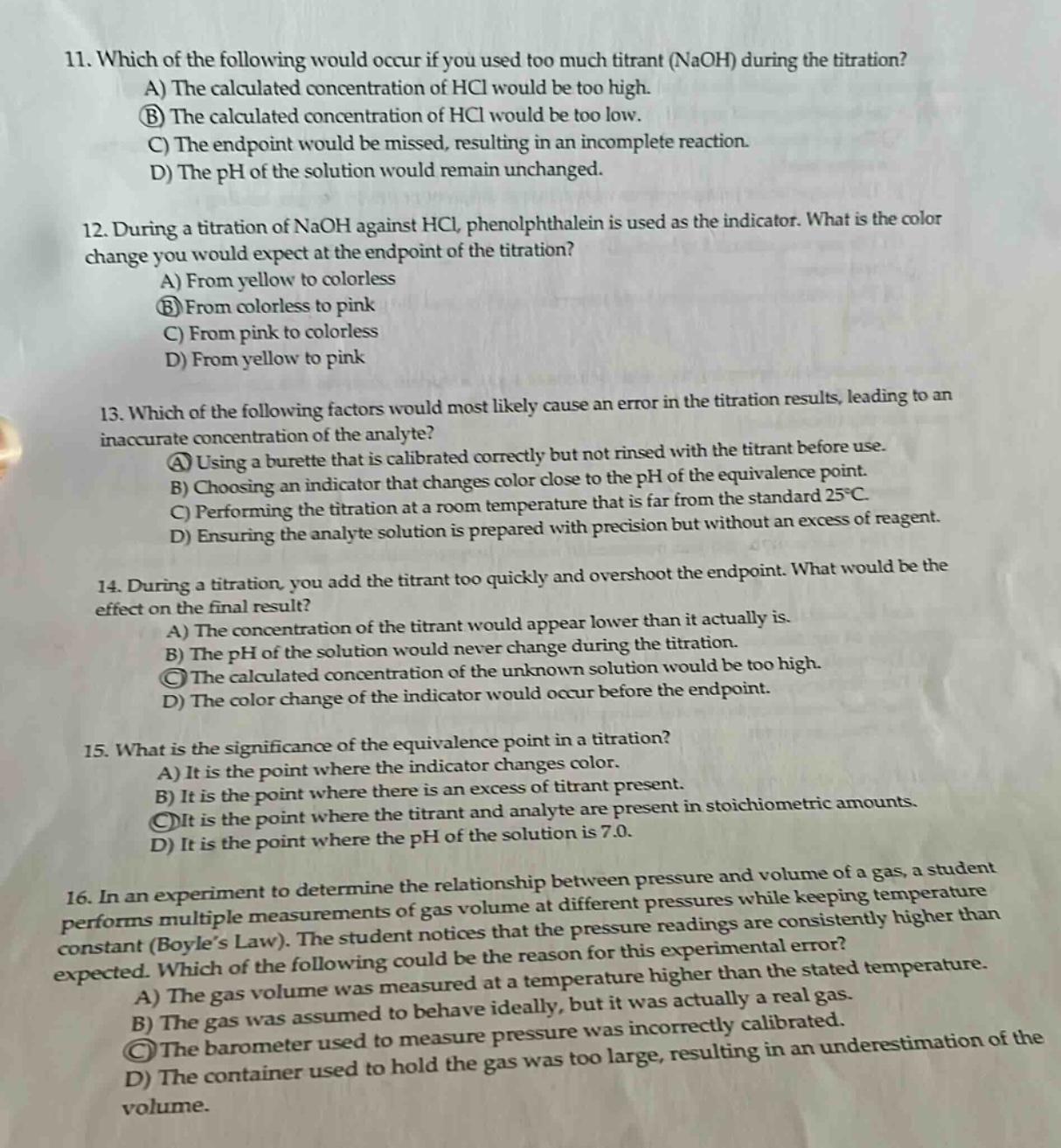
11. which of the following would occur if you used too much titrant (naoh) during the titration?\na) the calculated concentration of hcl would be too high.\nb) the calculated concentration of hcl would be too low.\nc) the endpoint would be missed, resulting in an incomplete reaction.\nd) the ph of the solution would remain unchanged.\n12. during a titration of naoh against hcl, phenolphthalein is used as the indicator. what is the color change you would expect at the endpoint of the titration?\na) from yellow to colorless\nb) from colorless to pink\nc) from pink to colorless\nd) from yellow to pink\n13. which of the following factors would most likely cause an error in the titration results, leading to an inaccurate concentration of the analyte?\na) using a burette that is calibrated correctly but not rinsed with the titrant before use.\nb) choosing an indicator that changes color close to the ph of the equivalence point.\nc) performing the titration at a room temperature that is far from the standard 25°c.\nd) ensuring the analyte solution is prepared with precision but without an excess of reagent.\n14. during a titration, you add the titrant too quickly and overshoot the endpoint. what would be the effect on the final result?\na) the concentration of the titrant would appear lower than it actually is.\nb) the ph of the solution would never change during the titration.\nc) the calculated concentration of the unknown solution would be too high.\nd) the color change of the indicator would occur before the endpoint.\n15. what is the significance of the equivalence point in a titration?\na) it is the point where the indicator changes color.\nb) it is the point where there is an excess of titrant present.\nc) it is the point where the titrant and analyte are present in stoichiometric amounts.\nd) it is the point where the ph of the solution is 7.0.\n16. in an experiment to determine the relationship between pressure and volume of a gas, a student performs multiple measurements of gas volume at different pressures while keeping temperature constant (boyle’s law). the student notices that the pressure readings are consistently higher than expected. which of the following could be the reason for this experimental error?\na) the gas volume was measured at a temperature higher than the stated temperature.\nb) the gas was assumed to behave ideally, but it was actually a real gas.\nc) the barometer used to measure pressure was incorrectly calibrated.\nd) the container used to hold the gas was too large, resulting in an underestimation of the volume.
Answer
Brief Explanations:
- The formula for calculating the concentration of the analyte ($HCl$) in a titration is $C_{HCl}=\frac{C_{NaOH}V_{NaOH}}{V_{HCl}}$. If too much $NaOH$ (titrant) is used, $V_{NaOH}$ is over - estimated, so the calculated $C_{HCl}$ will be too high.
- Phenolphthalein is colorless in acidic solutions ($HCl$) and turns pink in basic solutions ($NaOH$). At the endpoint of the $NaOH - HCl$ titration, the solution just turns basic, so the color change is from colorless to pink.
- A burette that is calibrated correctly but not rinsed with the titrant before use can have residual water or other substances that can dilute the titrant, leading to inaccurate results for the concentration of the analyte.
- Overshooting the endpoint means adding more titrant than necessary. Using the titration formula, a higher volume of titrant will lead to a calculated higher concentration of the unknown solution ($HCl$).
- The equivalence point in a titration is the point where the titrant and analyte react in stoichiometric amounts.
- If the barometer used to measure pressure is incorrectly calibrated, it can give pressure readings that are consistently higher or lower than the actual values.
Answer:
- A. The calculated concentration of HCl would be too high.
- B. From colorless to pink
- A. Using a burette that is calibrated correctly but not rinsed with the titrant before use.
- C. The calculated concentration of the unknown solution would be too high.
- C. It is the point where the titrant and analyte are present in stoichiometric amounts.
- B. The barometer used to measure pressure was incorrectly calibrated.