11. given the balanced ionic equation representing a reaction:\n2 al³⁺(aq) + 3 mg(s) → 3 mg²⁺(aq) + 2…
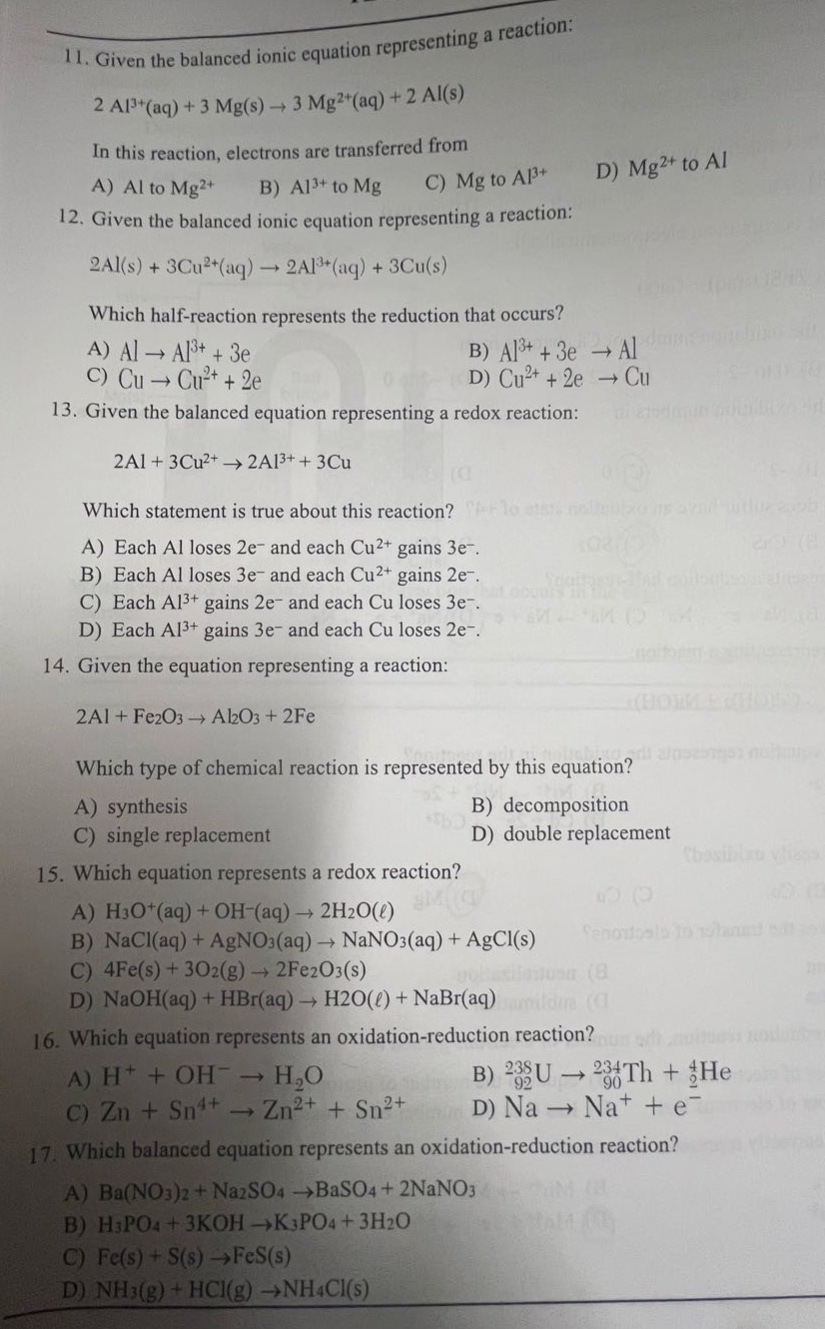
11. given the balanced ionic equation representing a reaction:\n2 al³⁺(aq) + 3 mg(s) → 3 mg²⁺(aq) + 2 al(s)\nin this reaction, electrons are transferred from\na) al to mg²⁺ b) al³⁺ to mg c) mg to al³⁺ d) mg²⁺ to al\n12. given the balanced ionic equation representing a reaction:\n2al(s) + 3cu²⁺(aq) → 2al³⁺(aq) + 3cu(s)\nwhich half - reaction represents the reduction that occurs?\na) al → al³⁺ + 3e⁻ b) al³⁺ + 3e⁻ → al\nc) cu → cu²⁺ + 2e⁻ d) cu²⁺ + 2e⁻ → cu\n13. given the balanced equation representing a redox reaction:\n2al + 3cu²⁺ → 2al³⁺ + 3cu\nwhich statement is true about this reaction?\na) each al loses 2e⁻ and each cu²⁺ gains 3e⁻.\nb) each al loses 3e⁻ and each cu²⁺ gains 2e⁻.\nc) each al³⁺ gains 2e⁻ and each cu loses 3e⁻.\nd) each al³⁺ gains 3e⁻ and each cu loses 2e⁻.\n14. given the equation representing a reaction:\n2al + fe₂o₃ → al₂o₃ + 2fe\nwhich type of chemical reaction is represented by this equation?\na) synthesis b) decomposition\nc) single replacement d) double replacement\n15. which equation represents a redox reaction?\na) h₃o⁺(aq) + oh⁻(aq) → 2h₂o(ℓ)\nb) nacl(aq) + agno₃(aq) → nano₃(aq) + agcl(s)\nc) 4fe(s) + 3o₂(g) → 2fe₂o₃(s)\nd) naoh(aq) + hbr(aq) → h₂o(ℓ) + nabr(aq)\n16. which equation represents an oxidation - reduction reaction?\na) h⁺ + oh⁻ → h₂o b) ₉₂²³⁸u → ₉₀²³⁴th + ₂⁴he\nc) zn + sn⁴⁺ → zn²⁺ + sn²⁺ d) na → na⁺ + e⁻\n17. which balanced equation represents an oxidation - reduction reaction?\na) ba(no₃)₂ + na₂so₄ → baso₄ + 2nano₃\nb) h₃po₄ + 3koh → k₃po₄ + 3h₂o\nc) fe(s) + s(s) → fes(s)\nd) nh₃(g) + hcl(g) → nh₄cl(s)
Answer
11.
Explanation:
Step1: Identify oxidation and reduction
In the reaction $2Al^{3 + }(aq)+3Mg(s)\to3Mg^{2 + }(aq)+2Al(s)$, magnesium ($Mg$) goes from an oxidation - state of 0 to + 2 (oxidation), and aluminum ($Al$) goes from + 3 to 0 (reduction). Electrons are transferred from the substance being oxidized to the substance being reduced. So electrons are transferred from $Mg$ to $Al^{3+}$.
Answer:
C
12.
Explanation:
Step1: Recall reduction definition
Reduction is the gain of electrons. In the reaction $2Al(s)+3Cu^{2 + }(aq)\to2Al^{3 + }(aq)+3Cu(s)$, copper ($Cu$) goes from an oxidation - state of + 2 in $Cu^{2+}$ to 0 in $Cu$. The half - reaction for the reduction of $Cu^{2+}$ is $Cu^{2 + }+2e^-\to Cu$.
Answer:
D
13.
Explanation:
Step1: Analyze oxidation and reduction in the reaction
In the reaction $2Al + 3Cu^{2+}\to2Al^{3+}+3Cu$, aluminum ($Al$) goes from an oxidation - state of 0 to + 3, so each $Al$ atom loses 3 electrons. Copper ($Cu$) goes from an oxidation - state of + 2 to 0, so each $Cu^{2+}$ ion gains 2 electrons.
Answer:
B
14.
Explanation:
Step1: Recall reaction type definitions
In the reaction $2Al + Fe_2O_3\to Al_2O_3+2Fe$, one element ($Al$) replaces another element ($Fe$) in a compound ($Fe_2O_3$). This is the characteristic of a single - replacement reaction.
Answer:
C
15.
Explanation:
Step1: Check for oxidation - number changes
In reaction A, it is an acid - base neutralization reaction with no change in oxidation numbers. In reaction B, it is a precipitation reaction with no change in oxidation numbers. In reaction C, iron ($Fe$) goes from 0 to + 3 and oxygen ($O$) goes from 0 to - 2, so it is a redox reaction. In reaction D, it is an acid - base neutralization reaction with no change in oxidation numbers.
Answer:
C
16.
Explanation:
Step1: Identify oxidation - reduction by oxidation number changes
In reaction A, it is a neutralization reaction with no change in oxidation numbers. In reaction B, it is a nuclear decay reaction. In reaction C, zinc ($Zn$) goes from 0 to + 2 and tin ($Sn$) goes from + 4 to + 2, so it is an oxidation - reduction reaction. In reaction D, it is just the oxidation of sodium, but considering the options, reaction C shows a complete oxidation - reduction process with both oxidation and reduction occurring.
Answer:
C
17.
Explanation:
Step1: Check for oxidation - number changes
In reaction A, it is a double - replacement reaction with no change in oxidation numbers. In reaction B, it is an acid - base reaction with no change in oxidation numbers. In reaction C, iron ($Fe$) goes from 0 to + 2 and sulfur ($S$) goes from 0 to - 2, so it is an oxidation - reduction reaction. In reaction D, it is a combination reaction with no change in oxidation numbers.
Answer:
C