13. what is a potential environmental benefit of using fuel cells over traditional combustion engines? a…
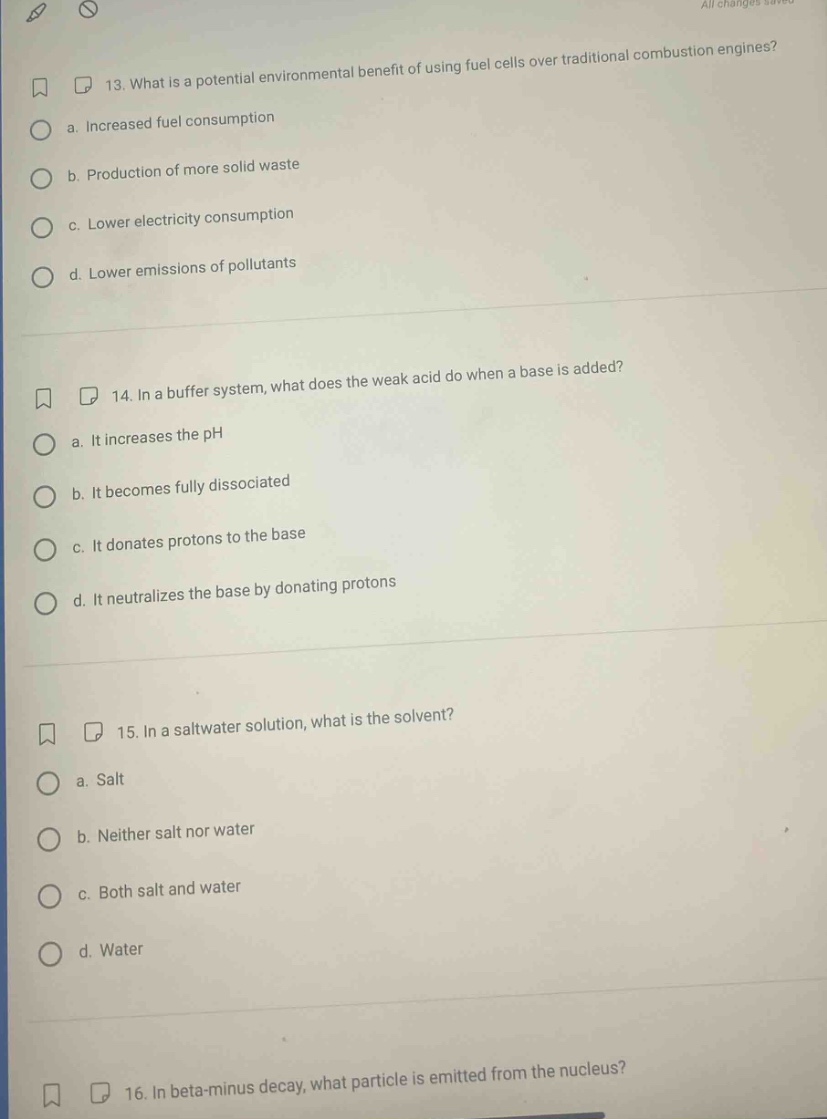
13. what is a potential environmental benefit of using fuel cells over traditional combustion engines? a. increased fuel consumption b. production of more solid waste c. lower electricity consumption d. lower emissions of pollutants 14. in a buffer system, what does the weak acid do when a base is added? a. it increases the ph b. it becomes fully dissociated c. it donates protons to the base d. it neutralizes the base by donating protons 15. in a saltwater solution, what is the solvent? a. salt b. neither salt nor water c. both salt and water d. water 16. in beta - minus decay, what particle is emitted from the nucleus?
Answer
Answer:
- d. Lower emissions of pollutants
- d. It neutralizes the base by donating protons
- d. Water
Brief Explanations:
- Fuel cells produce fewer pollutants compared to combustion engines.
- In a buffer, a weak - acid donates protons to neutralize added base.
- In a salt - water solution, water is the solvent and salt is the solute.