15. a student performed a chemical reactions and recorded the final and initial temperatures of the solution…
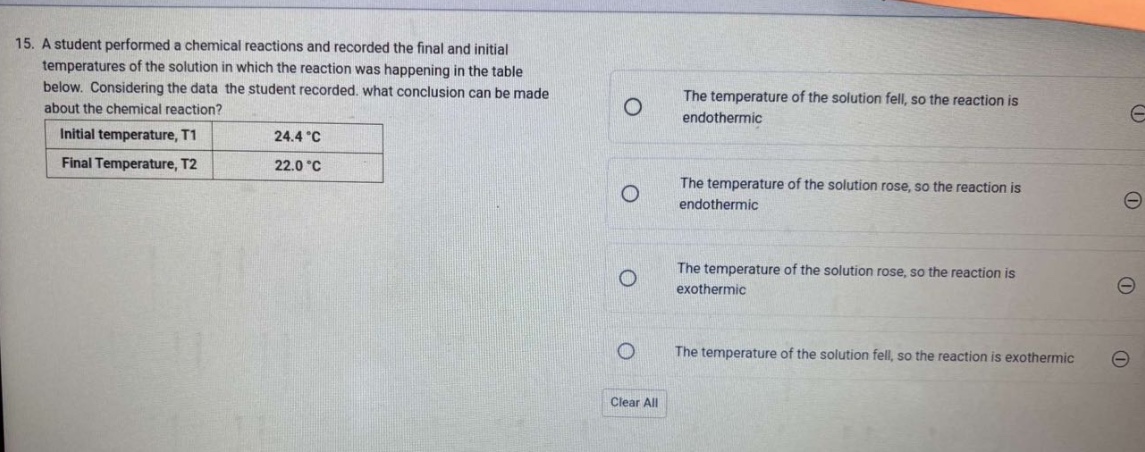
15. a student performed a chemical reactions and recorded the final and initial temperatures of the solution in which the reaction was happening in the table below. considering the data the student recorded, what conclusion can be made about the chemical reaction? initial temperature, t1 24.4 °c final temperature, t2 22.0 °c the temperature of the solution fell, so the reaction is endothermic the temperature of the solution rose, so the reaction is endothermic the temperature of the solution rose, so the reaction is exothermic the temperature of the solution fell, so the reaction is exothermic clear all
Answer
Explanation:
Step1: Compare initial and final temperatures
Initial temperature $T1 = 24.4^{\circ}C$ and final temperature $T2=22.0^{\circ}C$. Since $22.0<24.4$, the temperature of the solution fell.
Step2: Recall endothermic - exothermic definitions
In an endothermic reaction, the reaction absorbs heat from the surroundings (in this case the solution), causing the temperature of the surroundings to decrease. In an exothermic reaction, the reaction releases heat to the surroundings, causing the temperature of the surroundings to increase.
Answer:
The temperature of the solution fell, so the reaction is endothermic