a 150 ml sample of hydrochloric acid (hcl) completely reacted with 60.0 ml of a 0.100 m naoh solution. the…
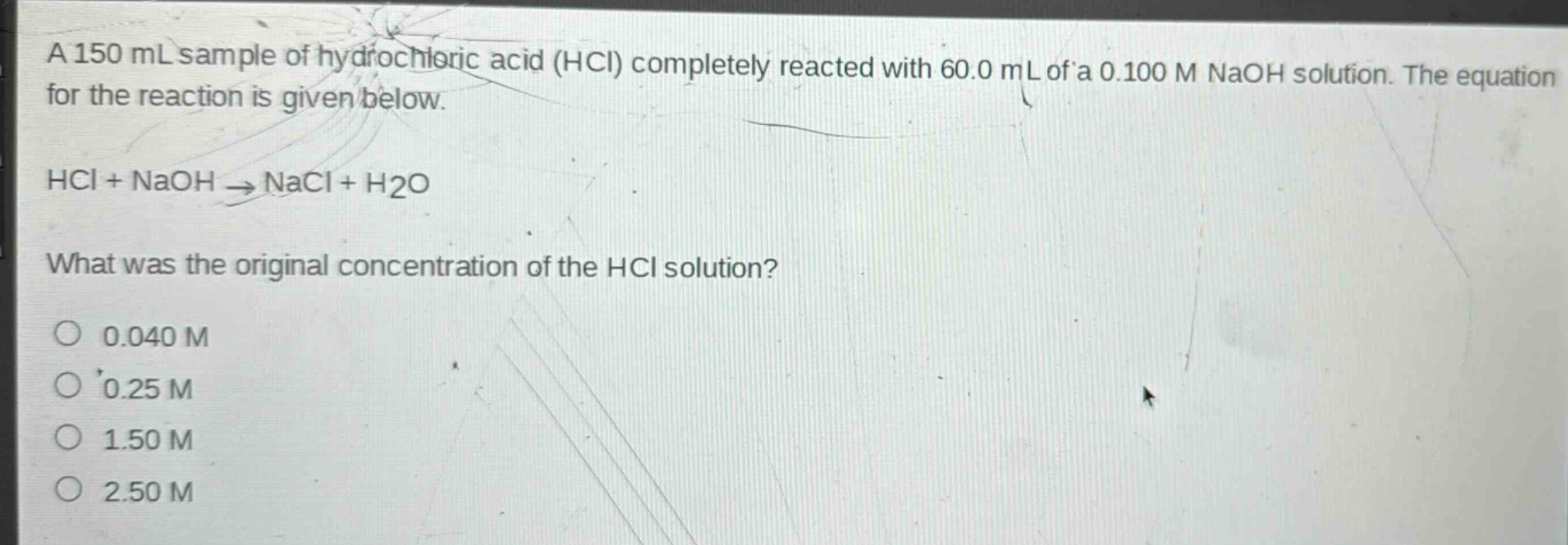
a 150 ml sample of hydrochloric acid (hcl) completely reacted with 60.0 ml of a 0.100 m naoh solution. the equation for the reaction is given below.\nhcl + naoh → nacl + h2o\nwhat was the original concentration of the hcl solution?\no 0.040 m\no 0.25 m\no 1.50 m\no 2.50 m
Answer
Explanation:
Step1: Calculate moles of NaOH
Use the formula $n = M\times V$, where $n$ is the number of moles, $M$ is the molarity and $V$ is the volume in liters. The volume of NaOH $V_{NaOH}=60.0\ mL = 0.0600\ L$ and molarity $M_{NaOH}=0.100\ M$. So $n_{NaOH}=M_{NaOH}\times V_{NaOH}=0.100\ mol/L\times0.0600\ L = 0.00600\ mol$.
Step2: Determine moles of HCl
From the balanced chemical equation $HCl + NaOH\rightarrow NaCl + H_2O$, the mole - ratio of $HCl$ to $NaOH$ is $1:1$. So $n_{HCl}=n_{NaOH}=0.00600\ mol$.
Step3: Calculate molarity of HCl
The volume of HCl $V_{HCl}=150\ mL = 0.150\ L$. Use the formula $M=\frac{n}{V}$, so $M_{HCl}=\frac{n_{HCl}}{V_{HCl}}=\frac{0.00600\ mol}{0.150\ L}=0.040\ M$.
Answer:
A. 0.040 M