16. find the volume of a 0.37 m solution if it contains 0.90 moles of potassium hydroxide.\n17. how many…
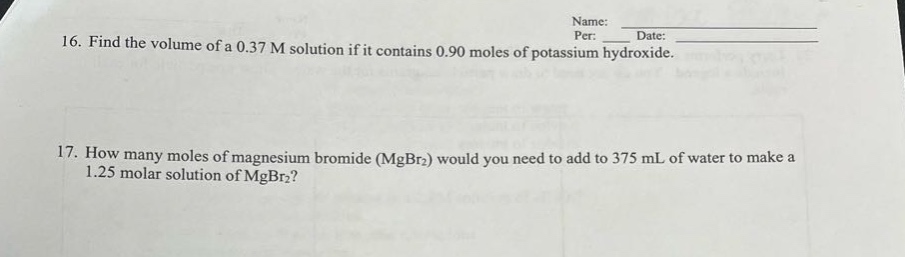
16. find the volume of a 0.37 m solution if it contains 0.90 moles of potassium hydroxide.\n17. how many moles of magnesium bromide (mgbr₂) would you need to add to 375 ml of water to make a 1.25 molar solution of mgbr₂?
Answer
Explanation:
Step1: Recall molarity formula
Molarity ($M$) is defined as $M=\frac{n}{V}$, where $n$ is the number of moles and $V$ is the volume in liters. For the first - question, we need to solve for $V$. $V=\frac{n}{M}$
Step2: Substitute values for the first question
Given $n = 0.90$ moles and $M=0.37$ M. $V=\frac{0.90}{0.37}\text{ L}\approx2.43\text{ L}$
Step3: For the second question, first convert volume to liters
We know that $1\text{ L}=1000\text{ mL}$, so $V = 375\text{ mL}=0.375\text{ L}$.
Step4: Use molarity formula to solve for moles
From $M=\frac{n}{V}$, we can solve for $n$. Rearranging gives $n = M\times V$. Given $M = 1.25$ M and $V=0.375$ L. $n=1.25\times0.375\text{ moles}=0.46875\text{ moles}\approx0.47\text{ moles}$
Answer:
- $2.43$ L
- $0.47$ moles