17. using the following equation, 2 naclo₃ → 2 nacl + 3 o₂, how many grams of naclo₃ must decompose to…
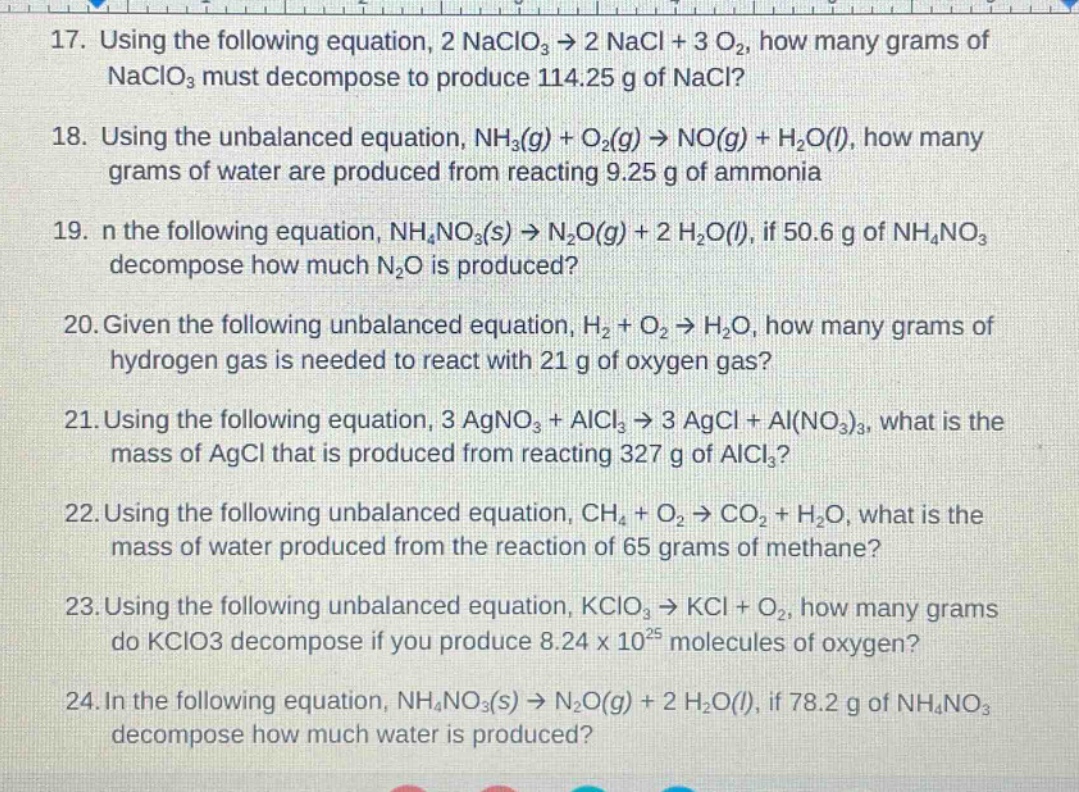
17. using the following equation, 2 naclo₃ → 2 nacl + 3 o₂, how many grams of naclo₃ must decompose to produce 114.25 g of nacl?\n18. using the unbalanced equation, nh₃(g) + o₂(g) → no(g) + h₂o(l), how many grams of water are produced from reacting 9.25 g of ammonia\n19. n the following equation, nh₄no₃(s) → n₂o(g) + 2 h₂o(l), if 50.6 g of nh₄no₃ decompose how much n₂o is produced?\n20. given the following unbalanced equation, h₂ + o₂ → h₂o, how many grams of hydrogen gas is needed to react with 21 g of oxygen gas?\n21. using the following equation, 3 agno₃ + alcl₃ → 3 agcl + al(no₃)₃, what is the mass of agcl that is produced from reacting 327 g of alcl₃?\n22. using the following unbalanced equation, ch₄ + o₂ → co₂ + h₂o, what is the mass of water produced from the reaction of 65 grams of methane?\n23. using the following unbalanced equation, kclo₃ → kcl + o₂, how many grams do kclo3 decompose if you produce 8.24 x 10²⁵ molecules of oxygen?\n24. in the following equation, nh₄no₃(s) → n₂o(g) + 2 h₂o(l), if 78.2 g of nh₄no₃ decompose how much water is produced?
Answer
17
Explanation:
Step1: Calculate moles of NaCl
Use the formula $n=\frac{m}{M}$, where $m$ is mass and $M$ is molar - mass. The molar mass of $NaCl$ is $M_{NaCl}=22.99 + 35.45=58.44\ g/mol$. $n_{NaCl}=\frac{114.25\ g}{58.44\ g/mol}\approx1.955\ mol$
Step2: Determine moles of $NaClO_3$ from mole - ratio
From the balanced equation $2NaClO_3\rightarrow2NaCl + 3O_2$, the mole - ratio of $NaClO_3$ to $NaCl$ is $1:1$. So, $n_{NaClO_3}=n_{NaCl}=1.955\ mol$
Step3: Calculate mass of $NaClO_3$
The molar mass of $NaClO_3$ is $M_{NaClO_3}=22.99+35.45 + 3\times16.00=106.44\ g/mol$. $m_{NaClO_3}=n_{NaClO_3}\times M_{NaClO_3}=1.955\ mol\times106.44\ g/mol\approx208\ g$
Answer:
$208\ g$
18
Explanation:
Step1: Balance the equation
The balanced equation is $4NH_3(g)+5O_2(g)\rightarrow4NO(g)+6H_2O(l)$
Step2: Calculate moles of $NH_3$
The molar mass of $NH_3$ is $M_{NH_3}=14.01+3\times1.01 = 17.04\ g/mol$. $n_{NH_3}=\frac{9.25\ g}{17.04\ g/mol}\approx0.543\ mol$
Step3: Determine moles of $H_2O$ from mole - ratio
The mole - ratio of $NH_3$ to $H_2O$ is $4:6 = 2:3$. So, $n_{H_2O}=\frac{3}{2}n_{NH_3}=\frac{3}{2}\times0.543\ mol = 0.8145\ mol$
Step4: Calculate mass of $H_2O$
The molar mass of $H_2O$ is $M_{H_2O}=2\times1.01+16.00 = 18.02\ g/mol$. $m_{H_2O}=n_{H_2O}\times M_{H_2O}=0.8145\ mol\times18.02\ g/mol\approx14.7\ g$
Answer:
$14.7\ g$
19
Explanation:
Step1: Calculate moles of $NH_4NO_3$
The molar mass of $NH_4NO_3$ is $M_{NH_4NO_3}=2\times14.01+4\times1.01 + 3\times16.00=80.04\ g/mol$. $n_{NH_4NO_3}=\frac{50.6\ g}{80.04\ g/mol}\approx0.632\ mol$
Step2: Determine moles of $N_2O$ from mole - ratio
From the balanced equation $NH_4NO_3(s)\rightarrow N_2O(g)+2H_2O(l)$, the mole - ratio of $NH_4NO_3$ to $N_2O$ is $1:1$. So, $n_{N_2O}=n_{NH_4NO_3}=0.632\ mol$
Step3: Calculate mass of $N_2O$
The molar mass of $N_2O$ is $M_{N_2O}=2\times14.01+16.00 = 44.02\ g/mol$. $m_{N_2O}=n_{N_2O}\times M_{N_2O}=0.632\ mol\times44.02\ g/mol\approx27.8\ g$
Answer:
$27.8\ g$
20
Explanation:
Step1: Balance the equation
The balanced equation is $2H_2+O_2\rightarrow2H_2O$
Step2: Calculate moles of $O_2$
The molar mass of $O_2$ is $M_{O_2}=2\times16.00 = 32.00\ g/mol$. $n_{O_2}=\frac{21\ g}{32.00\ g/mol}\approx0.656\ mol$
Step3: Determine moles of $H_2$ from mole - ratio
The mole - ratio of $H_2$ to $O_2$ is $2:1$. So, $n_{H_2}=2n_{O_2}=2\times0.656\ mol = 1.312\ mol$
Step4: Calculate mass of $H_2$
The molar mass of $H_2$ is $M_{H_2}=2\times1.01 = 2.02\ g/mol$. $m_{H_2}=n_{H_2}\times M_{H_2}=1.312\ mol\times2.02\ g/mol\approx2.65\ g$
Answer:
$2.65\ g$
21
Explanation:
Step1: Calculate moles of $AlCl_3$
The molar mass of $AlCl_3$ is $M_{AlCl_3}=26.98+3\times35.45 = 133.33\ g/mol$. $n_{AlCl_3}=\frac{327\ g}{133.33\ g/mol}\approx2.45\ mol$
Step2: Determine moles of $AgCl$ from mole - ratio
From the balanced equation $3AgNO_3+AlCl_3\rightarrow3AgCl + Al(NO_3)3$, the mole - ratio of $AlCl_3$ to $AgCl$ is $1:3$. So, $n{AgCl}=3n_{AlCl_3}=3\times2.45\ mol = 7.35\ mol$
Step3: Calculate mass of $AgCl$
The molar mass of $AgCl$ is $M_{AgCl}=107.87+35.45 = 143.32\ g/mol$. $m_{AgCl}=n_{AgCl}\times M_{AgCl}=7.35\ mol\times143.32\ g/mol\approx1053\ g$
Answer:
$1053\ g$
22
Explanation:
Step1: Balance the equation
The balanced equation is $CH_4+2O_2\rightarrow CO_2 + 2H_2O$
Step2: Calculate moles of $CH_4$
The molar mass of $CH_4$ is $M_{CH_4}=12.01+4\times1.01 = 16.05\ g/mol$. $n_{CH_4}=\frac{65\ g}{16.05\ g/mol}\approx4.05\ mol$
Step3: Determine moles of $H_2O$ from mole - ratio
The mole - ratio of $CH_4$ to $H_2O$ is $1:2$. So, $n_{H_2O}=2n_{CH_4}=2\times4.05\ mol = 8.1\ mol$
Step4: Calculate mass of $H_2O$
The molar mass of $H_2O$ is $M_{H_2O}=18.02\ g/mol$. $m_{H_2O}=n_{H_2O}\times M_{H_2O}=8.1\ mol\times18.02\ g/mol\approx146\ g$
Answer:
$146\ g$
23
Explanation:
Step1: Calculate moles of $O_2$
Use Avogadro's number $N_A = 6.022\times10^{23}\ mol^{-1}$. $n_{O_2}=\frac{8.24\times10^{25}}{6.022\times10^{23}\ mol^{-1}}\approx137\ mol$
Step2: Balance the equation
The balanced equation is $2KClO_3\rightarrow2KCl + 3O_2$
Step3: Determine moles of $KClO_3$ from mole - ratio
The mole - ratio of $KClO_3$ to $O_2$ is $2:3$. So, $n_{KClO_3}=\frac{2}{3}n_{O_2}=\frac{2}{3}\times137\ mol\approx91.3\ mol$
Step4: Calculate mass of $KClO_3$
The molar mass of $KClO_3$ is $M_{KClO_3}=39.10+35.45+3\times16.00 = 122.55\ g/mol$. $m_{KClO_3}=n_{KClO_3}\times M_{KClO_3}=91.3\ mol\times122.55\ g/mol\approx11299\ g$
Answer:
$11299\ g$
24
Explanation:
Step1: Calculate moles of $NH_4NO_3$
The molar mass of $NH_4NO_3$ is $M_{NH_4NO_3}=80.04\ g/mol$. $n_{NH_4NO_3}=\frac{78.2\ g}{80.04\ g/mol}\approx0.977\ mol$
Step2: Determine moles of $H_2O$ from mole - ratio
From the balanced equation $NH_4NO_3(s)\rightarrow N_2O(g)+2H_2O(l)$, the mole - ratio of $NH_4NO_3$ to $H_2O$ is $1:2$. So, $n_{H_2O}=2n_{NH_4NO_3}=2\times0.977\ mol = 1.954\ mol$
Step3: Calculate mass of $H_2O$
The molar mass of $H_2O$ is $M_{H_2O}=18.02\ g/mol$. $m_{H_2O}=n_{H_2O}\times M_{H_2O}=1.954\ mol\times18.02\ g/mol\approx35.2\ g$
Answer:
$35.2\ g$